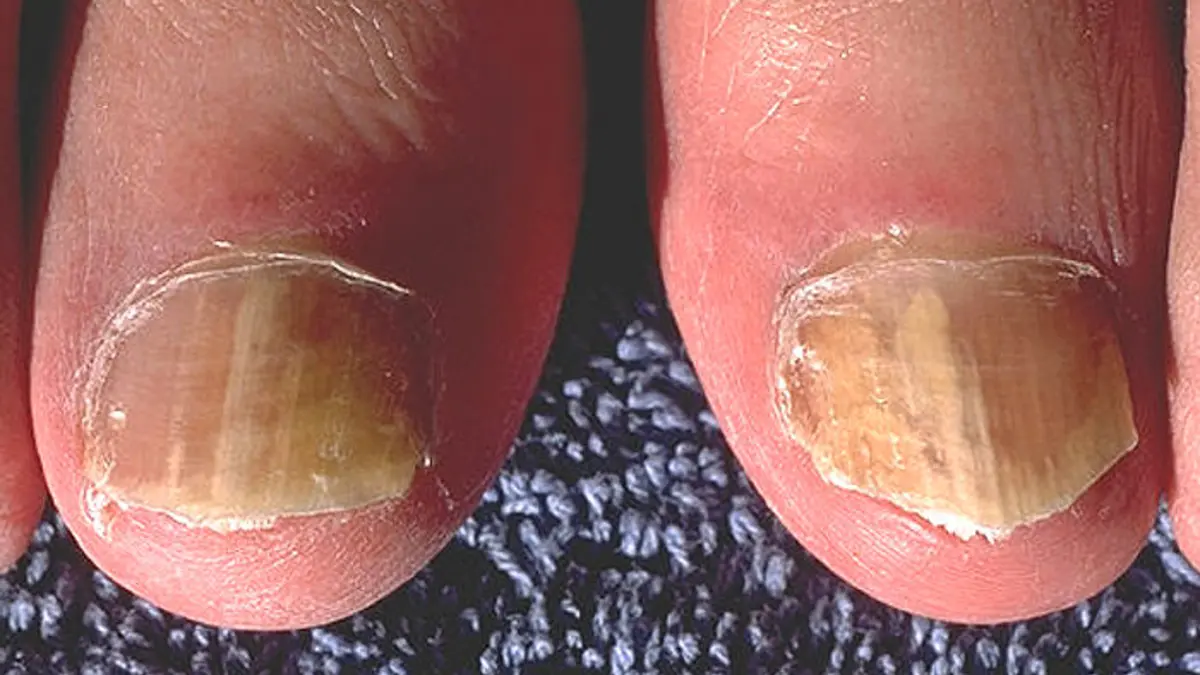

HealthWatchlist verdict: Essential oils are not a dependable treatment for toenail fungus. The main tea tree trial found low fungal cure rates and no advantage over clotrimazole solution. An improved-looking nail does not necessarily mean the infection has cleared.
Fungal nail infection is also called onychomycosis. Thick or discoloured nails can have other causes, so appearance alone does not confirm a fungal infection.
Why nail fungus is difficult to treat
A fungal infection can make a toenail thick, brittle, crumbly or discoloured. The infection lies in and under a hard nail plate, which makes it difficult for a topical product to reach every affected area.
The NHS says fungal nail infections can take a long time to treat. A healthy-looking replacement must grow from the base, so visible improvement can take many months even after treatment works.
Psoriasis, injury and other nail disorders can look similar. NICE Clinical Knowledge Summaries recommends confirming infection before oral treatment. That helps avoid exposing someone to a medicine they do not need.
The best-known tea tree oil trial
A 1994 randomised trial enrolled 117 people with culture-confirmed toenail infection. Participants used either 100% tea tree oil or 1% clotrimazole solution twice daily for six months.
At six months, cultures were negative in 18% of the tea tree group and 11% of the clotrimazole group. The difference was not statistically significant. Neither treatment produced a high mycological cure rate.
About 60% in each group reported full or partial improvement in appearance. Appearance and laboratory cure are not interchangeable, and the study did not show that neat tea tree oil was superior.
A combination study cannot isolate the oil
A 1999 trial randomised 60 patients to a cream containing 2% butenafine and 5% tea tree oil or a comparator. It reported cure in 80% of the combination group and none of the comparator group after 16 weeks.
The abstract describes the comparator as placebo. The 2022 systematic review describes it as 5% tea tree oil alone. This distinction matters: the study does not show that tea tree oil adds benefit to butenafine.
That trial cannot tell us whether tea tree oil added benefit, whether butenafine did the work, or whether the combination mattered. It is not evidence for applying undiluted oil from a bottle.
A 2022 review of complementary approaches to onychomycosis found a small and varied evidence base. Different mixtures, endpoints and study designs make confident comparisons difficult.
Laboratory activity is not a clinical cure
Tea tree, oregano, thyme and clove oils can inhibit fungi under laboratory conditions. A recent laboratory study reported antifungal activity from tea tree oil, while also saying clinical studies are needed to confirm long-term effectiveness and safety.
A culture plate does not reproduce a thick nail, surrounding skin, repeated exposure or the concentration that can be used safely. Laboratory findings can justify research, but they do not provide a treatment instruction.
Five more oils for fungal nails: what the studies establish
A fungal culture, the appearance of a nail and a laboratory inhibition zone measure different things. These comparisons keep the preparation and outcome attached to each finding.
Cinnamon oil for toenail fungus
Cinnamon bark and cassia were among the strongest oils in a 2020 laboratory screen of 65 oils and 21 blends against dermatophytes. Their activity persisted throughout the 21-day assay (Powers and colleagues). This was growth inhibition in culture, not clearance of infected toenails.
A 2024 experiment also found activity from cinnamon and several combinations against dermatophytes, with particularly favourable results against Microsporum canis (combination study). Its species-specific results cannot establish treatment success against every cause of nail infection.
Preparation matters too. A 2022 study tested cinnamon leaf oil against Candida albicans, examining fungal growth and virulence traits (Shahina and colleagues). That is a different plant part and a different fungal model from a cinnamon-bark toenail treatment.
These experiments justify further formulation research. We did not locate a controlled patient trial establishing cinnamon oil alone as a toenail-fungus cure. The laboratory concentrations are not a home recipe, and activity in culture does not show safe penetration through a nail.
Related: Cinnamon profile.
Clove oil for toenail fungus
Clove showed strong early activity in the 2020 dermatophyte screen, but inhibition declined over time. The study’s clinical isolates were tested outside the body (laboratory screen). Describing these as “clinical effects” should not imply that patients’ nails were treated.
The 2024 combination experiment found clove activity and synergy for some pairings, including cinnamon with clove and clove with tea tree (dermatophyte combination study). Synergy in a dish does not identify a safe mixture for repeated skin exposure or demonstrate that combining oils improves clinical cure.
The 2022 cinnamon-leaf and clove paper concerned Candida virulence. It did not test a course of clove treatment in people with onychomycosis (Candida experiment). Candida is also not interchangeable with the dermatophytes responsible for many fungal nails.
We did not locate a controlled patient trial establishing clove oil alone as a toenail-fungus treatment. The limiting issues include reaching the infection through the nail, tolerability and whether the fungus returns after treatment ends.
Related: Clove profile.
Coconut oil for toenail fungus
Coconut oil is a fatty oil rather than an essential oil. Its composition and processing need to be specified before comparing studies. Fractionated coconut oil served as a diluent in the 2020 dermatophyte screen and showed no inhibitory effect on the tested strains (Powers and colleagues). That finding concerns the fractionated product, not every coconut preparation.
A 2025 study investigated virgin and chemically modified coconut oils incorporated into a Pluronic hydrogel. The modified oil improved several formulation properties, including stability and compatibility with the gel (hydrogel study). This was laboratory formulation development, not a patient trial proving that food-grade coconut oil clears a fungal nail.
A gel remaining at the application site is only one requirement. A clinical study must also establish fungal clearance, appropriate exposure, adverse effects and durable improvement. We did not locate a controlled patient trial establishing ordinary coconut oil alone as a toenail-fungus cure. A nail or surrounding skin feeling softer does not confirm eradication of infection.
Related: Coconut profile.
Lavender oil for toenail fungus
Lavender research includes more than one species. A 2011 experiment found antifungal activity from Lavandula viridis oil, with dermatophytes among the more susceptible fungi. The authors explicitly called for clinical trials (Zuzarte and colleagues). This is not automatically evidence for a bottle labelled Lavandula angustifolia.
A November 2025 preprint tested a manuka-led spray containing basil, lavender and peppermint oils alongside hygiene advice. Of 265 starters, 192 completed follow-up; 129 improved on a nail-severity score, 35 were unchanged and 28 worsened (Weber and colleagues). The study was funded by the manufacturer, and all three authors reported ownership or employment links.
The report was not peer-reviewed and had no control group or blinding. Twelve-week appearance and severity scores do not establish fungal clearance or lavender’s individual contribution. Seventy-three participants did not complete the protocol. People with poor diabetic wound healing or severely compromised immunity were excluded, limiting safety conclusions for those groups.
This mixture deserves further study, but it does not establish a lavender-only nail treatment. We did not locate a controlled trial showing clinical cure with lavender essential oil alone.
Related: Lavender profile.
Lemon oil for toenail fungus
Lemon performed poorly in the 2020 dermatophyte screen compared with the more active oils (Powers and colleagues). A broad claim that all citrus oils are powerful nail antifungals therefore misses an important limiting result.
The small human nail-oil study discussed elsewhere in this guide tested lime, oregano and tea tree oils with vitamin E, not lemon. It enrolled 20 people and followed a six-month treatment period with six months without therapy. The authors reported improvement and cure, but there was no comparison group (Alessandrini and colleagues).
Neither the benefit of an individual ingredient nor the effect of substituting lemon can be inferred from that mixture. Lemon, lime, lemongrass and lemon myrtle are different products despite similar names. We did not locate a controlled patient trial establishing lemon essential oil alone as a toenail-fungus cure. This evidence does not support replacing a diagnosed infection’s treatment with lemon oil.
Related: Lemon profile.
What to do with this evidence
Do not copy a culture-plate concentration or assume a retail oil matches a research product. NHS guidance advises seeing a GP for fungal nail infection with diabetes or a weakened immune system, or when infection is severe and treatment has failed. A pharmacist can advise on suitable nail medicines. Recovery commonly takes months.
Search limitations: Targeted searches of web-indexed research and Europe PMC, with botanical names and citation follow-up, completed 14 September 2026. This is not an exhaustive systematic review or a search of all unpublished trials. Some papers were available only as indexed abstracts; unsuccessful full-text retrievals are not evidence that a study does not exist. The complete spray preprint was checked, including funding, exclusions and attrition; it was not peer-reviewed.
References for these comparisons
- Parrish N, Fisher SL, Gartling A, Craig D, Boire N, Khuvis J, Riedel S, Zhang S. Activity of Various Essential Oils Against Clinical Dermatophytes of Microsporum and Trichophyton. Frontiers in cellular and infection microbiology. 2020;10:545913. DOI:10.3389/fcimb.2020.545913.
- Sayed MA, Ghazy NM, El Sayed H, El-Bassuony AAH. Synergistic potential of essential oil combinations against Microsporum, Trichophyton, and Epidermophyton. International microbiology : the official journal of the Spanish Society for Microbiology. 2025;28:811-827. DOI:10.1007/s10123-024-00566-y.
- Shahina Z, Molaeitabari A, Sultana T, Dahms TES. Cinnamon Leaf and Clove Essential Oils Are Potent Inhibitors of Candida albicans Virulence Traits. Microorganisms. 2022;10:1989. DOI:10.3390/microorganisms10101989.
- Fitzpatrick DP, Lawler G, Kealey C, Brady D, Roche J. Hydrophobic Interactions of Modified Coconut Oil and Pluronic 127 Enable Stable Formation of Bioactive Hydrogel for Onychomycosis. Gels (Basel, Switzerland). 2025;11:592. DOI:10.3390/gels11080592.
- Zuzarte M, Zuzarte M, Gonçalves MJ, Cavaleiro C, Canhoto J, Vale-Silva L, Silva MJ, Pinto E, Salgueiro L. Chemical composition and antifungal activity of the essential oils of Lavandula viridis L'Her. Journal of medical microbiology. 2011;60:612-618. DOI:10.1099/jmm.0.027748-0.
- Weber A, Salsberg A, Eleveld J. Post-Marketing Clinical Evaluation of a Manuka Oil-Based Toenail Spray (FunghiClear), for Onychomycosis Management: Safety, Efficacy and Convenience. Preprints.org. 10 November 2025; version 1, not peer-reviewed. DOI:10.20944/preprints202511.0567.v1.
- Alessandrini A, Starace M, Bruni F, Piraccini BM. An Open Study to Evaluate Effectiveness and Tolerability of a Nail Oil Composed of Vitamin E and Essential Oils in Mild to Moderate Distal Subungual Onychomycosis. Skin appendage disorders. 2020;6:14-18. DOI:10.1159/000503305.
- NHS. Fungal nail infection. Accessed 14 September 2026.
What established care looks like
A pharmacist may suggest an antifungal nail medicine for a mild infection. These products need consistent use for months. Keeping feet dry, treating athlete’s foot and avoiding shared nail tools can reduce reinfection.
A GP may take a nail sample and prescribe antifungal tablets when infection is severe, painful or has not responded to topical treatment. Tablets are not suitable for everyone and may require attention to interactions or liver health.
The British Association of Dermatologists explains diagnosis, topical treatment, tablets and recurrence. It also notes that damaged nail appearance may persist until new nail grows.
Tea tree oil safety
NCCIH says tea tree oil should not be swallowed and that topical use can cause redness or irritation. Old or poorly stored oil can become more likely to trigger allergy as its components oxidise.
A clinical review of essential-oil contact allergy found tea tree among the oils producing notable patch-test reactions. Applying it twice daily for months creates repeated exposure.
Do not apply essential oil to cracked, bleeding or inflamed skin around the nail. Stop if burning, swelling, blistering or a spreading rash develops.
When to get help
Speak to a pharmacist or GP if the nail is painful, the infection is severe or treatment has not worked. Seek professional advice earlier if you have diabetes, poor circulation or a weakened immune system.
A dark streak, pigment spreading onto nearby skin, bleeding or a changing nail should be assessed. Not every abnormal nail is fungal, and a home oil trial can delay the correct diagnosis.
How to read a claimed cure rate
A nail looking better, a negative fungal culture and a completely clear nail are different outcomes. Check which a study measured, whether there was a comparison group and how long participants were followed.
The clotrimazole comparison does not establish equivalence to current oral antifungal treatment. Neither an old trial nor a laboratory result is a reason to copy its neat-oil regimen at home.
Our tea tree profile covers the oil more broadly. The ringworm review addresses skin infection, where the treatment site differs from a nail.
My verdict
Tea tree oil has more direct human evidence than most oils proposed for fungal nails. That evidence is still weak: the main trial produced low laboratory cure rates and found no significant advantage over its comparator.
I would not use neat tea tree oil as the default treatment. Confirm the problem, use a regulated antifungal when appropriate and expect nail recovery to take time.
References
- NHS: Fungal nail infection
- NICE CKS: Management of fungal nail infection
- British Association of Dermatologists: Fungal nail infections
- Buck and colleagues: Tea tree oil compared with clotrimazole
- Syed and colleagues: Butenafine and tea tree oil cream
- Nickles and colleagues: Complementary therapies for onychomycosis
- Álvarez and colleagues: Laboratory antifungal activity of tea tree oil
- NCCIH: Tea tree oil
- de Groot and Schmidt: Essential oils and contact allergy
Appearance, culture results and combination creams
The tea tree comparison trial reported an 18% culture-cure rate in its tea tree group. Its much higher figure for partial or full clinical improvement is a different outcome.
The 80% result from a butenafine and tea tree cream cannot establish tea tree’s independent effect. The distinction matters when an advertisement quotes the larger number while omitting the antifungal medicine.
Targeted evidence update: 12 September 2026. This addition does not represent a new review of every statement on this page.
Related evidence review: Tea Tree Oil for Toenail Fungus: Cure Rates and Combination Claims.
The mixed nail-oil pilot cannot isolate oregano
Evidence update: 13 September 2026.
An uncontrolled study of vitamin E, lime, oregano and tea tree oils reported encouraging outcomes. Without a comparator or an oregano-only arm, it cannot establish oregano’s independent effect. Controlled nail-treatment research distinguishes complete cure from fungal clearance and appearance alone.
Related evidence review: Oregano Oil for Toenail Fungus: Laboratory Promise and the Missing Clinical Proof.