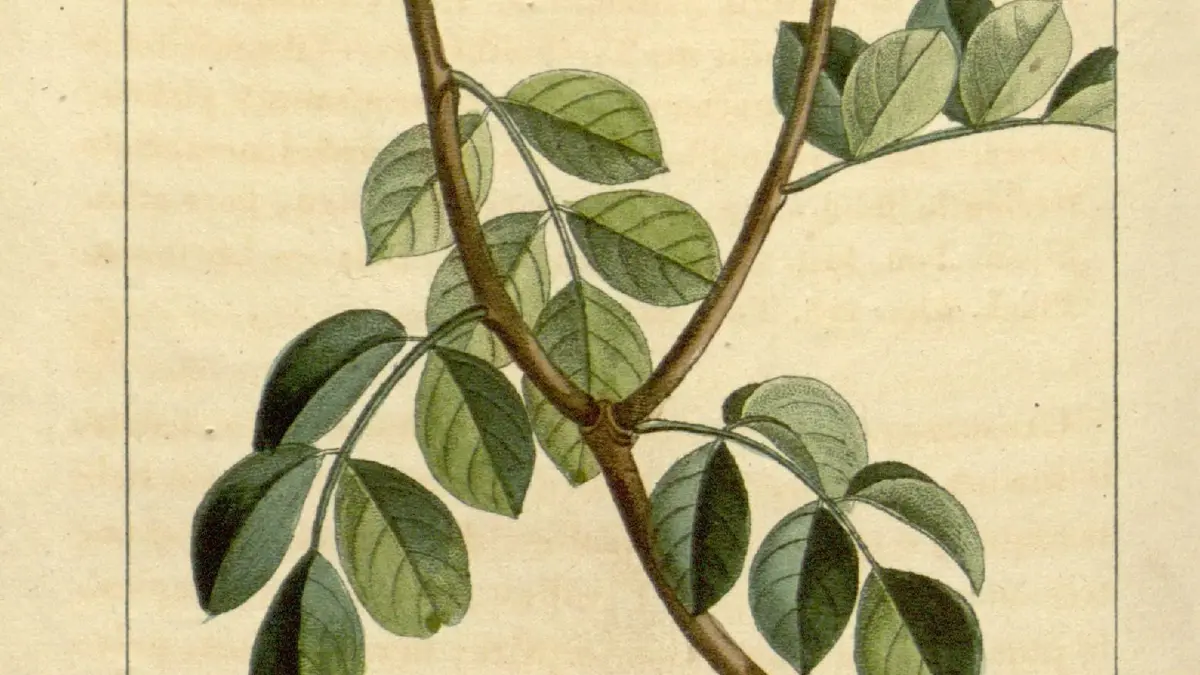
_(8182112730).jpg)
Short answer: amyris oil is a steam-distilled oil from the wood of Amyris balsamifera, a Caribbean tree in the citrus family. It is often called West Indian sandalwood, but it is not a true sandalwood and should not be used as a cheaper evidence substitute for Santalum oils.
What is amyris essential oil?
Kew accepts Amyris balsamifera as the botanical name. The tree is native to parts of Florida, the Caribbean and northern South America. Its family, Rutaceae, also contains citrus plants, although amyris oil does not have the bright, peel-like chemistry people may expect from that connection.
The essential oil is normally obtained by steam distilling chipped or ground wood. It is slow to evaporate and has a soft woody, balsamic smell, so perfumers use it as a base note and as a fixative. “West Indian sandalwood” is a trade name based on aroma and use, not botanical kinship. True sandalwood oils come from Santalum species in the Santalaceae family.
Composition and product identity
Amyris is chiefly a sesquiterpene-rich oil. Published chemical work has identified valerianol among its characteristic alcohols; one peer-reviewed analysis described valerianol as a major component. Composition can vary with the wood, distillation and analytical method, which is why a current batch report is more informative than a generic list copied between shops.
A useful label should state Amyris balsamifera, the wood as the plant part and steam distillation as the extraction method. A bottle labelled only “sandalwood” is ambiguous. It may contain amyris, a true Santalum oil, a mixture or a fragrance composition. The INCI name and supplier documentation should resolve that question.
What are the claimed benefits?
Amyris is marketed for sleep, anxiety, meditation, skin care, breathing and insect control. These claims often rest on traditional descriptions, its persistent aroma, constituent research or studies that did not test human use of amyris oil. They should not be treated as one body of clinical evidence.
I could not identify a convincing randomised human trial showing that inhaled or topically applied amyris oil treats insomnia, anxiety or a skin condition. A recent study of amyris oil as an anaesthetic in fish is relevant to animal husbandry research, not proof that the oil safely sedates people. A pleasant scent may form part of a calming routine without becoming a treatment for a diagnosed condition.
Laboratory antimicrobial or insect studies can help researchers describe chemical activity, but a result in a culture dish does not establish an effective household concentration, a safe skin preparation or a medical benefit. The distinction matters particularly for products advertised with several unrelated therapeutic promises.
How might it be used?
The best-supported role is fragrance. Amyris can provide a mild woody note in a properly formulated perfume, cosmetic or brief diffuser session. It may also be encountered in soap and room-fragrance blends. Those are sensory uses; the label should not convert them into claims that the product treats stress, infection or sleep disorders.
For a diffuser, follow the device and product instructions, ventilate the room and stop if the scent causes coughing, headache, nausea or irritation. For skin products, a professionally formulated finished cosmetic is easier to judge than a home recipe because the concentration and intended area of use are defined.
Safety and buying checks
Do not swallow amyris oil. Essential oils are concentrated mixtures, and a history of use in perfumery does not establish a safe oral dose. Avoid undiluted application, the eyes, mucous membranes and broken skin. Keep the bottle away from children and animals, and seek urgent advice after a significant accidental ingestion rather than waiting for symptoms.
- Look for the full botanical name, plant part, extraction method and batch number.
- Do not accept “sandalwood” as adequate identification.
- Prefer a supplier that provides a batch-specific chromatogram and explains what it can and cannot prove.
- Reject medical promises that are unsupported by human trials of the same oil and route.
- Store the closed bottle away from heat and light; oxidation can change both aroma and skin tolerance.
My assessment
Amyris is a legitimate botanical essential oil with a clear role in fragrance. Its nickname creates avoidable confusion with true sandalwood, and its health marketing runs well ahead of clinical research. I would buy it for its aroma only, after confirming the botanical identity, rather than for sleep, anxiety or infection claims.
What would stronger evidence look like?
A useful human study would identify the batch, analyse its composition, specify inhaled exposure and compare amyris with both an unscented control and another pleasant scent. It would register one primary outcome in advance, report adverse effects and follow participants long enough to distinguish a momentary preference from a meaningful sleep or anxiety benefit. Until research of that kind exists, constituent studies and animal sedation experiments should remain clearly labelled as indirect evidence.