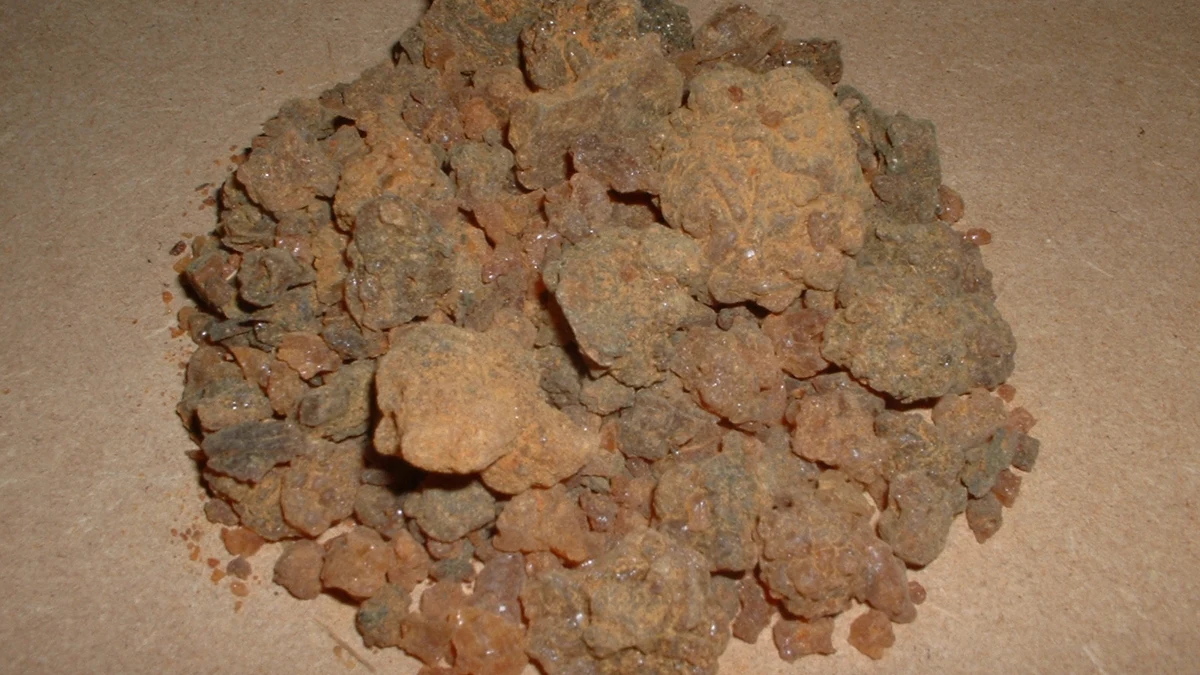

HealthWatchlist verdict: Myrrh mouthwash has been studied after dental procedures, but this does not establish myrrh essential oil as a toothache remedy. Some healing measures improved; pain results were less convincing. A painful tooth still needs its cause identified.
The extraction study did not treat an untreated toothache
Al Eid’s trial enrolled 40 healthy adults having simple tooth extractions. It compared a myrrh-resin preparation with saline mouthwash for seven days after the procedure.
The myrrh group had better swelling, tenderness and socket-size findings. However, the difference in reported pain was not statistically significant. Teeth with abscesses or other local pathology were excluded.
The report also gives inconsistent percentages for participants without pain in its table and narrative. That is another reason to avoid presenting the results as a precise pain-relief promise.
The preparation used ground resin in water, not distilled myrrh essential oil. The trial followed dental treatment and excluded infected teeth. Its findings cannot establish that oil applied at home treats decay, a dental abscess or an inflamed tooth nerve.
What the implant trial adds
A 2022 randomised study compared myrrh and chlorhexidine mouthwashes after implant placement in 35 patients. At one week, differences in pain, swelling, bleeding and redness were not statistically significant.
The authors reported favourable aspects of early healing with myrrh, but the small study cannot establish equivalence to chlorhexidine. Failing to find a difference is not the same as proving two treatments equally effective.
Both studies concern care after a procedure. Neither establishes a treatment for an untreated painful tooth, and neither supports substituting a bottle of essential oil for a dentist’s mouthwash instructions.
Why the form of myrrh matters
Resin, an extract, a formulated mouthwash and essential oil contain different proportions of substances. A product’s common plant name does not make these preparations interchangeable.
Laboratory antimicrobial findings would still leave practical questions about tolerable concentration, contact time and access to the source of infection. A rinse cannot repair damaged tooth structure.
Use only oral-care products appropriate for their stated purpose and follow professional advice. Do not put concentrated essential oil into a cavity, on gums or in an extraction socket. Do not copy a research recipe.
Getting help for the pain
The NHS advises seeing a dentist for toothache lasting more than two days, pain that does not settle with painkillers, or pain with fever, swelling or a bad taste.
A pharmacist can advise on suitable pain relief while you arrange care. If you cannot obtain urgent dental help, NHS 111 can direct you. A GP cannot provide the dental procedure needed.
Swelling around the eye or neck, or swelling affecting breathing, swallowing or speech, requires emergency care. Do not wait to see whether an oil helps.
Evidence assessment
Not adequately tested; indirect evidence for myrrh oil and toothache. Small mouthwash studies offer a reason to investigate postoperative healing. Their mixed endpoints and different preparations do not support an essential-oil analgesic claim.
How this review was researched
Research checked on 14 September 2026. Targeted web searches used the oil name, botanical or ingredient names, the condition and clinical-trial terms. We checked accessible primary reports, PubMed records and the guidance cited below. This is an editorial review, not a systematic review. Some full texts were inaccessible; absence from these searches does not prove that no study exists. Different preparations and laboratory results are identified explicitly.
Related reading
References
- Al Eid RA (2021). Efficacy of Commiphora myrrh mouthwash on early wound healing after tooth extraction: a randomized controlled trial. Saudi Dental Journal. PMID:33473242.
- Ibraheem WI et al. (2022). Evaluating Soft Tissue Healing after Implant Placement Using Two Different Mouthwashes (Myrrh and Chlorhexidine Gluconate): A Randomized Control Trial. Medicina 58:1351.
- NHS. Toothache.