.png)
HealthWatchlist verdict: Essential oils are not established treatments for conjunctivitis and should not be put in the eye. Tea tree research on eyelid mites concerns a different problem, while laboratory studies raise concerns about exposure of eye cells to tea tree constituents.
A red eye needs the right explanation
Conjunctivitis can result from infection or allergy. Redness, watering, irritation and discharge do not identify the cause on their own. Other eye conditions can look similar but need different care.
Get urgent advice for eye pain, light sensitivity, vision changes or a very red eye. A baby younger than thirty days with red, sticky eyes also needs urgent assessment. These NHS warning signs should not be treated with a home oil mixture.
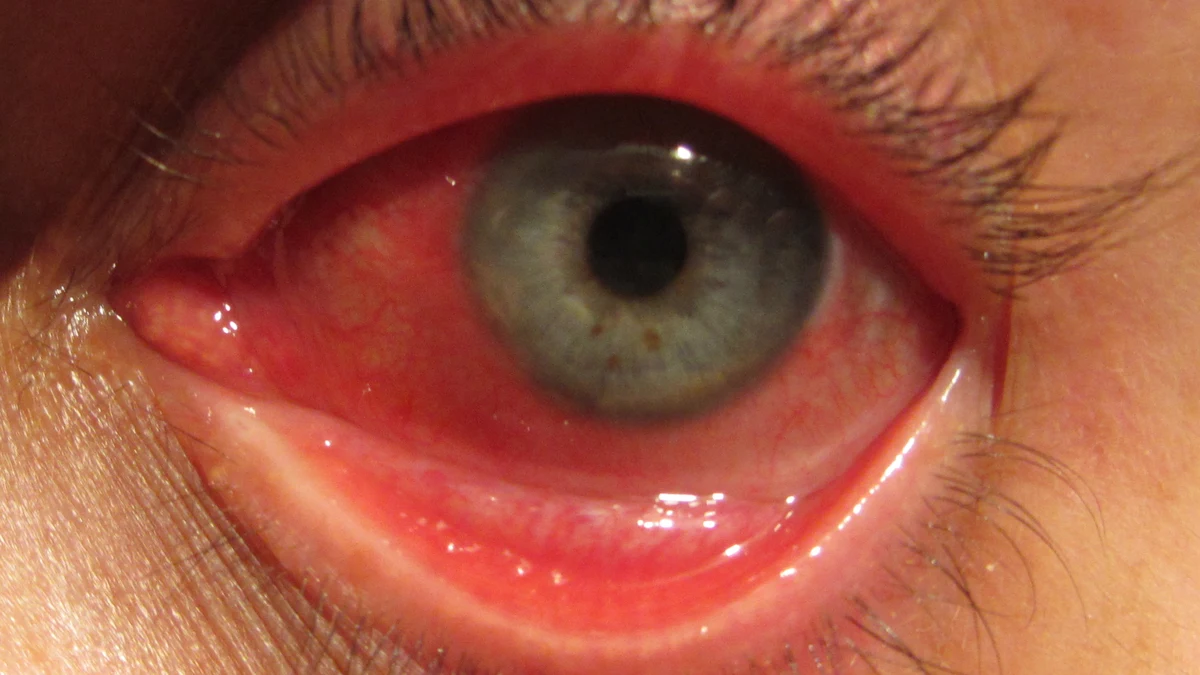
The featured photograph illustrates conjunctivitis; it is not a way to diagnose your own eye. A comparison with an internet photograph cannot rule out a more serious cause of redness.
Why tea tree studies appear in searches
Blepharitis affects the eyelids and can cause crusting around the eyelashes. Some cases involve Demodex mites. That is different from the usual claim that an oil treats infectious or allergic conjunctivitis.
A Cochrane review assessed six tea-tree trials in Demodex blepharitis, involving 562 participants. The studies had unclear or high risk of bias. The review found uncertainty about effectiveness and recorded irritation or discomfort in some participants.
Even a clear result for an eyelid condition would not justify putting an oil onto the surface of the eye. Preparation, application site and diagnosis are all part of the treatment being evaluated.
More recent clinical evidence is still condition-specific
An open-label trial compared a tea-tree eye gel with standard treatment for anterior blepharitis. Its diagnosis and product are different from homemade conjunctivitis drops, and the open-label design leaves room for expectation effects.
A systematic review of randomised tea-tree studies covers several uses and notes limitations in the clinical evidence. A total count of tea-tree trials does not equal the number of trials for conjunctivitis.
Recognising these boundaries prevents an apparently plausible chain of reasoning: tea tree affects mites, mites can affect eyelids, therefore tea tree is suitable for any pink eye. Each step needs evidence rather than assumption.
Laboratory safety findings matter too
A study exposed human meibomian-gland cells to terpinen-4-ol, a tea-tree constituent. Cell survival decreased with increasing exposure. These glands help support the tear film.
Another study examined tea tree oil in human corneal keratocytes. Higher concentrations reduced cell viability and altered cell appearance. The researchers stressed protecting the eye surface from excessive exposure.
These are laboratory findings, not a prediction of the risk from every finished ophthalmic product. They also cannot be used to calculate a safe homemade dilution. They undermine the assumption that something natural is automatically gentle enough for an inflamed eye.
| Claim | What the evidence actually addresses |
|---|---|
| Tea tree treats pink eye | Much of the cited research concerns eyelid mites or blepharitis. |
| Antimicrobial activity proves safety | Activity against organisms and toxicity to eye tissues are separate questions. |
| A weak dilution must be safe | Cell experiments do not validate a home preparation. |
| All red eyes need antibiotic drops | Treatment depends on the cause; viral and allergic cases differ. |
What established treatment evidence shows
A 2023 Cochrane review of acute bacterial conjunctivitis found that topical antibiotics modestly improved the chance of resolution compared with placebo. Many cases also resolved without antibiotics.
That review concerns diagnosed bacterial conjunctivitis. It does not make antibiotics appropriate for every red eye, and it gives no support to replacing them with an essential oil. A pharmacist or clinician can help identify suitable treatment.
NHS advice includes avoiding contact lenses until symptoms have settled and using simple hygiene measures to limit the spread of infectious conjunctivitis. Do not share towels or rub irritated eyes. Persistent symptoms need reassessment.
If oil has already entered the eye
NHS guidance for eye exposure advises rinsing with plenty of clean, non-hot water for at least twenty minutes. Do not rub the eye or add another oil in an attempt to neutralise the first one.
Seek urgent medical advice about the exposure, particularly if pain, redness or blurred vision continues. Severe pain or changes in sight after an eye injury require emergency assessment. Keep the product container so its contents can be identified.
Conclusion
The relevant evidence does not support essential oils as conjunctivitis treatment. Eyelid research and laboratory antimicrobial claims cannot justify putting a non-ophthalmic oil in the eye. Correct assessment and an appropriate eye-care product are more useful than a home recipe.
How this review was researched
Research checked on 13 September 2026. We searched PubMed for the named oils or preparations and the condition, followed relevant review references, and checked the official guidance linked below. This is an editorial review, not an exhaustive systematic review. We distinguish human treatment outcomes from laboratory findings, and identify where a study tested a mixture or a different preparation.
Related reading
References
- Tea tree oil for Demodex blepharitis.
- Comparison of the effect of tea tree oil eye gel with standard treatment in patients with anterior blepharitis: An open-label clinical trial.
- Efficacy and safety of Melaleuca alternifolia (tea tree) oil for human health-A systematic review of randomized controlled trials.
- Effects of Terpinen-4-ol on Meibomian Gland Epithelial Cells In Vitro.
- Tea tree oil influence on human keratocytes growth and viability.
- Antibiotics versus placebo for acute bacterial conjunctivitis.
- NHS: Conjunctivitis
- NHS: Blepharitis
- NHS: Eye injuries