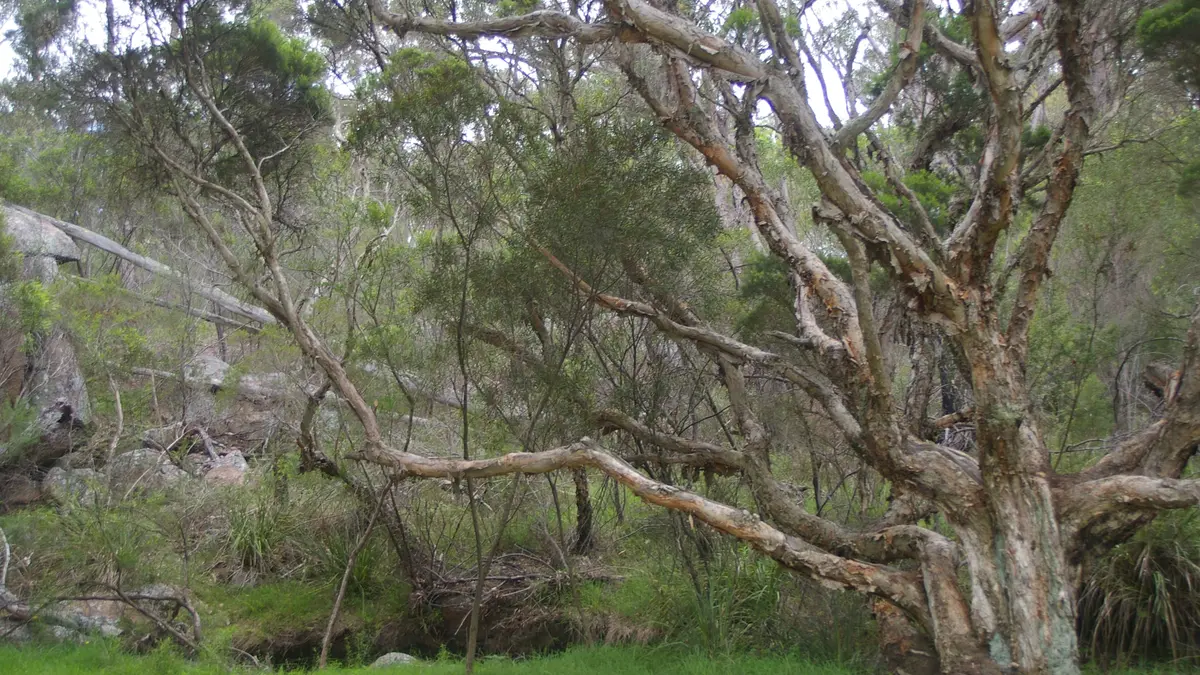

Tea tree essential oil is distilled from the Australian plant Melaleuca alternifolia. This profile focuses on botanical identity, extraction and the history of use rather than treating traditional claims as recommendations.
Botanical identity
Melaleuca alternifolia is a small tree in the myrtle family. The everyday name “tea tree” can be confusing because it is unrelated to the tea plant used for black or green tea, and other Melaleuca species may also be given similar common names.
Origins
The plant is native to parts of eastern Australia. Commercial plantations now supply foliage for oil production, while quality standards help describe the expected chemical profile of the finished oil.
How tea tree essential oil is extracted
Tea tree oil is normally produced by steam distilling leaves and small branches. The distillate is a concentrated mixture of volatile compounds and must not be confused with a water-based herbal infusion.
Aroma and composition
The oil is often described as fresh, medicinal and camphoraceous. Terpinen-4-ol is one of its characteristic constituents, but the complete composition and storage history matter because essential oils can change through oxidation.
Traditional and historical uses
Leaves of related Australian tea trees have histories of Indigenous use, while commercial tea tree oil developed into a widely marketed topical and household ingredient. Broad historical narratives should be treated carefully: a traditional plant preparation is not automatically equivalent to a bottled modern essential oil.
Tea tree claims we have investigated
Tea tree and urinary tract infection
Tea tree experiments in artificial urine and catheter models are not trials of treatment in patients. Do not use oil as home catheter care. See the detailed evidence comparison for the studies, limitations and appropriate care.
Tea tree and snoring
Tea tree was included as a comparator in a chemotherapy sleep-questionnaire trial; this did not test snoring or overnight airway obstruction. See the detailed evidence comparison for the studies, limitations and appropriate care.
Tea tree and sinus symptoms
A laboratory experiment used tea tree mixtures fortified with manuka compounds. It does not establish treatment with ordinary tea tree oil or justify nasal use. See the detailed evidence comparison for the studies, limitations and care context.
Tea tree and jaw pain
A prepared tea tree gel affected some gingivitis measures but did not reduce plaque. Gum-health findings do not establish treatment of TMD or make bottled oil suitable for oral use. See the detailed evidence comparison for the studies, limitations and care context.
Tea tree and earache
Human ear swabs were tested in culture, while animal safety findings varied by exposure. Neither establishes effective or safe homemade tea tree ear drops. See the detailed evidence comparison for the studies, limitations and care context.
Tea tree and Lyme disease
Tea tree appeared in a laboratory screen, with weaker activity as concentration fell. It was not shown to prevent regrowth in the paper’s later low-concentration subculture experiment or to treat Lyme disease in people. See the detailed evidence comparison for the studies, limitations and care context.
Tea tree and psoriasis
Tea tree psoriasis publications include a hypothesis and experimental formulations, not a verified human efficacy trial. Dandruff shampoo evidence concerns a different diagnosis, and allergic dermatitis is documented. See the detailed evidence comparison for the primary studies, limitations and care context.
Tea tree and rashes
Tea tree has diagnosis-specific positive findings alongside null outcomes and dermatitis reactions. The nickel experiment, dandruff trial and athlete’s-foot trials do not establish a universal rash treatment. See the detailed evidence comparison for the primary studies, limitations and care context.
Profile sources
- Royal Botanic Gardens, Kew: Plants of the World Online
- National Center for Complementary and Integrative Health: Tea tree oil
Keep each tea tree claim separate
A shampoo trial, a fungal-nail trial and a rosacea trial combining tea tree with permethrin ask different questions. Their results cannot be pooled into a general claim that tea tree treats skin disease.
Finished products and their other active ingredients matter. A favourable combination result does not prove that the essential oil alone produced the benefit.
Targeted evidence update: 12 September 2026. This addition does not represent a new review of every statement on this page.
Related evidence review: Tea Tree Oil for Dandruff: Shampoo Evidence and Its Limits.
Related evidence review: Tea Tree Oil for Toenail Fungus: Cure Rates and Combination Claims.
Related evidence review: Essential Oils for Rosacea: Evidence, Irritation and Safer Care.
Eye and ear exposure need separate safety evidence
The Cochrane review of tea tree for Demodex blepharitis found uncertainty, and it concerned an eyelid condition rather than routine conjunctivitis. Eye-cell experiments with terpinen-4-ol raise toxicity concerns. An animal middle-ear study also found adverse auditory effects at high exposure. These findings do not define safe home dilutions. Do not put aromatherapy oil into the eye or ear canal.
Targeted evidence update: 13 September 2026. This section reviews the specified claim; it does not represent a new review of every statement on this page.
Related evidence review: Essential Oils for Earache: Evidence and Why Ear Drops Need Care.
Related evidence review: Essential Oils for Conjunctivitis: Why Eye Safety Comes First.
Nickel experiments do not establish atopic eczema treatment
Evidence update: 14 September 2026.
The experimental contact dermatitis study reported reduced nickel reactions, but not equivalent benefits for irritation or histamine-related itch. An earlier study found no significant effect from a 5% lotion. These results do not validate bottled tea tree oil for atopic eczema, especially given recognised contact allergy.
Related evidence review: Tea Tree Oil for Eczema: What the Contact Dermatitis Studies Actually Show.
Keep symptom relief separate from fungal cure
Evidence update: 14 September 2026.
The 10% tea tree cream trial improved athlete’s foot symptoms without significantly outperforming placebo for fungal clearance. A stronger-solution trial had a positive fungal result but also reported dermatitis. These studies concern defined foot-skin preparations, not every type of ringworm or retail oil.
The successful lice regimen used a finished combination
Evidence update: 14 September 2026.
A tea tree and lavender product performed well after repeated applications. A separate egg study did not show complete egg killing. Neither result validates drops added to shampoo. NHS advice favours wet combing or suitable pharmacy treatments.
Related evidence review: Tea Tree Oil for Athlete’s Foot: Symptom Relief, Fungal Cure and Safer Options.
Related evidence review: Tea Tree Oil for Head Lice: Why the Product Trials Do Not Prove a Home Remedy.
Eyelid-product studies do not support putting essential oil in the eye
Evidence update: 14 September 2026.
The Cochrane review of tea tree for Demodex blepharitis found uncertain effectiveness across small, varied trials. Blepharitis and conjunctivitis are different conditions. Specialist eyelid regimens do not justify bottled essential oil in or around the eyes.
Related evidence review: Tea Tree Oil for Blepharitis: Eyelid Studies and Eye Safety.
Related evidence review: Tea Tree Oil for Thrush: The Small Study and Safety Limits.