
HealthWatchlist verdict: No essential oil is established as a safe home treatment to put inside a painful ear. Herbal ear-drop studies concern particular mixed formulations, while laboratory antibacterial activity does not demonstrate safe treatment of an ear infection.
Earache is a symptom, not a single diagnosis
Ear pain can come from an infection, wax, an injury or pain referred from another area. Treating every earache with the same oil ignores those differences. Discharge, hearing changes and the condition of the eardrum can change which treatments are suitable.
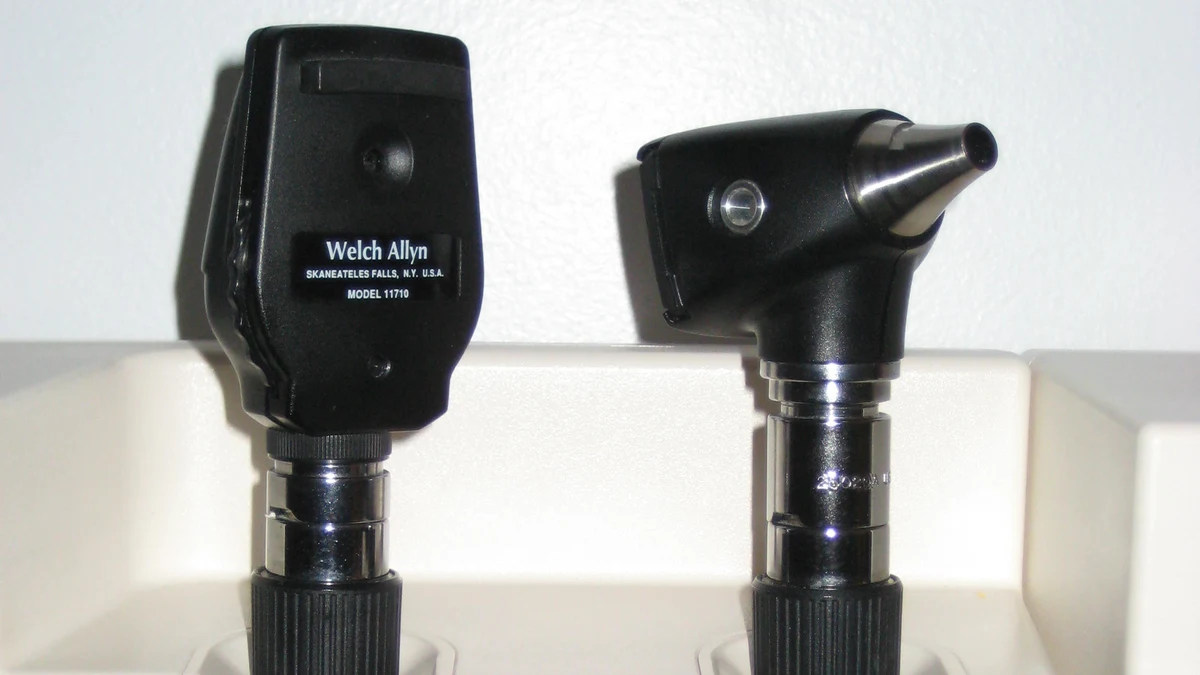
A GP or pharmacist may use an otoscope to examine the ear. The photograph shows an otoscope alongside an ophthalmoscope. Looking at the ear is more informative than choosing an oil because its label says “antibacterial”.
What the herbal-drop studies tested
A 2001 trial compared a mixed herbal-extract ear drop with an anaesthetic ear drop in 103 children aged 6–18 with pain associated with middle-ear infection. Pain improved during the three-day study, with comparable results between the preparations.
The herbal product contained several extracts in olive oil. It was not a test of a bottle of garlic, lavender or tea tree essential oil. Comparison with another active treatment also leaves uncertainty about how much improvement reflects the natural course of symptoms.
A later trial involving 171 children examined related herbal and anaesthetic preparations, with or without an antibiotic. All groups improved over three days, and the authors attributed much of the change to time.
The trials are worth acknowledging, but pain relief is not the same as clearing an infection or preventing complications. Their findings do not justify choosing antibiotics, withholding them or making ear drops at home. Those decisions require current assessment and guidance.
Antibacterial activity is not an ear-treatment trial
A clove-oil study tested bacteria isolated from children with otitis media using laboratory methods. Although the organisms came from patients, the patients were not treated with the oil in that experiment.
The distinction matters: a clear zone around an oil in a laboratory dish measures growth inhibition under those conditions. It does not establish delivery through an ear canal, a safe exposure for the eardrum or an improvement in hearing.
Some newer blend research uses bacterial isolates from dogs with otitis externa. That is veterinary laboratory evidence, not a human earache trial. A search result containing the word “otitis” is not enough to support a treatment claim for a child.
Why safety cannot be assumed
A guinea-pig experiment investigated tea tree oil applied to the middle ear. High-concentration exposure affected an auditory-nerve measurement. A lower-concentration result under the study’s conditions did not establish that homemade diluted drops are safe in people.
This is animal safety evidence, not a measurement of how often human hearing damage occurs. It nevertheless gives a reason to avoid assuming that a natural product is harmless to delicate ear structures.
If the eardrum is damaged or there are ventilation tubes, substances may reach areas they would not reach through an intact eardrum. Do not put essential oils into the ear canal, including on cotton wool, or use an internet dilution recipe to replace a recommended product.
| What a citation reports | What it does not prove |
|---|---|
| Pain improved with mixed herbal drops | That one essential oil treats the infection. |
| Bacteria were inhibited in a dish | That the preparation is safe inside a human ear. |
| A lower animal exposure caused no lasting measured change | A safe home dilution or duration. |
| A veterinary isolate responded | Benefit for a child or adult with earache. |
Basil, chamomile, lavender, lemon and oregano: what the earache studies tested
There is human research on some prepared mixtures, alongside animal and laboratory experiments. The diagnosis, formulation and outcome matter when deciding what each study can support.
Basil and earache
A 2005 experiment placed basil oil or separate volatile compounds in the ear canals of rats with experimentally induced middle-ear infections. Researchers followed ear-examination findings and bacterial cultures. Some treatments improved infection or healing outcomes compared with placebo.
This is animal treatment evidence, rather than a human earache trial. The published success ranges cover several compounds and two infecting organisms; they should not be quoted as a single basil-oil cure rate. The experiment also does not establish a safe concentration for a child’s or adult’s ear.
We did not locate a controlled human trial establishing basil essential oil alone for earache. Middle-ear infection, outer-ear inflammation and pain referred from teeth or the jaw need different assessment. Do not reproduce the animal application or use an oil instead of having persistent pain, discharge or hearing changes checked.
Related: Basil profile.
Chamomile and earache
A laboratory study of chamomile-containing ear and eye drops found reduced bacterial growth after exposing cultures to the commercial preparations. The paper describes products containing chamomile extract, including homeopathic drops. It did not treat patients or establish that distilled chamomile essential oil would behave similarly.
The whole formulation was tested, so the abstract does not establish chamomile’s individual contribution. Its suggestion of possible use in mild infections goes beyond the clinical evidence generated by a culture experiment. Pain relief, eardrum safety and patient recovery were not demonstrated.
A separate study in 25 dogs tested several essential-oil mixtures for yeast-associated outer-ear disease. A mixture containing Roman chamomile, lemon, clary sage and rosemary had favourable clinical findings, but yeast counts did not decrease after treatment. This was veterinary research on a blend, not a chamomile-only human trial.
We did not locate a controlled human trial establishing chamomile essential oil alone for earache. German chamomile extract, Roman chamomile oil and a finished multi-ingredient product are not interchangeable. None of these findings justifies homemade drops.
Related: Chamomile profile.
Lavender and earache
A randomised trial in 70 patients with acute outer-ear infection compared ciprofloxacin drops with Lamigex, a prepared blend of lavender, clove and Geranium robertianum oils. After one week, both groups improved in pain, symptoms and cultures; the reported differences between groups were not statistically significant.
This is relevant human evidence for the specific blend, but a non-significant difference does not by itself prove equivalence to an antibiotic. The abstract does not describe a prespecified equivalence margin. It also cannot isolate lavender’s effect or establish safety for homemade formulations, a perforated eardrum or longer use.
A separate trial in 171 children with middle-ear-associated pain studied a herbal-extract preparation containing lavender and several other ingredients, alongside anaesthetic drops and antibiotic comparisons. Pain improved in all groups over three days. Although some comparisons favoured the herbal preparation, the authors attributed most improvement to elapsed time.
Outer-ear infection and middle-ear disease are different settings, and the preparations were different too. These studies do not establish that lavender oil alone treats either condition. Antibiotic decisions require current clinical assessment; the older paper’s broad conclusion is not a reason to withhold indicated treatment. Do not copy the trial preparations at home.
Related: Lavender profile.
Lemon and earache
A small childhood study is sometimes found in searches for lemon and ear infection because its supplement was lemon-flavoured cod liver oil. Eight children also received a multivitamin–mineral product. They had fewer antibiotic-treatment days during supplementation than before it, but there was no parallel untreated comparison.
This was not a lemon-essential-oil trial. It cannot separate nutritional ingredients, changes over time or prescribing decisions, and it studied prevention-related antibiotic use rather than immediate pain relief.
A veterinary study included lemon in a mixture with clary sage, rosemary and Roman chamomile. Dogs’ clinical signs improved, but yeast counts did not decrease. This cannot establish lemon’s contribution or a treatment for a person’s earache.
We did not locate a controlled human lemon-essential-oil earache trial. Lemon flavouring, nutritional supplements and a veterinary oil mixture answer different questions. Do not put lemon juice or essential oil into a painful ear.
Related: Lemon profile.
Oregano and earache
A laboratory study tested oregano oil, thyme oil and their main phenolic constituents against 100 bacterial and fungal isolates from dogs with outer-ear infections. The materials showed antimicrobial activity, including against some resistant isolates.
The organisms came from clinical cases, but the oils were tested in culture rather than administered to the dogs. The authors called for further in-vivo investigation. There were no human pain, hearing, recovery or safety outcomes.
The concentrations that inhibit organisms in broth are not a recipe for ear drops. Tissue exposure, formulation and effects on delicate ear structures need separate study. We did not locate a controlled human trial establishing oregano essential oil alone for earache. Laboratory activity does not show that it can replace a prescribed antibiotic or antifungal preparation.
Related: Oregano profile.
Assessment and practical care
NHS earache guidance describes suitable pain relief and a warm flannel outside the ear as comfort measures. Seek urgent advice for pain lasting more than two to three days, discharge, swelling, hearing changes or feeling generally unwell. NHS ear-infection guidance also advises urgent help when symptoms occur in someone with diabetes or a weakened immune system. Do not put essential oils into the ear canal; a pharmacist or clinician can assess whether a particular ear-drop product is appropriate.
Search limitations: Targeted Europe PMC and web searches used common and botanical names with tinnitus, hearing, anxiety, earache and otitis, followed by citation checks, completed 15 September 2026. This is an editorial review, not an exhaustive systematic review or search of unpublished trials. The patchouli dental report was checked in full; the other studies were appraised from indexed abstracts, limiting assessment of methods, adverse effects and bias. We distinguish finished mixtures, extracts, flavouring and distilled oils. Failure to locate a trial does not prove that none exists.
References for these comparisons
- Kristinsson KG, Magnusdottir AB, Petersen H, Hermansson A. Effective treatment of experimental acute otitis media by application of volatile fluids into the ear canal. The Journal of infectious diseases. 2005;191:1876-1880. DOI:10.1086/430003.
- Farsi S, Chaudhry S, Khan A, Gardner J, Ogwo M, Ofori B, Hosseini M, Cervantes J. Antimicrobial effect of chamomile-containing over-the-counter ear and eye drops. Journal of investigative medicine : the official publication of the American Federation for Clinical Research. 2024;72:305-311. DOI:10.1177/10815589231223201.
- Nardoni S, Pistelli L, Baronti I, Najar B, Pisseri F, Bandeira Reidel RV, Papini R, Perrucci S, Mancianti F. Traditional Mediterranean plants: characterization and use of an essential oils mixture to treat Malassezia otitis externa in atopic dogs. Natural product research. 2017;31:1891-1894. DOI:10.1080/14786419.2016.1263853.
- Panahi Y, Akhavan A, Sahebkar A, Hosseini SM, Taghizadeh M, Akbari H, Sharif MR, Imani S. Investigation of the effectiveness of Syzygium aromaticum, Lavandula angustifolia and Geranium robertianum essential oils in the treatment of acute external otitis: a comparative trial with ciprofloxacin. Journal of microbiology, immunology, and infection = Wei mian yu gan ran za zhi. 2014;47:211-216. DOI:10.1016/j.jmii.2012.10.002.
- Sarrell EM, Cohen HA, Kahan E. Naturopathic treatment for ear pain in children. Pediatrics. 2003;111:e574-9. DOI:10.1542/peds.111.5.e574.
- Linday LA, Dolitsky JN, Shindledecker RD, Pippenger CE. Lemon-flavored cod liver oil and a multivitamin-mineral supplement for the secondary prevention of otitis media in young children: pilot research. The Annals of otology, rhinology, and laryngology. 2002;111:642-652. DOI:10.1177/000348940211100713.
- Sim JXF, Khazandi M, Chan WY, Trott DJ, Deo P. Antimicrobial activity of thyme oil, oregano oil, thymol and carvacrol against sensitive and resistant microbial isolates from dogs with otitis externa. Veterinary dermatology. 2019;30:524-e159. DOI:10.1111/vde.12794.
- NHS. Earache. Accessed 15 September 2026.
- NHS. Ear infections. Accessed 15 September 2026.
Rosemary and tea tree: completing the earache comparisons
The remaining comparisons include veterinary mixtures, human-derived cultures and animal hearing-safety tests. Those are different kinds of evidence, with different limitations.
Rosemary and earache
A study in 25 dogs with yeast-associated outer-ear disease tested several essential-oil mixtures. One contained rosemary, lemon, clary sage and Roman chamomile. Clinical signs improved, but the report says yeast counts did not fall after treatment. Improvement in appearance therefore should not be described as eradication of the organism.
A separate laboratory investigation tested oils against organisms previously isolated from dogs and cats with outer-ear infections. Rosemary inhibited some fungi, while sensitivity varied across organisms. The animals were not treated in that culture experiment.
Neither study isolates rosemary’s clinical effect in a person with earache. We did not locate a controlled human rosemary-essential-oil earache trial. Veterinary blends and laboratory activity do not establish a safe human ear-drop preparation, and applying oil outside the ear has no demonstrated effect on an infection behind the eardrum.
Related: Rosemary profile.
Tea tree and earache
A study using swabs from 52 people with outer-ear infection tested the recovered organisms against tea tree oil in the laboratory. Many isolates were susceptible, but Pseudomonas aeruginosa was less consistently affected. The patients were not treated with tea tree oil, so the study did not measure recovery or pain relief.
Animal safety findings differ with the preparation and exposure. In a guinea-pig experiment, concentrated tea tree oil placed in the middle ear affected a high-frequency auditory-nerve measurement. A lower-concentration preparation did not cause a significant lasting change under the same short exposure conditions.
In a later study of nine chinchillas, a diluted tea tree preparation produced no significant measured hearing-threshold change or visible auditory-hair-cell damage over the reported follow-up. This reassuring result belongs alongside the earlier safety signal, but it does not establish safety or efficacy in people.
We did not locate a controlled human tea-tree-oil treatment trial for earache. These experiments cannot supply a safe home dilution, particularly when the eardrum’s condition is unknown. Do not put bottled tea tree oil or homemade mixtures into the ear.
Related: Tea tree profile.
Keep temporary relief separate from treatment
NHS ear-infection guidance recommends urgent advice for discharge, swelling, hearing changes or feeling generally unwell, and when symptoms occur in someone with diabetes or a weakened immune system. Do not put essential oils into the ear canal. A clinician or pharmacist can assess the cause and which preparation, if any, is appropriate.
Search limitations: Targeted Europe PMC and web searches used common and botanical names with earache, otitis, ototoxicity, toothache, pulpitis, dental pain and dental caries, followed by citation checks, completed 16 September 2026. This is an editorial review, not a systematic review or exhaustive unpublished-trial search. The peppermint injection trial, 2024 lavender pulpitis trial, 2025 oral lavender extract trial and 2026 lavender surgery report were checked in full. Other studies were appraised from indexed abstracts, limiting assessment of methods and adverse effects. Failure to locate a trial does not establish that none exists.
References for these comparisons
- Nardoni S, Pistelli L, Baronti I, Najar B, Pisseri F, Bandeira Reidel RV, Papini R, Perrucci S, Mancianti F. Traditional Mediterranean plants: characterization and use of an essential oils mixture to treat Malassezia otitis externa in atopic dogs. Natural product research. 2017;31:1891-1894. DOI:10.1080/14786419.2016.1263853.
- Ebani VV, Nardoni S, Bertelloni F, Najar B, Pistelli L, Mancianti F. Antibacterial and Antifungal Activity of Essential Oils against Pathogens Responsible for Otitis Externa in Dogs and Cats. Medicines (Basel, Switzerland). 2017;4:E21. DOI:10.3390/medicines4020021.
- Farnan TB, McCallum J, Awa A, Khan AD, Hall SJ. Tea tree oil: in vitro efficacy in otitis externa. The Journal of laryngology and otology. 2005;119:198-201. DOI:10.1258/0022215053561495.
- Zhang SY, Robertson D. A study of tea tree oil ototoxicity. Audiology & neuro-otology. 2000;5:64-68. DOI:10.1159/000013869.
- Bezdjian A, Mujica-Mota MA, Azzi M, Daniel SJ. Assessment of ototoxicity of tea tree oil in a chinchilla animal model. International journal of pediatric otorhinolaryngology. 2014;78:2136-2139. DOI:10.1016/j.ijporl.2014.09.023.
- NHS. Ear infections. Accessed 16 September 2026.
What to do instead
NHS guidance describes suitable pain relief and a warm flannel held against the outside of the ear as options for comfort. A pharmacist can help decide whether ear drops are appropriate and whether examination is needed.
Seek prompt advice if pain lasts more than two to three days, or sooner if there is discharge, swelling around the ear, hearing change, a high temperature or a generally unwell child or adult. Infants need particular care.
The NHS ear-infection guidance also advises urgent assessment when symptoms occur in someone with diabetes or a weakened immune system. These are reasons to get help rather than extend a trial of home remedies.
Conclusion
NCCIH notes that tea tree oil should not be swallowed and can cause irritation when used on skin. Its uses elsewhere do not establish safety inside the ear. Different routes require different evidence.
The useful conclusion is that some formulated herbal drops have been studied, but that evidence does not identify a “best essential oil” for earache. Finding the cause and using an appropriate treatment is the safer route.
How this review was researched
Research checked on 13 September 2026. We searched PubMed for the named oils or preparations and the condition, followed relevant review references, and checked the official guidance linked below. This is an editorial review, not an exhaustive systematic review. We distinguish human treatment outcomes from laboratory findings, and identify where a study tested a mixture or a different preparation.
Related reading
References
- Efficacy of naturopathic extracts in the management of ear pain associated with acute otitis media.
- Naturopathic treatment for ear pain in children.
- IN VITRO AND IN SILICO ANTIBACTERIAL ACTIVITIES OF SYZGIUM AROMATICUM ESSENTIAL OIL AGAINST BACTERIA ASSOCIATED WITH OTITIS MEDIA IN CHILDREN.
- Activity of thieves-type protective blends and their individual components (cinnamon, clove, rosemary, eucalyptus and lemon essential oils) against Staphylococcus pseudintermedius strains isolated from canine otitis externa.
- A study of tea tree oil ototoxicity.
- NHS: Earache
- NHS: Ear infections
- NCCIH: Tea tree oil