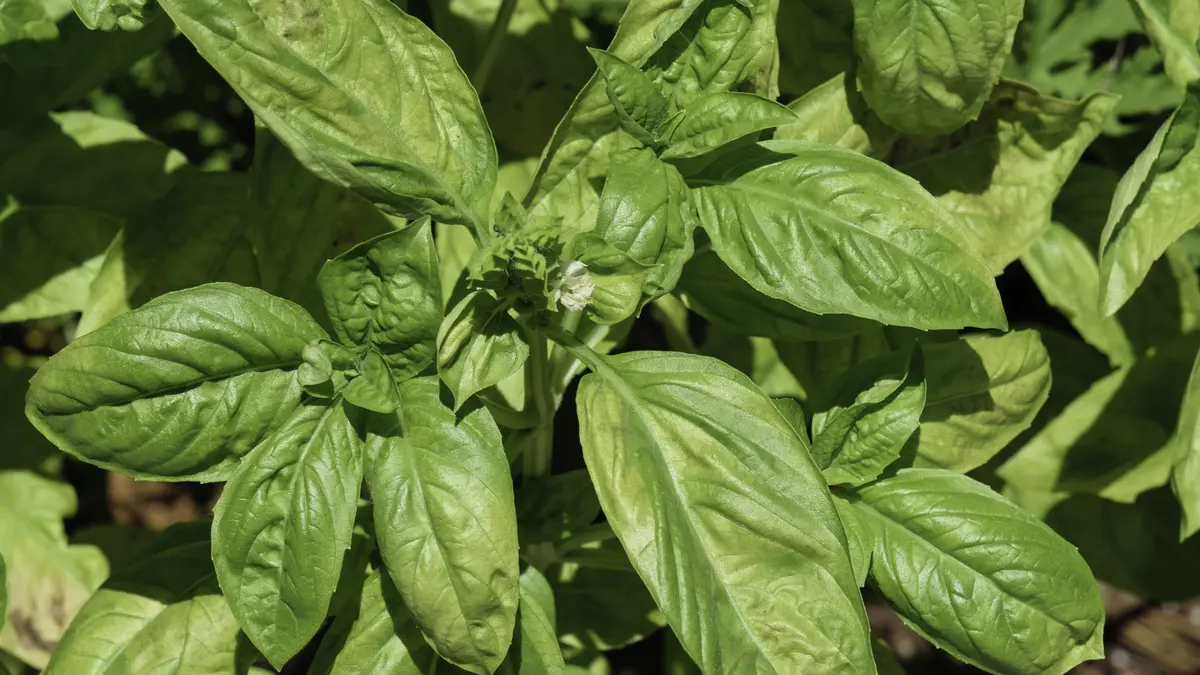

Short answer: basil essential oil is usually steam-distilled from Ocimum basilicum, but its chemistry varies markedly between cultivars and growing regions. Some oils are rich in linalool, while others contain substantial estragole or methyl eugenol. Laboratory studies do not establish that the oil treats infection, inflammation, anxiety or another condition in people.
Identity comes before benefits
Kew’s Plants of the World Online accepts Ocimum basilicum L. as a species. “Basil”, however, is used for several Ocimum plants and many cultivars. Holy basil, often Ocimum tenuiflorum, is not the same botanical material as sweet basil.
A bottle should state the Latin name, plant part, extraction method and country of origin. Steam-distilled leaf or flowering-herb oil is different from culinary leaves, basil tea, an extract, a fragrance oil or a supplement. Evidence for one cannot simply be assigned to another.
Chemistry and chemotypes
Basil oil can contain linalool, estragole, eugenol, methyl eugenol, 1,8-cineole and other constituents in very different proportions. A review of sweet basil describes substantial botanical and chemical variation. Climate, cultivar, plant stage and distillation all influence the result.
This variation makes a generic “basil oil” safety statement unreliable. Ask for a current batch analysis. An oil dominated by linalool is not chemically equivalent to an estragole-rich oil, even when both labels say O. basilicum.
Estragole and methyl eugenol
Estragole deserves particular attention. The European Medicines Agency’s 2023 public statement describes estragole as a naturally occurring genotoxic carcinogen on the basis of toxicological evidence and recommends minimising exposure in herbal medicinal products.
A 2025 laboratory study examined estragole metabolism and DNA effects in human liver-cell systems. Such research is not a measurement of risk from smelling a particular commercial oil, but it reinforces the need to know composition and avoid casual ingestion.
Methyl eugenol may also occur in basil. Researchers have measured methyl eugenol in a Genovese basil cultivar. Culinary use of basil leaves does not establish the safety of swallowing a concentrated volatile oil.
Human evidence
There is no robust body of clinical trials showing that basil essential oil treats a defined disease. A US National Library of Medicine overview notes the absence of scientifically valid clinical trials for the health uses commonly promoted for basil.
An experiment exposed chronically stressed rats to basil oil or linalool by inhalation. It examined weight, blood lipids and physiological measures. It did not study people and cannot establish treatment for human anxiety, insomnia or chronic stress.
Studies of basil extracts, capsules, foods or tea answer questions about those preparations. They do not establish the effect or safe dose of the distilled oil.
Laboratory antimicrobial research
Laboratory work has reported antimicrobial activity for chemically characterised basil oils. Other in-vitro research has examined antifungal activity.
These experiments place organisms in direct contact with controlled concentrations. They do not demonstrate that a home diffuser disinfects air, that neat oil treats a skin infection, or that swallowing the oil treats an internal infection. Clinical effectiveness requires a safe formulation, an appropriate route and comparative human trials.
Using basil oil more cautiously
- Do not swallow it or add it to food or drink.
- Avoid neat skin application and contact with eyes or mucous membranes.
- Use a finished cosmetic formulated for skin rather than an improvised drop dilution.
- Diffuse briefly at low intensity with ventilation, and stop after irritation, headache, nausea, coughing or wheeze.
- Keep the bottle locked away from children and pets.
- Seek individual advice during pregnancy, breastfeeding or when using medicines.
Oxidation and variable composition can alter sensitisation risk over time. Keep the cap closed, follow storage directions and replace oil that has changed markedly in odour or appearance.
Buying checklist
- Ocimum basilicum appears on the label.
- The plant part and steam distillation are stated.
- A batch number and recent gas-chromatography report are available.
- Estragole and methyl eugenol are quantified rather than ignored.
- The supplier does not turn laboratory antimicrobial results into treatment claims.
- Directions do not encourage ingestion.
Do not use a marketing term such as “French basil”, “exotic basil” or “sacred basil” as a substitute for the Latin name and analysis. If the seller cannot say which plant was distilled or provide a batch document, the attractive common name does not resolve the uncertainty.
My assessment
Basil essential oil has a clear fragrance role and a large body of laboratory research. Human clinical evidence remains thin, while chemotype variation and estragole make careful identification important. Buy by botanical name and batch composition, not by a list of alleged benefits.
Basil oil and snoring
A human basil-inhalation experiment measured waking brain activity and blood pressure, not sleep or snoring. It cannot establish quieter or safer breathing at night.
Read the basil comparison in our snoring guide for the study details and clinical limits.
Targeted evidence update: 14 September 2026. This section does not represent a new review of every claim on this profile.
Reference: Hong SJ et al. Journal of Functional Foods. 2024;112:105918. doi:10.1016/j.jff.2023.105918.
Basil and plantar heel pain
A traditional basil-and-sesame preparation was studied for knee arthritis; it was not distilled basil oil and did not establish a plantar-fasciitis treatment. See the detailed plantar-fasciitis comparison for the studies, limitations and care context.
Basil and sinus symptoms
Basil inhibited some respiratory bacteria in culture, while others resisted it. This does not establish a safe or effective sinusitis treatment. See the detailed sinusitis comparison for the preparations, findings and limitations.
Basil and tinnitus
Basil research in rats concerned induced middle-ear infections and cultures, not human tinnitus. It does not justify putting basil oil into the ear. See the detailed evidence comparison for the studies, limitations and care context.
Basil and earache
Basil improved some outcomes in experimentally infected rats. The study does not establish a human earache treatment or a safe home ear-drop preparation. See the detailed evidence comparison for the studies, limitations and care context.
Basil and eczema
Basil wound-healing and cosmetic extract studies do not establish an essential-oil eczema treatment. Species and preparations differ, and occupational contact allergy has been reported. See the detailed evidence comparison for the primary studies, limitations and care context.
References
- Kew Plants of the World Online: Ocimum basilicum
- Review of sweet basil botany, chemistry and research
- European Medicines Agency: Public statement on estragole
- Human liver-cell study of estragole metabolism and DNA effects
- Methyleugenol measured in a Genovese basil cultivar
- National Library of Medicine overview of basil
- Basil oil and linalool inhalation in chronically stressed rats
- Chemical composition and laboratory antimicrobial findings
- Laboratory antifungal study of basil oil
Editorial responsibility and correction note
Editor: John Hamlen. This article has not been independently reviewed by a clinician.
Reference correction, 12 September 2026: Changes in this check: Correct animal experiment previously described as a human study; Correct bibliographic description against source record. This was a targeted correction, not a comprehensive new review of every claim in this article.
Read our editorial policy, evidence method and corrections policy, including how to report an error.