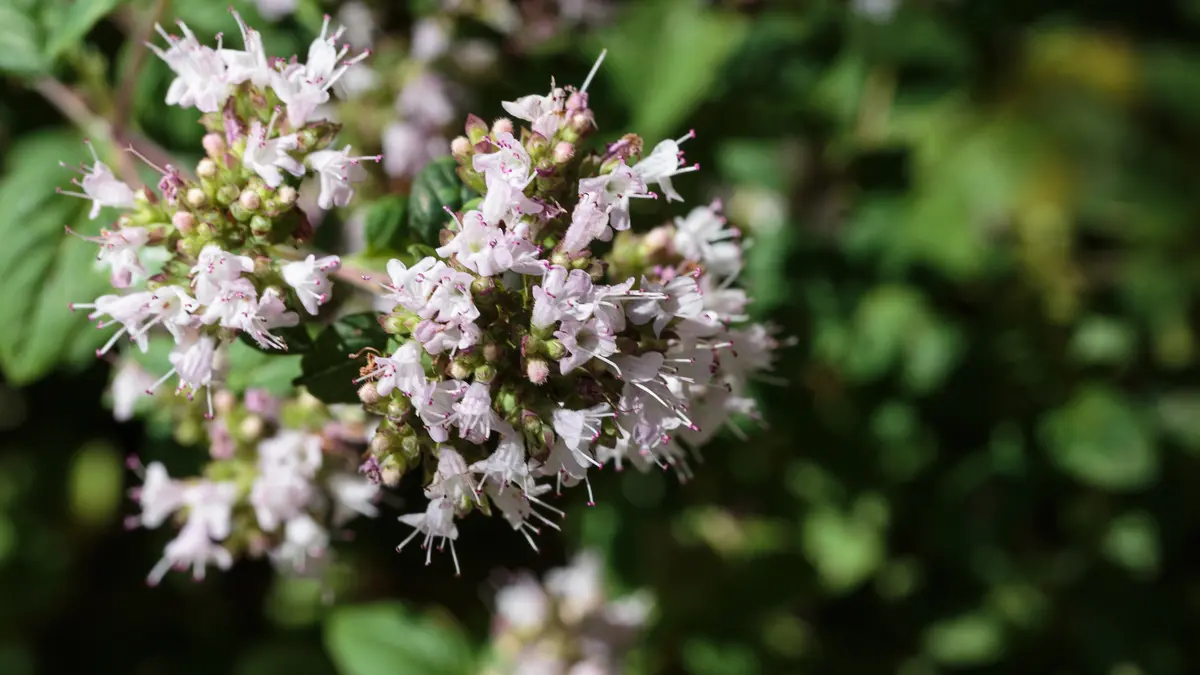

Short answer: oregano essential oil is a highly concentrated volatile oil, commonly from Origanum vulgare. It can inhibit microorganisms in laboratory tests, but this does not make it a proven or safe treatment for infections. Culinary oregano, “oil of oregano” supplements and undiluted essential oil are not interchangeable.
What is in the bottle?
Kew records Origanum vulgare, but commercial oregano products may use subspecies, cultivars or other Origanum species. The essential oil is normally steam-distilled from flowering aerial parts.
Research on oregano-oil diversity shows why botanical and chemical identity matter. Some oils are rich in carvacrol, others in thymol or different terpenes. Origin, harvest and processing can alter the profile.
“Oil of oregano” may mean an essential oil diluted in a carrier and sold as a supplement. A culinary herb is less concentrated and contains non-volatile constituents that are absent from the distilled oil. Safety and efficacy cannot be inferred from the familiar food use of oregano.
Strong laboratory activity, weak clinical inference
A composition and antimicrobial study describes active oregano chemotypes. A wider review summarises oregano chemistry and experimental pharmacology. Such work confirms that selected oils and constituents can affect microbes under controlled conditions.
The gap between a dish and a patient is substantial. Laboratory concentrations contact microorganisms directly. In a person, the oil must reach the relevant tissue at an effective exposure without damaging skin, mucosa, liver or other organs. These experiments do not show that swallowing oregano oil treats bacterial, fungal or viral infection, nor that diffusion disinfects a room.
A study in human keratinocyte and experimental wound models investigated biological activity, while nanoemulsion research explored anti-acne activity in preclinical systems. Neither is a clinical trial showing that a household oregano-oil preparation safely treats wounds or acne.
Why “natural antibiotic” is misleading
An antibiotic claim needs human trials against a diagnosed infection, a defined dose, comparison with appropriate care and monitoring for harm. Test-tube inhibition alone does not meet that standard. Delaying medical assessment for a spreading skin infection, breathing problem, urinary symptoms or persistent fever can be dangerous.
Cytotoxicity research also illustrates that biological activity can include harm to mammalian cells. “Kills cells” is not automatically a benefit.
Evidence must match the route
Researchers may test a purified constituent, a pharmaceutical formulation, a diluted supplement or vapour under controlled conditions. None is automatically equivalent to a retail essential-oil bottle. The route changes absorption and risk: swallowing, inhaling and applying to skin expose different tissues.
Clinical usefulness also requires more than statistical activity. A study must show a meaningful outcome in people and compare the intervention with appropriate care. It should identify the infection rather than rely on vague symptoms, and it must monitor irritation, allergy, interactions and treatment failure.
Safety
Carvacrol- and thymol-rich oils can be intensely irritating to skin and mucous membranes. Concentrated exposure may cause burning, nausea, coughing or sensitisation. Essential oils are recognised causes of allergic contact dermatitis.
- Do not swallow oregano essential oil or use it instead of prescribed antimicrobial treatment.
- Never put it neat in the mouth, nose, ear, vagina or on broken skin.
- Do not use a diffuser as a method of treating a respiratory infection.
- Keep the bottle locked away from children and pets.
- After accidental ingestion or a significant exposure, contact a poison service promptly.
Buying checklist
- The full botanical name, plant part and extraction method are stated.
- The label distinguishes essential oil from a diluted supplement and culinary herb.
- A batch chromatogram identifies the dominant constituents.
- The supplier gives prominent dilution and ingestion warnings.
- Laboratory antimicrobial results are not advertised as human proof.
My assessment
Oregano oil has credible laboratory antimicrobial activity and insufficient evidence as a self-directed human treatment. Its potency is precisely why casual internal or neat topical use is a poor idea. The responsible conclusion is not that it is ineffective in every future application, but that current laboratory findings do not establish a safe household antibiotic.
Oregano and yeast infection
Oregano and carvacrol findings come from laboratory and animal models. They do not establish a home treatment for vaginal thrush. See the detailed evidence comparison for the studies, limitations and appropriate care.
Oregano and urinary tract infection
Oregano research covers laboratory biofilms, slow-growing bacteria and computer predictions. Clinical cure in people remains unestablished. See the detailed evidence comparison for the studies, limitations and appropriate care.
Oregano and sinus symptoms
A mixed throat spray containing oregano gave immediate symptom relief but no significant advantage after three days; it did not test oregano alone or sinusitis. See the detailed sinusitis comparison for the preparations, findings and limitations.
Oregano and earache
Oregano inhibited organisms isolated from dogs’ ears in laboratory testing. This does not establish pain relief, clinical recovery or safe ear use in people. See the detailed evidence comparison for the studies, limitations and care context.
References
- Kew Plants of the World Online: Origanum vulgare
- Study of oregano essential-oil diversity
- Oregano chemotypes, composition and antimicrobial activity
- Review of oregano chemistry and experimental pharmacology
- Experimental wound and keratinocyte research
- Preclinical oregano-oil nanoemulsion research
- Oregano-oil cytotoxicity study
- Clinical review of allergic contact dermatitis from essential oils
A promising nail lacquer still needs human trials
Evidence update: 13 September 2026.
Oregano-containing nail-lacquer research showed penetration and antifungal activity in experiments, including infected nail material outside the body. It did not establish clinical cure in living patients. The manufactured formulation cannot be recreated simply by applying concentrated oregano oil to a nail.
Related evidence review: Oregano Oil for Toenail Fungus: Laboratory Promise and the Missing Clinical Proof.
Related evidence review: Oregano Oil for Lyme Disease: Laboratory Findings Explained.