.jpg)
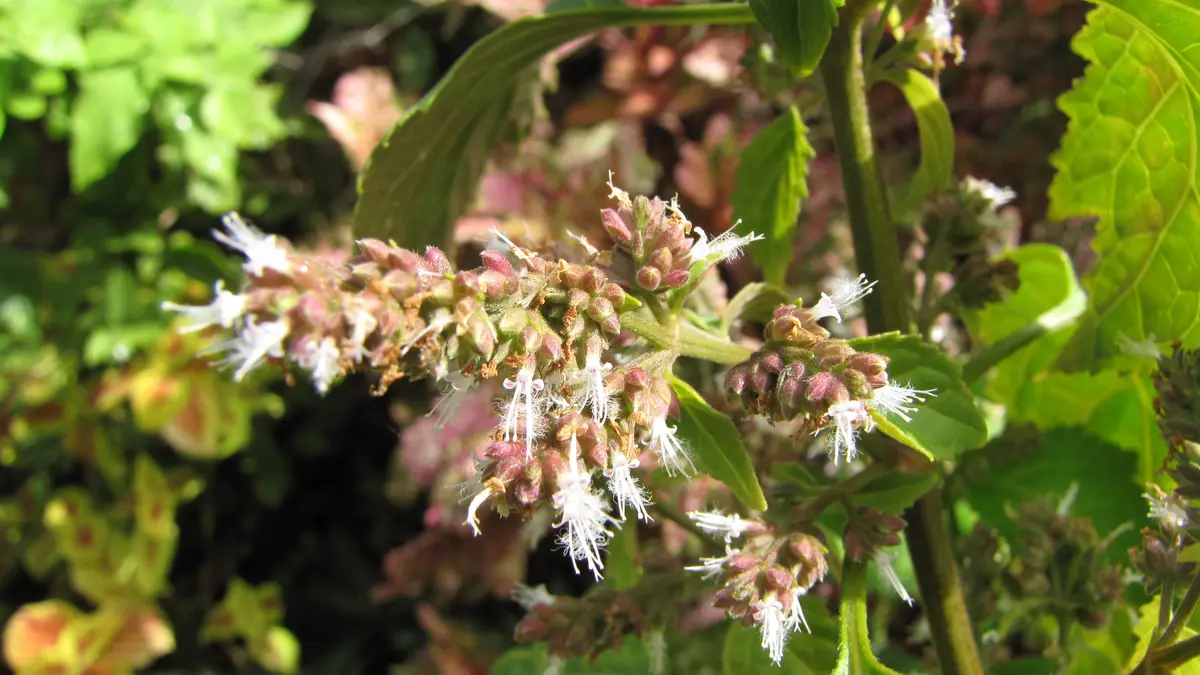
Short answer: patchouli essential oil is distilled from the leaves and stems of Pogostemon cablin. It is well established as a fragrance material, and laboratory or animal studies report several biological effects. Direct human evidence for anxiety, depression, skin disease, libido or hormone claims is lacking.
Identity and production
Kew records Pogostemon cablin, an aromatic member of the mint family. Commercial patchouli oil is normally obtained by steam distillation of dried or partially processed leaves and stems.
Drying, storage, fermentation-like processing and distillation can change both yield and aroma. Patchoulol, also called patchouli alcohol, is commonly an important constituent. A darker or older-smelling oil is not automatically more effective, and fragrance character does not establish medical quality.
What the evidence can tell us
A study reported behavioural and biological effects of patchouli oil in a rat stress model. Animal research can explore mechanisms and guide further experiments, but it cannot establish treatment for human anxiety or depression. Doses, metabolism and behavioural measurements differ.
Research has also examined patchouli oil and its constituents for activity against insects. Results obtained with particular pests, concentrations and laboratory methods do not prove that a casual skin blend is a reliable or safe human repellent.
Patchouli constituents have been studied for antimicrobial, anti-inflammatory and other effects in cells and animals. Those findings are preliminary. They do not demonstrate that the oil treats acne, eczema, fungal infection, inflammation or wounds in people.
Claims about mood, libido and hormones
The earthy aroma may feel calming, pleasant or unpleasant depending on the person and context. That preference is real, but it is not a clinical diagnosis or treatment outcome. Claims that inhalation raises serotonin, corrects hormones or acts as an aphrodisiac require direct human measurements and meaningful clinical results.
At present, the research does not support patchouli oil as a treatment for depression, sexual dysfunction or an endocrine condition. People with persistent low mood or sexual symptoms deserve assessment for underlying medical, psychological and medicine-related causes.
How to interpret product claims
Words such as “grounding”, “balancing” and “detoxifying” are not defined clinical outcomes. A useful study would specify the population, exposure, comparison, duration and measurement. It would also distinguish an immediate reaction to a familiar fragrance from improvement in a diagnosed condition.
For skin claims, the finished formulation matters. A cosmetic containing a small, safety-assessed amount of patchouli oil cannot validate neat application. For insect claims, protection time and the target species matter, and evidence should be compared with public-health recommended repellents where bite-borne disease is possible.
Safety
Patchouli is used in perfumery, where exposure occurs in formulated products rather than by applying a concentrated bottle directly. Essential oils can irritate skin, and repeated exposure can lead to allergy. A clinical review describes allergic contact dermatitis associated with essential oils.
- Do not swallow patchouli essential oil.
- Do not apply it neat, to broken skin or near the eyes.
- Prefer a properly formulated cosmetic over a home mixture.
- Diffuse briefly with ventilation and stop if symptoms develop.
- Keep concentrated oils away from children and pets.
- Do not use it to delay care for infection, persistent rash or depression.
Buying checklist
- The label says Pogostemon cablin and identifies the distilled plant parts.
- Origin, batch number and extraction method are provided.
- A current chemical analysis is available.
- The product is distinguished from a patchouli fragrance composition.
- Animal and laboratory findings are not presented as proof of human treatment.
My assessment
Patchouli oil is a legitimate fragrance material with a recognisable chemical profile. Its medical claims rest largely on preclinical evidence and tradition. It may be used cautiously for scent, but there is no sound basis for presenting it as a treatment for anxiety, depression, skin infection, libido problems or hormonal imbalance.
Patchouli and tinnitus
A dental study compared patchouli with lavender without an unscented group and had baseline imbalances. It provides no evidence that patchouli changes tinnitus or ear circulation. See the detailed evidence comparison for the studies, limitations and care context.
Patchouli and psoriasis
Patchouli gel improved psoriasis-like lesions in mice. The engineered formulation and animal model limit translation, and a contact-allergy report prevents assuming that a natural oil is universally soothing. See the detailed evidence comparison for the primary studies, limitations and care context.
References
- Kew Plants of the World Online: Pogostemon cablin
- Patchouli-oil research in a rat stress model
- Experimental research on patchouli oil and insects
- In-vivo research on a patchouli-oil repellent formulation
- Clinical review of allergic contact dermatitis from essential oils
- Poison Control guidance on essential-oil exposure