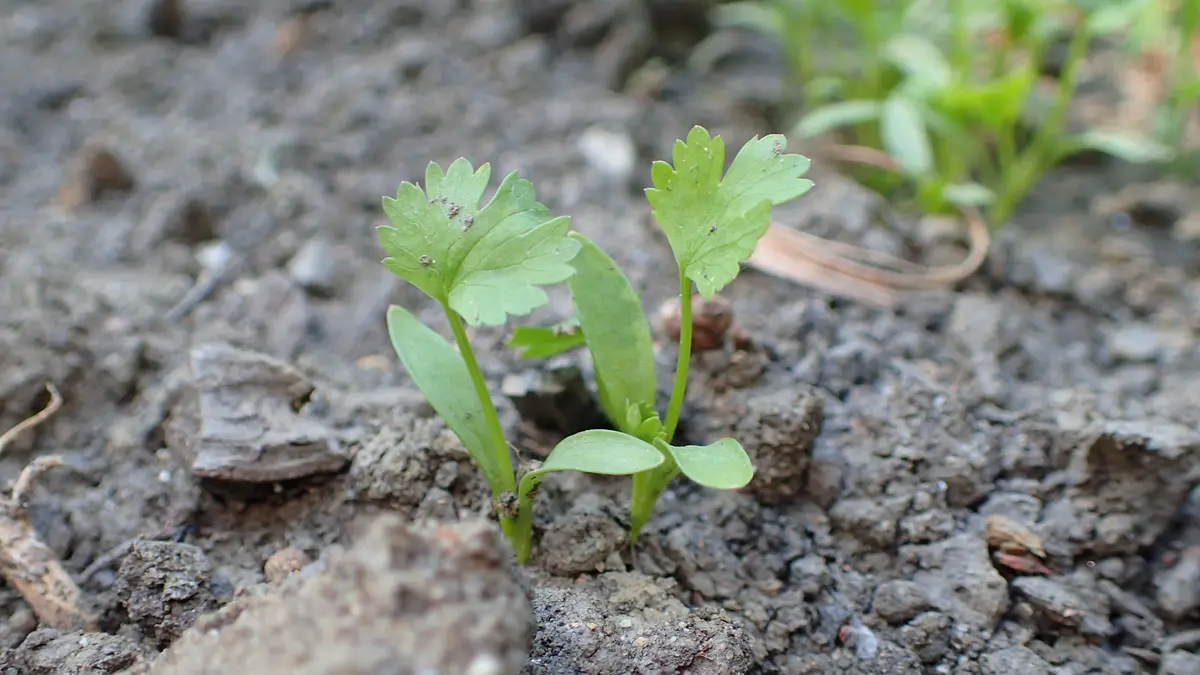

Coriander essential oil comes from Coriandrum sativum, the culinary plant also known as cilantro. The seed-like fruits and green leaves produce chemically different oils, making the plant part used an essential piece of identification.
Botanical identity
Coriandrum sativum is an annual member of the carrot family. In some countries “coriander” names the whole plant; in North American usage, cilantro commonly means the fresh leaves while coriander means the dried fruits sold as a spice.
Origins and cultivation
Kew records the native range from the eastern Mediterranean to western Pakistan. Coriander has travelled widely as a culinary herb and spice and is now cultivated in many regions.
Kew’s taxonomic record is useful for identity and distribution, but it does not establish the contents of a commercial oil. Variety, growing conditions, maturity and the part harvested all influence the distillate.
How coriander essential oil is extracted
Steam distillation can be applied to the dried fruits or to the green aerial parts. These should not be treated as interchangeable products: fruit oil is commonly rich in linalool, while leaf oil has a different composition and odour.
Experimental work on coriander hydrodistillation shows that processing conditions can change both yield and composition. The essential oil is the volatile fraction carried by steam; it is not the same as ground spice, a tea, fixed seed oil or a solvent extract.
Aroma and composition
Oil from the mature fruits is typically sweet, spicy and woody. Leaf oil is greener and more pungent. Precise labelling should identify the botanical name and plant part because “coriander oil” alone can hide an important difference.
A comparative chemical study of coriander leaf and seed oils illustrates that difference. Fruit oil is frequently dominated by linalool, whereas green aerial-part oil may contain substantial aldehydes. A safety or efficacy statement about one cannot be transferred casually to the other.
Traditional uses
Coriander has a very long history as food, flavouring and a traditional herbal ingredient. This profile records that cultural context without using it as evidence that the concentrated oil treats a modern medical condition.
What does the research cover?
A review of coriander research reports laboratory, animal and human work across foods, extracts and volatile oils. Another pharmacological review likewise covers several preparations. These are maps of a broad literature, not clinical proof for a retail essential oil.
Laboratory researchers have tested coriander oil against selected microbes. Such results depend on concentration, contact and organism. They do not show that applying the oil treats an infection safely, and they cannot replace clinical diagnosis or an authorised antimicrobial product.
Digestive, anxiety and blood-sugar claims
These claims often borrow from culinary coriander, oral extracts or animal studies. Smelling a linalool-rich fruit oil is not the same intervention as eating coriander or taking a standardised extract. I could not identify robust human evidence that inhaled or topically applied coriander essential oil treats anxiety, diabetes or digestive disease.
Describing an aroma as comforting after a meal is a sensory judgement. Describing it as an antidiabetic or antispasmodic treatment requires a defined product, dose, comparator and clinically important outcome.
Safety
A safety assessment describes coriander fruit oil used as a flavouring material. That history does not authorise swallowing an aromatherapy bottle or establish a home dose. Food flavouring use involves controlled specifications and very small quantities in a food matrix.
Avoid neat application, eyes, mucous membranes and damaged skin. Stop after burning, rash or swelling. Store the closed bottle away from heat and light and keep it from children and animals. Anyone with a significant accidental ingestion should obtain poisons advice promptly.
Buying checks
- Coriandrum sativum and the country of origin.
- Fruit/seed or leaf/aerial parts stated clearly.
- Steam or hydrodistillation identified.
- A batch-specific analysis that fits the stated plant part.
- No transfer of food, extract or laboratory evidence to an unsupported oil treatment.
Coriander claims we have investigated
No Claim Review is currently linked to this oil. Traditional use or a marketing claim is not enough to assign an Evidence Score.
Profile sources
- Royal Botanic Gardens, Kew: Coriandrum sativum
- Review of coriander chemistry and research
- Pharmacological review of coriander
- Comparison of coriander leaf and seed oils
- Hydrodistillation conditions and coriander-oil composition
- Laboratory antimicrobial study
- Safety assessment of coriander fruit oil as a flavouring material