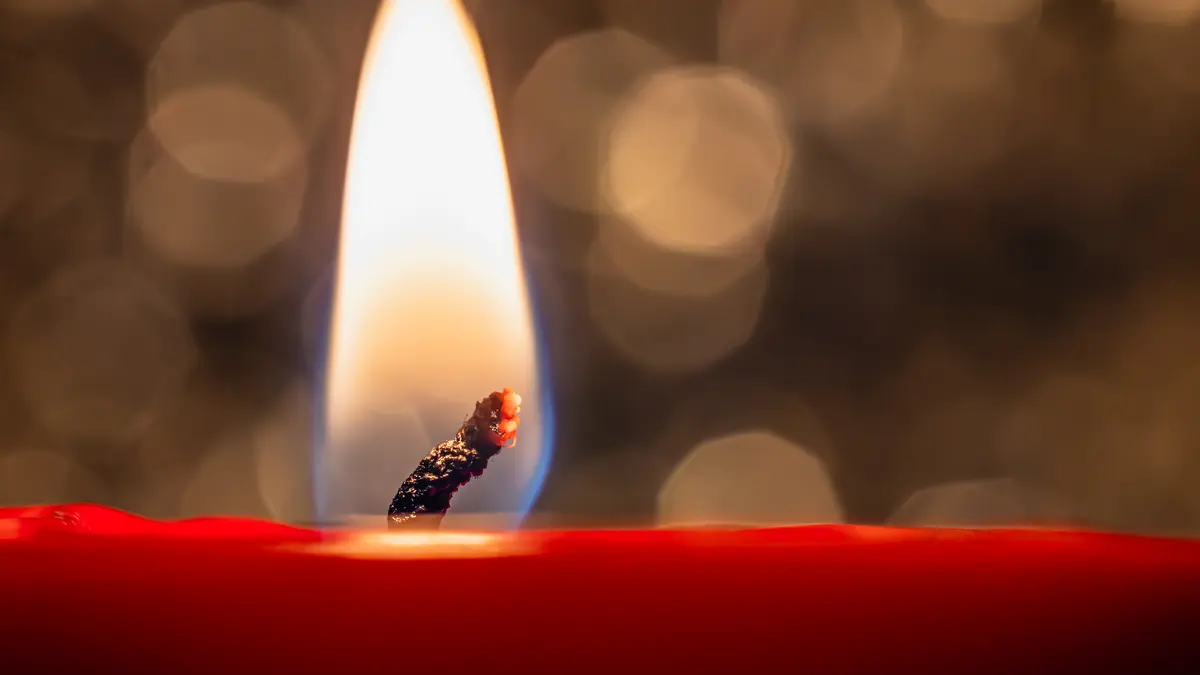

No: never add essential oil to a burning candle, its flame, or the pool of hot melted wax around the wick. Essential oils are concentrated mixtures of volatile chemicals. Adding liquid near a flame can cause sputtering, flaring, smoke, loss of wick control or a fire.
Why the flame changes the answer
A lit candle is a small, controlled combustion system. Wax melts, travels up the wick and vaporises before burning. Pouring another combustible mixture into that system changes the fuel and can disturb the flame. The result cannot be made safe by using fewer drops or by holding the bottle farther away.
London Fire Brigade advises placing candles in stable, heat-resistant holders, keeping them away from combustible materials and never leaving them unattended. An essential-oil bottle should be kept away from the candle too. If oil spills, extinguish the candle without leaning over it and deal with the spill only when the area is cool.
What about an extinguished candle?
Dripping oil into a candle after blowing it out is still a poor method. The wax may remain hot, the next burn may draw an unpredictable mixture into the wick, and neat oil can sit on the surface. A candle designed without added fragrance has not been tested with the new fuel.
Do not relight a candle if anything has been added to its melt pool. Once cool, follow the manufacturer’s disposal advice. Do not try to rescue it by adding more wax, trimming the wick aggressively or burning it outdoors.
Making a scented candle from scratch
Candle making is safer than altering a lit candle only when the whole system is formulated and tested together. Wax type, vessel, wick, dye, fragrance load and diameter all affect burn behaviour. Essential oil does not automatically perform well as candle fragrance, and a natural origin does not remove flammability, sensitisation or aquatic-hazard classifications.
The Health and Safety Executive explains the hazard pictograms used for flammable, irritant and environmentally hazardous substances. Check the safety data sheet for every raw material before buying it. HSE guidance explains what a safety data sheet should communicate.
Use a candle-tested fragrance from a supplier that states the appropriate maximum and supplies documentation. The IFRA Standards Library provides use restrictions by fragrance material and product category. An IFRA certificate does not prove that a particular wax, wick and vessel will burn safely, so the finished candle still needs burn testing.
A sensible burn test
For a candle made from scratch, test one controlled variable at a time and keep written records. Observe flame height, smoking, soot, mushrooming, container temperature and whether the wick stays centred. Stop if the vessel becomes excessively hot, cracks, the flame grows unusually large or the candle smokes persistently.
Do not conduct a first test beside curtains, books, bedding, pets or children. Devon and Somerset Fire and Rescue Service advises using a heat-resistant surface and keeping candles away from draughts and flammable objects.
Safer ways to change the room’s scent
- Extinguish the candle and let it cool fully.
- Ventilate the room.
- Use a separate scent product according to its instructions, never beside the flame.
- Keep fragrance exposure low if anyone has asthma, migraine or sensitivity.
- Choose an unscented candle if the atmosphere of the flame is what you want.
Burning a candle and operating a diffuser at the same time adds both combustion products and fragrance chemicals to indoor air. ANSES has recorded irritation and respiratory symptoms associated with essential-oil sprays and diffusers and recommends ventilation. More scent is not necessarily more pleasant or safer.
If a flare occurs
Do not move a burning container or throw water onto hot wax. Leave the room and call 999 if a fire cannot be put out immediately and safely. A fire blanket or suitable extinguisher is only useful when you know how to use it and have a clear escape route.
Can oil be placed near the candle instead?
Do not warm an open dish of essential oil beside a candle or balance anything on the candle holder. Radiant heat can increase evaporation, and a knocked bottle or dish can carry combustible liquid towards the flame. If you want two different scents over an evening, use separate finished candles at separate times. Extinguish the first one, ventilate and allow it to cool before introducing another product. This also keeps the room’s total fragrance exposure lower.
My verdict
Adding essential oil to a burning candle is not a candle-scenting technique. It introduces an untested fuel beside an open flame. Buy a candle formulated for the intended fragrance, or make one from documented materials and test the complete design before use.