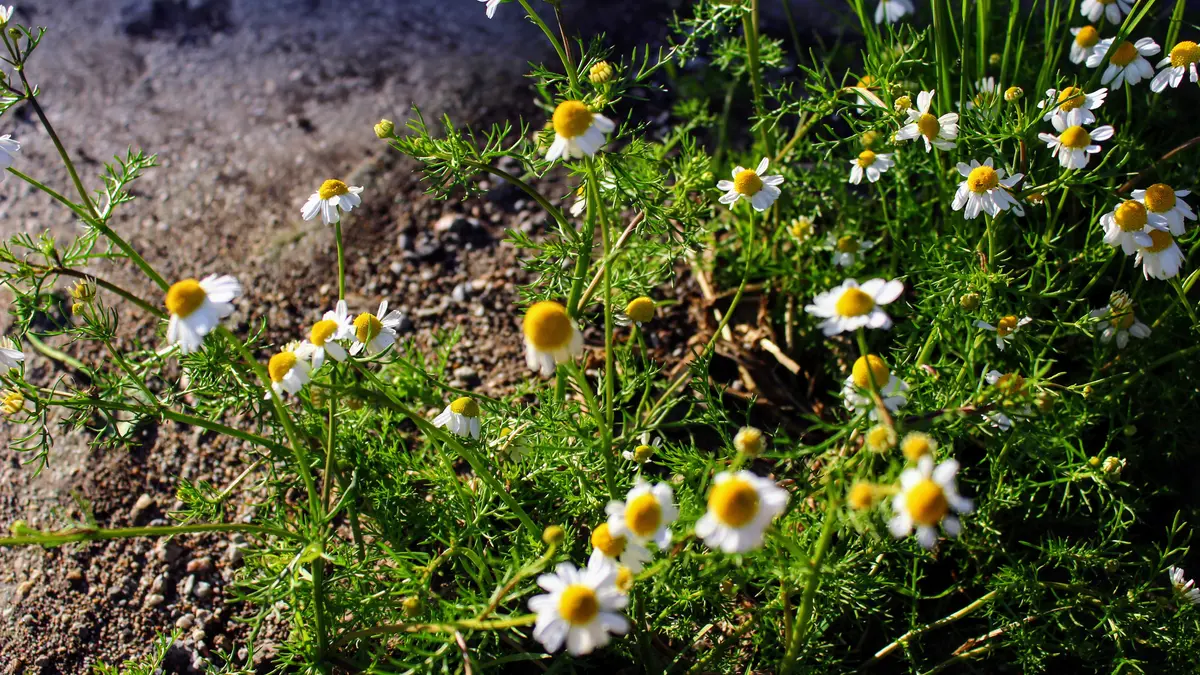

Short answer: German chamomile essential oil is distilled from Matricaria chamomilla. Its blue colour can reflect chamazulene formed during distillation, but colour is not proof of purity or therapeutic effect. Chamomile has a substantial herbal literature, yet studies of tea and oral extracts cannot be transferred automatically to the essential oil.
Which chamomile?
German chamomile is botanically different from Roman chamomile. Kew records Matricaria chamomilla, a member of the Asteraceae family. Roman chamomile is normally Chamaemelum nobile. Their oils have different chemical profiles, so “chamomile” alone is not an adequate label.
The German oil is steam-distilled from flower heads. During distillation, matricin can be converted into blue chamazulene. The resulting oil is not the same preparation as chamomile tea, a dry extract, a tincture or a cream containing a measured extract.
What the research covers
A broad review describes chamomile chemistry, traditional uses and experimental research. It also demonstrates the central interpretation problem: the word “chamomile” covers several species and preparations. Positive findings for an oral extract do not establish that inhaling or applying the volatile oil produces the same exposure.
A systematic review assessed chamomile for anxiety and sleep outcomes, but the included interventions were not simply German chamomile essential oil. A small trial of chamomile extract in chronic insomnia likewise tested capsules rather than aromatherapy. These studies can inform the wider chamomile story, not prove an essential-oil claim.
The US National Center for Complementary and Integrative Health concludes that evidence is insufficient for many proposed uses. It notes preliminary research in some contexts and very limited evidence for insomnia. That is more cautious than claims that the oil treats anxiety, induces sleep or controls inflammation.
Laboratory findings are preliminary
Chamomile constituents show anti-inflammatory, antimicrobial and antioxidant activity in experimental systems. Such work helps researchers identify mechanisms and doses worth studying. It does not show that a diluted skin blend treats eczema, that vapour disinfects a room or that the oil controls a medical condition in people.
Human trials would need to identify the oil chemically, use a credible comparison, report adverse effects and measure a defined outcome. Aroma trials are difficult to blind because participants can usually recognise the smell.
How to assess a chamomile claim
First check the Latin name. Next identify whether participants drank tea, swallowed an extract, inhaled an oil or used a cream. Then check the dose and outcome. A trial measuring a sleep questionnaire after capsules cannot demonstrate that a few diffuser drops change sleep duration or daytime function.
It also matters whether the study enrolled healthy volunteers, people with a diagnosed disorder or patients undergoing a stressful procedure. A short reduction in procedure-related nervousness is not equivalent to treating an anxiety disorder. Reviews that combine dissimilar chamomile preparations may be useful maps, but they cannot erase these differences.
Safety and allergy
Chamomile can cause allergic reactions, particularly in people sensitive to related Asteraceae plants such as ragweed, chrysanthemums and daisies. NCCIH also notes that evidence about use during pregnancy and breastfeeding is limited. A clinical review documents allergic contact dermatitis from essential oils generally.
- Do not swallow the essential oil or add it to drinks.
- Do not apply it neat, near the eyes or to broken skin.
- Stop after rash, swelling, wheeze or worsening irritation; breathing difficulty needs urgent help.
- Keep concentrated oils away from children and pets.
- Ask a clinician or pharmacist before use during pregnancy, breastfeeding or alongside medicines.
Buying checklist
- The label says Matricaria chamomilla and names the flower as the plant part.
- The seller distinguishes German from Roman chamomile.
- A batch report is available and the supplier does not use blue colour as its only quality claim.
- Evidence about teas or extracts is not presented as proof for the oil.
- There are clear dilution, allergy and storage warnings.
My assessment
German chamomile is a recognisable essential oil with well-described chemistry, but its clinical reputation is ahead of direct human research on the oil itself. The wider chamomile literature is relevant only when species, preparation and route match. It is reasonable to treat the aroma as a personal preference; it is not reasonable to describe the bottle as a proven treatment for insomnia, anxiety, eczema or infection.
References
- Kew Plants of the World Online: Matricaria chamomilla
- NCCIH overview of chamomile evidence and safety
- Review of chamomile uses, constituents and research
- Systematic review of chamomile for anxiety and sleep
- Randomised trial of an oral chamomile extract for insomnia
- Clinical review of allergic contact dermatitis from essential oils
Traditional chamomile oil is not always essential oil
The chamomile-pumpkin psoriasis trial used a traditional preparation made from an aqueous chamomile extract processed into sesame oil. It was not a test of steam-distilled chamomile essential oil.
This is a useful example of why the preparation method matters. The positive result concerns the tested mixture and should not be attributed to an unrelated essential-oil bottle.
Targeted evidence update: 12 September 2026. This addition does not represent a new review of every statement on this page.
Related evidence review: Essential Oils for Psoriasis: What Human Studies Do and Do Not Show.
Related evidence review: Chamomile Oil for Eczema: Cream Trials, Allergy and Evidence Limits.
Related evidence review: Chamomile for Anxiety: What Extract, Tea and Essential-Oil Studies Show.
Related evidence review: Chamomile for Sleep: Tea, Extract and Essential-Oil Evidence.