.jpg)
Bottom line: jojoba is a seed-derived liquid wax used as a carrier and cosmetic emollient. It is not an essential oil, and clinical evidence does not support the many treatment claims attached to it.
This profile explains the ingredient rather than recommending it as a medicine. Check the complete formula when a product is sold as “jojoba oil”.
What jojoba oil is
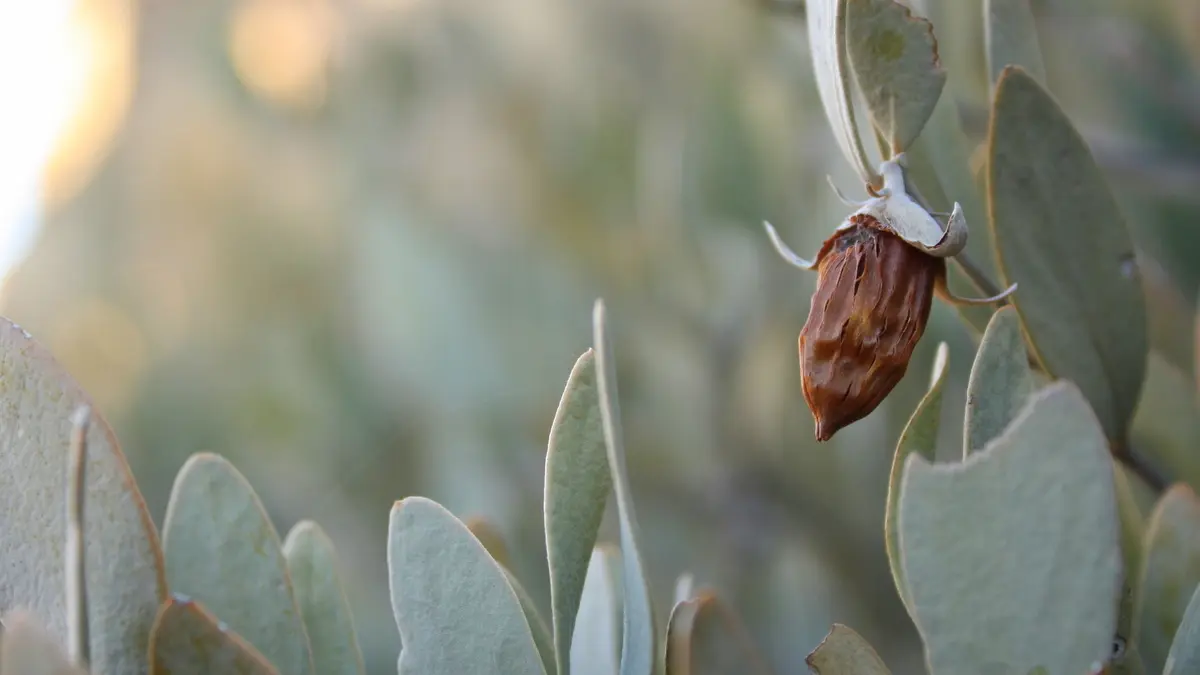
Jojoba comes from the seeds of Simmondsia chinensis, a shrub native to dry areas of North America. The commercial ingredient is usually pressed from the seed.
Kew’s Plants of the World Online provides the accepted botanical naming framework. A botanical name on a label helps identify the plant but does not prove purity or processing quality.
A detailed review describes jojoba as a liquid wax made mainly from long-chain wax esters. This chemistry differs from triglyceride-rich vegetable oils and volatile essential oils.
The everyday name “jojoba oil” is established, so it is not necessarily deceptive. The important correction is that it should not be treated as a steam-distilled aromatic oil.
How it is produced
Producers clean and press jojoba seeds, then may filter, refine or deodorise the resulting material. Colour, odour and minor components can change with processing.
A cold-pressed, unrefined product and a refined cosmetic ingredient are not chemically identical. Neither description proves a health benefit.
Refining can reduce colour and odour, which may suit a formulation. “Unrefined” is not automatically safer, more active or more authentic for every use.
Hydrogenated jojoba is a solid wax used in cosmetic formulas. Jojoba esters are processed derivatives. These names describe related ingredients, not one interchangeable product.
Why formulators use it
Jojoba spreads easily and is relatively resistant to oxidation. It can reduce friction, soften the skin surface and carry other ingredients.
A review of topical plant oils discusses how different lipids influence skin-barrier function. Jojoba’s use as an emollient is more secure than claims that it treats disease.
In hair products, a light coating can improve feel and shine. That is not evidence that jojoba changes follicle biology or causes new hair growth.
As a carrier, jojoba can dilute an essential oil. Dilution reduces concentration but does not remove allergy, phototoxicity or other product-specific risks.
Acne evidence is preliminary
A small exploratory study assessed clay masks containing jojoba oil in people with acne-prone skin. Lesion counts improved during the study.
The product combined clay and jojoba, used an uncontrolled design and did not isolate jojoba’s contribution. It cannot show that plain jojoba treats acne.
Acne can scar and has several effective treatments. A non-comedogenic moisturiser may support a routine, but it should not replace suitable care for persistent inflammatory acne.
Wound-healing claims
A laboratory study found that jojoba affected keratinocyte and fibroblast behaviour in wound-healing models. Cell-culture findings are useful for generating hypotheses.
They do not establish that retail jojoba oil speeds wound healing or prevents infection in people. Open wounds need products designed for that purpose and appropriate clinical care.
An experiment applied jojoba wax to human skin maintained outside the body. It measured inflammation-related signals and extracellular-matrix components. This was an ex-vivo tissue study, not a clinical trial or a review, so it does not establish improvement in patients.
What the safety assessments say
The Cosmetic Ingredient Review lists safety assessments covering jojoba-derived ingredients. Cosmetic safety depends on concentration, use pattern and the complete formulation.
An earlier safety report reviewed animal, irritation and sensitisation data for jojoba oil and wax. Evidence was more extensive for cosmetic use than for treating medical conditions.
Allergic reactions appear uncommon, but “low risk” is not “impossible”. Stop use if a product causes persistent redness, itch, swelling or blistering.
A blend may contain fragrance, essential oils or preservatives that matter more than jojoba. Read the full ingredient list instead of judging the front label.
Patch testing a small area can reveal immediate irritation but cannot guarantee that delayed allergy will never develop. Avoid using a cosmetic on broken skin unless it is designed for that purpose.
How to read a jojoba label
- Botanical name: Look for Simmondsia chinensis.
- Ingredient type: Distinguish seed oil, wax, esters and a fragranced blend.
- Processing: Check whether the product is refined, unrefined or hydrogenated.
- Complete formula: Look for fragrance, preservatives and added essential oils.
- Intended use: A cosmetic carrier is not a wound or acne medicine.
- Batch and supplier: Prefer traceable labelling and realistic claims.
Jojoba and essential-oil recipes
Calling jojoba a carrier does not create a universal dilution rule. The appropriate concentration depends on the essential oil, body area, age, duration and product purpose.
NCCIH notes that essential oils are commonly diluted for skin use. It also warns that products can vary and may cause skin reactions.
Do not assume that adding jojoba makes an oil safe for babies, pregnancy, damaged skin or animals. Those are separate safety decisions.
My verdict
Jojoba is a useful, stable cosmetic emollient and carrier. Its identity as a liquid wax explains many practical qualities without turning it into a treatment.
The human evidence for acne and other medical claims is too limited for confident recommendations. Buy it for a clear cosmetic purpose and judge any blend by every ingredient it contains.
References
- Jojoba in dermatology: Chemistry and uses
- Jojoba wax in an ex-vivo human skin culture model
- Topical plant oils and the skin barrier
- Jojoba in cell-based wound-healing models
- Exploratory clay and jojoba mask study
- Jojoba oil: A dermatological review
- Cosmetic Ingredient Review: Jojoba seed oil
- Safety assessment of jojoba oil and wax
- Royal Botanic Gardens, Kew: Plants of the World Online
- NCCIH: Aromatherapy
Editorial responsibility and correction note
Editor: John Hamlen. This article has not been independently reviewed by a clinician.
Reference correction, 12 September 2026: Changes in this check: Distinguish ex-vivo human tissue from clinical evidence; Correct bibliographic description against source record. This was a targeted correction, not a comprehensive new review of every claim in this article.
Read our editorial policy, evidence method and corrections policy, including how to report an error.