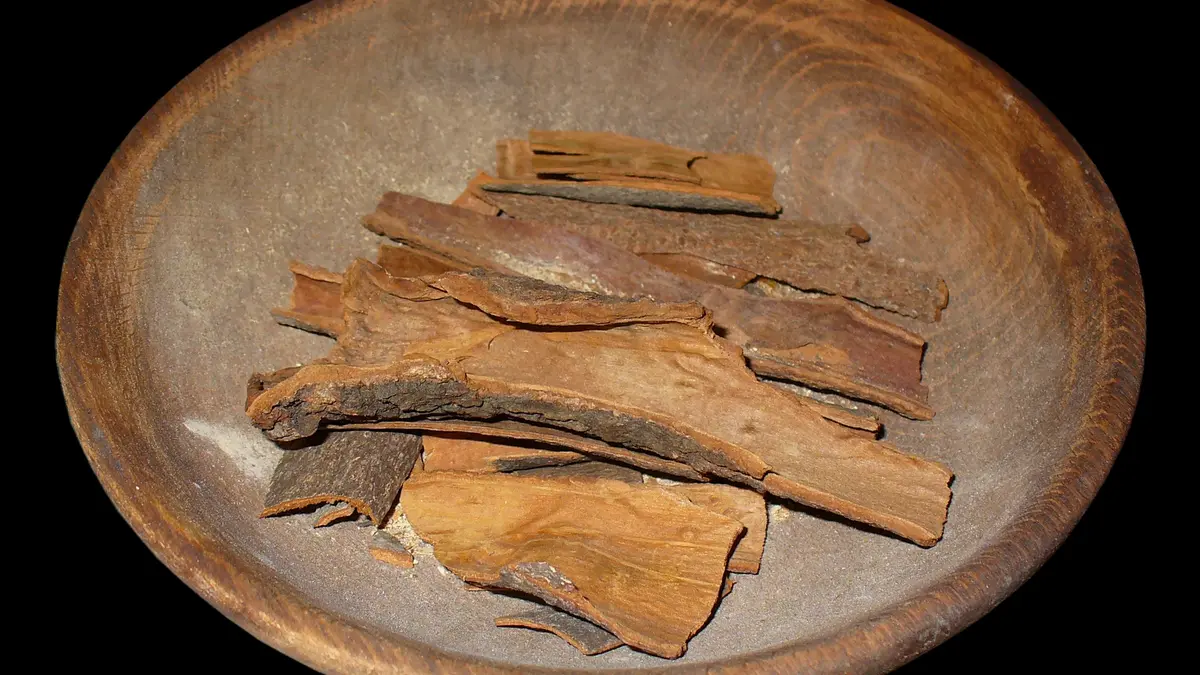

Short answer: cassia essential oil is a powerful cinnamon-bark or leaf distillate, usually from Cinnamomum cassia. It is rich in cinnamaldehyde, strongly aromatic and much more irritating than its familiar food-spice image suggests. Laboratory antimicrobial results do not make neat skin use or swallowing safe.
Cassia, cinnamon and botanical names
Cassia is often sold as “cinnamon” oil, but cinnamon labels can refer to several species and plant parts. Cinnamomum cassia is also listed in scientific literature under the accepted name Cinnamomum aromaticum. Ceylon or “true” cinnamon is Cinnamomum verum. Their bark and leaf oils are not chemically identical.
A detailed review of Cinnamomum chemistry shows why the species, plant part and extraction method must be stated. A useful retail label should name all three rather than relying on the warm familiarity of “cinnamon”.
Extraction and chemistry
Cassia oil is commonly steam-distilled from bark, twigs or leaves. Cinnamaldehyde is often dominant, especially in bark-derived material, while other cinnamon leaf oils may be richer in eugenol. A recent review of cinnamon essential oils describes their variable composition and the need to relate any result to the exact material tested.
The same chemistry that gives cassia its forceful smell and antimicrobial activity contributes to its irritation and sensitisation risk. “Natural” does not mean mild, and culinary use of tiny amounts of ground spice does not establish that a concentrated volatile oil is safe to apply or ingest.
What does research show?
Cassia oil has inhibited selected microbes in laboratory testing. Other experiments compare cinnamon oils with bacteria, fungi or biofilms under controlled conditions. These studies can identify possible mechanisms and compounds for further research. They do not establish a safe and effective dose for treating infection in a person.
A dish or tube allows direct contact at a known concentration. Human skin, lungs and digestive tissue are more complex, and a concentration high enough to affect a microbe may also damage tissue. Clinical evidence would need a defined preparation, comparator, diagnosis, safety monitoring and meaningful patient outcomes.
Claims for blood sugar, weight loss or digestive disease often draw on studies of cinnamon powder, extracts or food intake. They cannot be transferred to cassia essential oil. Swallowing the oil is not a concentrated version of adding cinnamon to food.
Fragrance and household use
Cassia can create a strong warm, spicy note in a professionally formulated fragrance. In a diffuser it can become overwhelming quickly and may provoke coughing, headache or airway irritation. Use only a product intended for that method, follow the device instructions, keep sessions brief and ventilate. Stop at the first sign of discomfort.
Laboratory antimicrobial findings do not prove that diffusion disinfects a room. Air concentration, contact time, ventilation and the organism all matter, while people and animals are exposed at the same time. Cleaning a surface with a suitable labelled product is more predictable than attempting to “sterilise the air” with fragrance.
Skin safety
Cassia is not a good choice for casual home skincare. It can cause burning, irritant dermatitis and allergic contact dermatitis. Do not apply it neat or use it in a bath, where oil droplets do not dissolve evenly in water. Avoid the face, lips, genitals, damaged skin and any improvised oral-care recipe.
Products formulated for skin should comply with the limits appropriate to their intended use. A patch test cannot guarantee that repeated exposure will not sensitise someone, and adding more carrier oil after a reaction has started is not a substitute for washing off the product and obtaining advice when symptoms are significant.
Buying checks
- Full botanical name, plant part and distillation method.
- Batch information and a chromatogram that matches the product.
- Clear hazard, dilution and storage instructions.
- No instruction to swallow the oil or put it under the tongue.
- No claim that laboratory antimicrobial activity makes it a treatment for infection.
My assessment
Cassia oil has a legitimate fragrance role and substantial laboratory literature, but its risk profile makes it unsuitable for casual experimentation. I would not use it on skin or take it orally. Any health claim must be supported by human research on the same oil and route, not by spice studies or a petri-dish result.
What would stronger evidence look like?
Because cassia can irritate tissue, a useful clinical study would need more than a signal of antimicrobial activity. It would use a standardised finished product, justify the concentration, compare it with established care and report burns, dermatitis and withdrawals. It would also separate C. cassia bark oil from cinnamon powder, extracts and other species. Until benefit clearly outweighs that predictable irritation risk, home treatment claims are not justified.