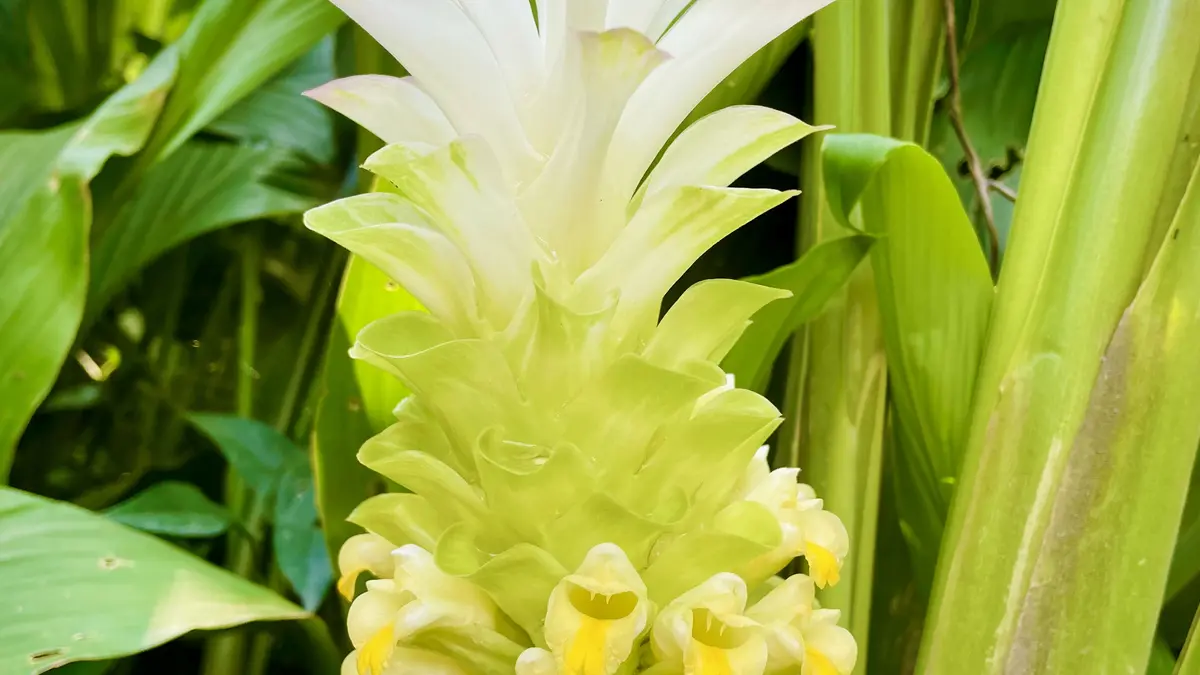

Short answer: turmeric essential oil is the volatile fraction distilled from Curcuma longa. It is not curcumin, turmeric powder or a standardised oral extract, so their clinical evidence does not establish benefits from the oil.
Identity comes first
Kew records Curcuma longa in the ginger family. The aromatic rhizome can be steam-distilled to produce an essential oil rich in volatile compounds, including turmerones.
Curcumin is a non-volatile yellow polyphenol. It does not distil across in meaningful quantities with the essential oil. A bottle of turmeric essential oil should therefore not be described as concentrated curcumin.
Why the distinction changes the evidence
NCCIH reviews research on oral turmeric and curcumin, including studies of osteoarthritis and metabolic outcomes. It concludes that evidence remains insufficient for definitive health claims. Those studies still do not test inhaled or topical turmeric essential oil.
Chemical analysis has identified turmerones and related constituents in turmeric volatile material. Describing those constituents is useful for authentication. It does not demonstrate that the complete oil treats inflammation, cancer, pain or infection in people.
What experimental studies can tell us
Experimental work has compared turmeric essential oils, their composition and laboratory activity. Such studies can generate hypotheses about antioxidant or enzyme-related pathways.
Cells and animals can receive concentrations that would be unsuitable for human skin or inhalation. A plausible mechanism is not a clinical outcome. Human trials must specify the oil, dose, route, comparator and adverse events.
Claims that should raise questions
Watch for sellers who cite a curcumin capsule trial while selling distilled oil. Also question claims that the oil “detoxifies” the liver, cures infection or treats joint disease. These statements join unlike preparations and often omit dose and safety.
“Turmeric oil” may also refer to an infused carrier oil, fragrance or extract. The ingredients list should explain whether the product is distilled volatile oil, fixed oil containing turmeric material or a formulated cosmetic.
What better evidence would look like
A useful human study would analyse the exact oil, describe its turmerone profile and test one route against a credible comparator. It would use a defined outcome rather than a broad promise such as “supports wellness”.
Separate trials would be needed for inhalation and skin application because exposure differs. Safety reporting should include irritation, allergy, withdrawals and medicines used by participants.
Safety
NCCIH reports digestive effects and liver injury concerns for some oral turmeric or enhanced-curcumin products. Those warnings should not be copied mechanically to the essential oil, but they show why preparation and route matter.
Topical essential oils can cause irritation or allergy. A clinical review describes allergic contact dermatitis linked to essential oils. Turmeric-derived products may also stain fabrics and skin.
- Do not swallow turmeric essential oil.
- Do not treat it as a substitute for prescribed medicine.
- Do not apply it neat, near eyes or to damaged skin.
- Keep it away from children and pets.
- Stop use if irritation, coughing, wheeze or headache develops.
Poison Control explains why concentrated essential oils can be hazardous when swallowed or misused.
Buying checklist
- The label names Curcuma longa, the rhizome and distillation.
- The seller distinguishes essential oil from curcumin and turmeric extract.
- A batch report describes the volatile constituents.
- No oral use is encouraged without product-specific regulatory approval.
- Claims are supported by studies using the same preparation and route.
My assessment
Turmeric essential oil is a genuine distilled product, but most familiar turmeric evidence concerns different preparations. Its chemistry supports further research, not broad medical claims. The most important consumer skill is recognising when curcumin evidence has been borrowed for an oil that contains little or none.
References
- Kew Plants of the World Online: Curcuma longa
- NCCIH: turmeric usefulness and safety
- Analysis of volatile constituents in turmeric rhizome and root tuber
- Comparative analysis of fresh and dried Curcuma essential oils
- Clinical review of essential-oil contact dermatitis
- Poison Control: essential-oil safety