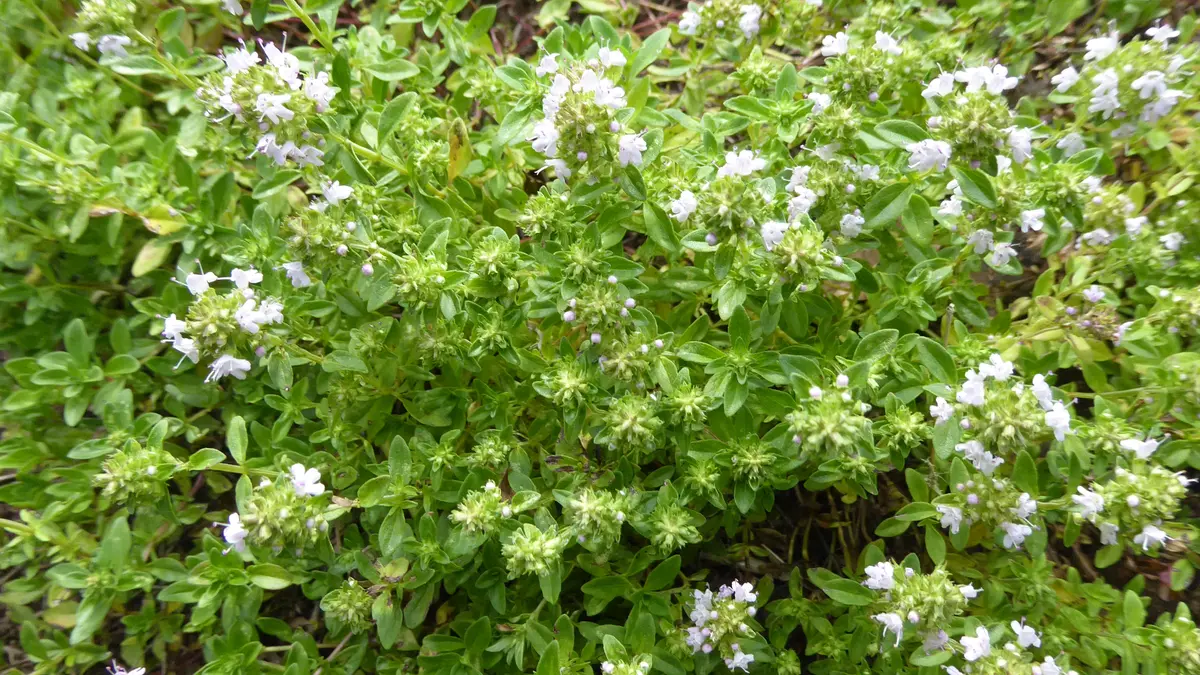

Short answer: thyme essential oil is a concentrated volatile oil whose chemistry varies markedly between plants and batches. Laboratory antimicrobial results are common, but they do not prove that the oil safely treats infection in people.
What thyme oil is
Commercial thyme oil is commonly distilled from Thymus vulgaris. Kew recognises Thymus vulgaris as an accepted species in the mint family. A complete label should state the botanical name, plant part, extraction method and, where relevant, chemotype.
Thyme used as food is not the same exposure as concentrated essential oil. A herbal tea, dry extract, mouthwash and vapour also deliver different mixtures and doses. Evidence for one cannot be transferred automatically to another.
Why chemotype matters
Thyme plants can produce oils dominated by thymol, carvacrol, linalool, geraniol or other constituents. A review of thyme chemistry and biological activity describes this variability. Geography, harvest conditions and distillation can also change the final composition.
Thymol-rich and carvacrol-rich oils are often promoted for antimicrobial activity. Linalool-rich material may smell and behave differently. A study naming only “thyme oil” may therefore be hard to reproduce or apply to a bottle with no chemical specification.
What laboratory research shows
The thyme review reports laboratory activity against selected bacteria and fungi. Such experiments expose organisms directly to controlled concentrations. They help define chemistry and possible mechanisms, but they do not establish a safe treatment dose for skin, lungs or internal use.
Results can change with the organism, growth medium, oil composition and test method. An inhibition zone in a dish does not show that diffused thyme oil disinfects a room or that topical oil reaches an infection without damaging tissue.
What human evidence can support
The European Medicines Agency has assessed traditional herbal preparations made from thyme herb for cough associated with colds. That assessment concerns specified herbal products and traditional use. It is not approval of neat thyme essential oil for respiratory infection.
Clinical products may combine thyme with other ingredients. Combination studies cannot identify which ingredient caused an effect. They also cannot justify replacing antibiotics, antifungals or medical assessment with a home-made essential-oil preparation.
What a useful clinical trial would need
A persuasive trial would identify the botanical source and chemotype, publish a batch analysis and use a defined formulation. It would compare that product with placebo or usual care for a diagnosed condition.
Researchers would also need to report irritation, allergy, treatment withdrawals and follow-up. Without those details, an apparently positive result may not apply to another thyme oil or to routine home use.
Safety
Concentrated thyme oil can irritate skin and mucous membranes. A clinical review documents irritant and allergic contact dermatitis from essential oils. Oxidation during poor storage can increase sensitisation risk for some volatile constituents.
- Do not swallow thyme essential oil or add it to food or drinks.
- Do not apply it neat, to broken skin or close to eyes and airways.
- Keep the bottle away from children and pets.
- Stop use after burning, rash, wheeze, headache or breathing discomfort.
- Seek advice before use during pregnancy, breastfeeding or alongside medicines.
Poison Control warns that essential oils can cause poisoning when swallowed or misused. Packaging described as “natural” does not make a concentrated product harmless.
Buying checklist
- Thymus vulgaris appears on the label rather than “thyme fragrance”.
- The plant part and steam-distillation method are identified.
- The chemotype or a batch analysis explains the dominant constituents.
- The seller gives dilution, storage and first-aid information.
- Laboratory antimicrobial findings are not presented as clinical proof.
My assessment
Thyme oil is chemically interesting and often active in laboratory antimicrobial tests. Direct clinical evidence for household treatment claims is much weaker. Product identity and chemotype must be known before even preliminary findings can be interpreted.
Thyme oil and snoring
The positive thyme–ivy trial concerned an extract syrup for bronchitis cough. It did not test essential-oil diffusion or snoring. The distinction matters when interpreting respiratory claims.
Primary research and its reported outcomes.
Read the thyme comparison in our snoring guide for the evidence limits, other formulations and signs that need assessment.
Targeted evidence update: 14 September 2026. This section does not represent a new review of every claim on this profile.
Thyme and yeast infection
Garlic–thyme cream trials provide mixed clinical findings, including a comparison favouring clotrimazole for itching. They do not isolate thyme’s effect. See the detailed evidence comparison for the studies, limitations and appropriate care.
Thyme and sinus symptoms
Thyme laboratory activity, an inconclusive postoperative honey trial and a nasal-cell study do not establish a thyme-essential-oil sinusitis treatment. See the detailed evidence comparison for the studies, limitations and care context.
Thyme and eczema
Thyme evidence includes mouse experiments and isolated thymol research. The small human study used selected oil mixtures and found no added benefit over massage alone; it did not establish thyme-specific efficacy. See the detailed eczema evidence comparison for the studies, limitations and care context.