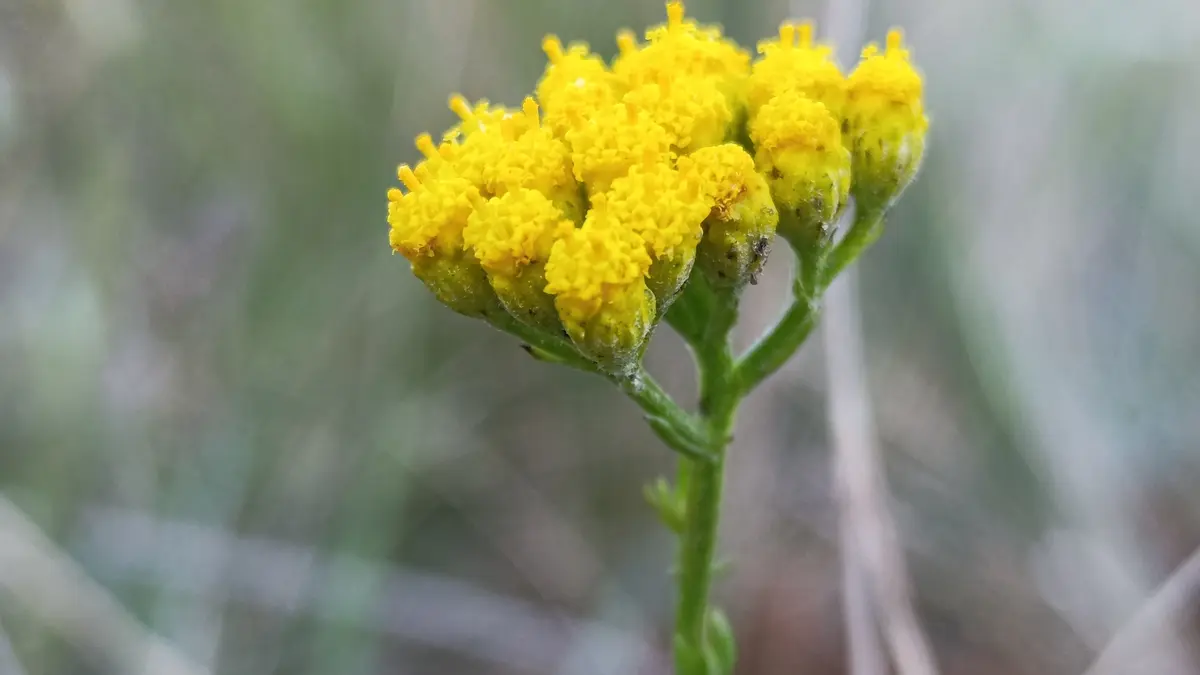
Short answer: blue tansy oil is distilled from Tanacetum annuum, a Mediterranean plant also classified as Vogtia annua. Its blue colour develops during distillation and is associated with chamazulene. Laboratory studies describe its chemistry, but there is not good human evidence that the oil treats acne, eczema, allergy or anxiety.
Blue tansy is not common tansy
The name causes recurring confusion. Blue tansy is Tanacetum annuum, while common tansy is usually Tanacetum vulgare. They are different species with different chemical profiles. Current taxonomic databases may place blue tansy under the accepted name Vogtia annua, so a responsible supplier should explain the synonym rather than omit the botanical identity.
A detailed chemical study of T. annuum essential oil describes a complex mixture whose proportions can change with origin and plant material. Marketing photographs of a deep-blue bottle do not establish species, purity or composition.
Why is the oil blue?
Chamazulene is formed from plant precursors during heating and distillation. It contributes a blue colour and attracts much of the product’s marketing. The colour is not, by itself, a quality test. Concentration, storage, oxidation, blending and added colour can all affect appearance.
Research on blue tansy oil has reported its volatile composition and laboratory repellent activity. This may help characterise the material, but it does not demonstrate a skin treatment or establish a safe household dose.
What does the evidence support?
Most accessible research concerns plant chemistry, antioxidant tests, antimicrobial assays or effects on insects. Those are useful starting points for formulation and further investigation. They are not clinical trials. HealthWatchlist did not find a reliable body of controlled human studies showing that inhaled or topically applied blue tansy oil treats a defined condition.
Claims for acne and eczema are especially easy to overstate. A substance can inhibit microorganisms in a laboratory dish and still fail to improve acne on living skin. Eczema is associated with an impaired skin barrier, which can make fragranced products more irritating. Neither blue colour nor an in-vitro result proves anti-inflammatory benefit for a person.
Claims about calm or sleep face a similar gap. A scent may be pleasant and become part of a relaxing routine, but preference is not evidence that it treats an anxiety disorder or insomnia.
There is also no clinical basis for describing blue tansy as a “natural antihistamine”. Allergy involves several possible organs and mechanisms, and serious reactions can progress quickly. A laboratory observation about one constituent cannot show that smelling or applying the oil prevents an allergic response.
Identity and safety problems
Confusing blue tansy with common tansy is not a trivial naming error. Research on common tansy shows substantial chemical diversity, including profiles that may contain thujone. A separate laboratory study of common tansy tested biological activity and cell toxicity. These findings should not be used to describe genuine blue tansy, but they show why the Latin name matters.
Essential oils can cause irritant or allergic contact dermatitis. A clinical review describes allergic contact dermatitis associated with essential oils and their constituents. Oxidation may change the sensitisation profile, so old or poorly stored oil is not necessarily equivalent to a fresh batch.
Using it more cautiously
- Do not swallow the oil or put it in food, drinks or capsules.
- Do not apply it neat or use it on broken, inflamed or eczematous skin.
- Prefer a finished cosmetic with a full ingredient list over a homemade facial mixture.
- Keep it away from eyes and mucous membranes.
- Diffuse briefly, with ventilation, and stop if it causes headache, coughing, wheeze or nausea.
- Keep it out of reach of children and pets.
People who are pregnant, breastfeeding, treating a child, using multiple medicines or living with asthma or fragrance allergy should seek individual advice before exposure.
Storage deserves attention because a partly used bottle contains both oil and air. Keep it tightly closed, away from heat and light, and follow the supplier’s shelf-life advice. Discard it if the smell or appearance changes markedly rather than trying to mask deterioration in a blend.
Buying checklist
- The label states Tanacetum annuum and ideally acknowledges the synonym Vogtia annua.
- The plant part, origin and distillation method are disclosed.
- A recent batch analysis is available.
- The supplier distinguishes blue tansy from T. vulgare.
- The blue colour is not presented as proof of medical activity.
- The seller avoids claims to treat acne, eczema, allergy, anxiety or sleep disorders.
My assessment
Blue tansy is an interesting aromatic material with distinctive chemistry, but its online reputation is much larger than its human evidence base. The priority is correct species identification, a current analysis and conservative exposure. It should be bought as a fragrance ingredient, not as a blue-coloured shortcut to treating a skin or mental-health condition.
Blue tansy oil and snoring
Published blue-tansy research includes chemical and mosquito-repellent testing. Our targeted search found no controlled human trial measuring snoring or sleep-disordered breathing.
Read the blue tansy comparison in our snoring guide for the evidence gap and search limits.
Targeted evidence update: 14 September 2026. This section does not represent a new review of every claim on this profile.
Reference: Stappen I et al. Natural Product Communications. 2021. doi:10.1177/1934578X21990194.
References
- Kew Plants of the World Online search for Tanacetum annuum
- Chemical characterisation of Tanacetum annuum essential oil
- Composition and laboratory repellent research
- Chemical diversity of common tansy
- Common tansy oil and constituents: Laboratory activity and cytotoxicity
- Clinical review of allergic contact dermatitis from essential oils
Editorial responsibility and correction note
Editor: John Hamlen. This article has not been independently reviewed by a clinician.
Reference correction, 12 September 2026: Changes in this check: Correct original laboratory research labelled as a review; Correct bibliographic description against source record. This was a targeted correction, not a comprehensive new review of every claim in this article.
Read our editorial policy, evidence method and corrections policy, including how to report an error.