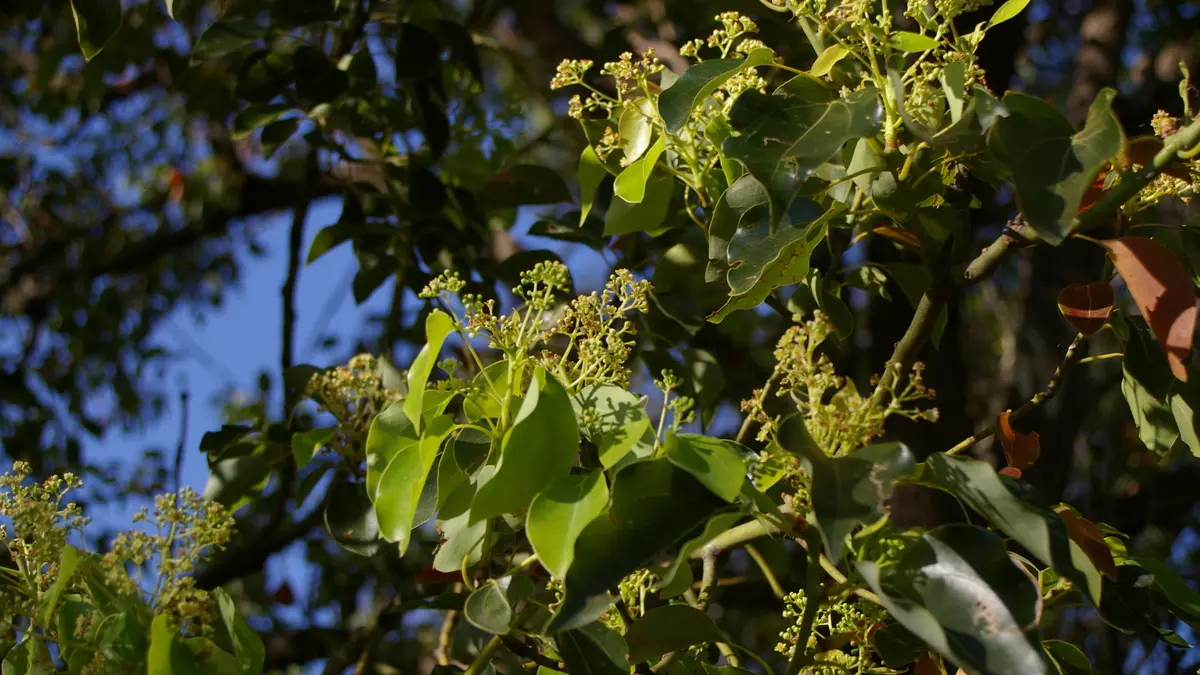

Short answer: camphor-tree essential oil comes from Cinnamomum camphora, but oils from the species can have very different dominant constituents. Camphor itself can cause seizures and other serious poisoning after ingestion. The label and batch analysis matter, and the oil should not be used as a home oral remedy.
One tree, several chemical profiles
Cinnamomum camphora is an aromatic evergreen in the laurel family. The oil may be distilled from leaves, wood or other plant material. “White camphor oil”, “ho wood” and “ravintsara” are not reliable substitutes for a full botanical and chemical description.
Research on C. camphora describes marked chemical variation and multiple chemotypes. Some material is rich in camphor, while other material may be dominated by linalool, 1,8-cineole or different constituents. Analyses of different plant tissues also show that the part distilled affects composition.
This means that evidence or safety advice for one chemotype cannot automatically be applied to every bottle bearing the species name. A current batch report is more informative than a broad promise of “purity”.
What has been studied?
A broad review catalogues traditional uses, chemistry and experimental research on the camphor tree. Much of the activity literature involves isolated constituents, extracts, animals or cells. It is not a body of clinical proof for ordinary aromatherapy use.
Camphor-containing topical medicines have been used as counterirritants and in vapour products. A regulated finished product with a stated concentration and age restriction is not equivalent to neat essential oil or a homemade chest rub. HealthWatchlist did not find robust trials showing that camphor-tree essential oil treats respiratory infection, chronic pain, inflammation or another defined disease.
The familiar cooling or warming sensation is not a measurement of healing. Sensory effects can change how discomfort feels without changing its cause. A strong vapour can likewise create a subjective feeling of a clearer nose without demonstrating better airflow or treatment of infection.
Why ingestion is dangerous
Camphor is absorbed rapidly and can affect the brain. An evidence-based poisoning guideline describes the assessment and management of camphor exposure. Seizures can occur after ingestion, and a person may become unwell quickly.
A recent clinical case report documents severe camphor toxicity. A study of paediatric exposures also shows why camphor products need secure storage. Case reports do not quantify the risk from a correctly used finished cosmetic, but they decisively rule out treating ingestion as a benign experiment.
Putting camphor oil in the nostrils, mouth or on a child’s skin is not a safe way to manage congestion. Vapour does not kill a respiratory infection, and strong odours may irritate people with asthma or sensitive airways.
Skin and inhalation safety
Neat essential oil can irritate skin, and fragrance constituents can cause sensitisation. A clinical review explains allergic contact dermatitis associated with essential oils. A patch test at home cannot rule out later sensitisation and is not a substitute for a properly formulated product.
- Never swallow camphor oil or add it to food, water or capsules.
- Keep it locked away from children and pets.
- Do not place it in or around the nostrils, particularly in babies and children.
- Do not apply it neat, over damaged skin or under a dressing.
- Use only products whose camphor concentration and age directions are explicit.
- Stop inhalation after coughing, wheeze, headache, dizziness or nausea.
If swallowed, contact a poisons service or emergency medical service promptly. Do not induce vomiting or delay while waiting for symptoms.
Seizure risk means the exposed person should not be left alone or made to walk around. If a seizure occurs, protect them from injury, do not put anything in their mouth and follow emergency-service instructions. This is first-aid guidance for accidental exposure, not a suggested use of the product.
Buying checklist
- The exact botanical name, plant part and extraction method are stated.
- The chemotype or major constituents appear on a current batch analysis.
- The supplier distinguishes the oil from isolated camphor and from differently named commercial oils.
- Child-safety and ingestion warnings are prominent.
- Laboratory findings are not presented as proof that the oil treats infection or disease.
My assessment
Camphor-tree oil cannot be judged safely from the species name alone because composition varies. There is substantial experimental literature, but little reason to treat the oil as a proven medicine. For a camphor-rich product, poisoning risk is the decisive fact: avoid ingestion, keep it away from children and use only clearly labelled finished products within their directions.
Camphor and jaw pain
Trials of a blended ointment cannot identify this ingredient’s individual effect, and their pain outcomes are mixed. Our oil-specific evidence appraisal explains the studied preparation, comparison and limits. It also sets the claim alongside appropriate care.
References
- Kew Plants of the World Online search for Cinnamomum camphora
- Chemical variation and chemotypes of C. camphora
- Composition of oils from different camphor-tree tissues
- Review of camphor-tree chemistry and research
- Evidence-based guideline for camphor poisoning
- Clinical case report of severe camphor toxicity
- Paediatric camphor exposures
- Clinical review of essential-oil contact allergy