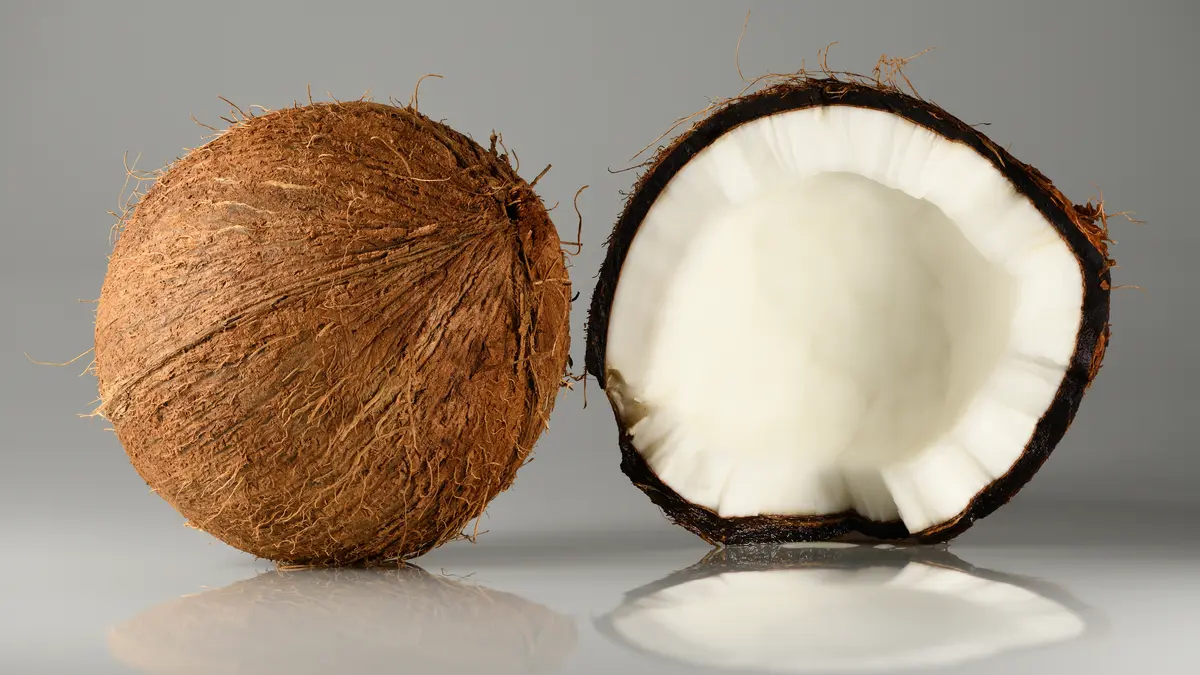

“Coconut essential oil” is often an imprecise sales name. Coconut carrier oil, fractionated coconut oil, an infused oil and a coconut fragrance are different products.
Botanical identity
Cocos nucifera is the coconut palm listed by Kew’s Plants of the World Online. The familiar oil is obtained from the fruit’s kernel.
A correct botanical name does not tell you whether the bottle contains virgin coconut oil, fractionated oil, an extract or added fragrance. The ingredient list must answer that question.
Coconut oil is usually a carrier oil
Virgin and refined coconut oils are fixed oils. They contain fats, feel oily and do not evaporate like the volatile material normally called an essential oil.
Fractionated coconut oil remains liquid because longer-chain components have been removed. It is widely used to dilute essential oils for skin products and roll-ons.
Neither product becomes an essential oil simply because it carries aromatic ingredients.
What might “coconut essential oil” mean?
A product using that phrase may be:
- coconut carrier oil with added fragrance;
- another carrier oil infused with coconut material;
- a solvent or carbon-dioxide extract;
- a perfume composition that smells of coconut;
- a blend of essential oils designed to suggest a coconut scent.
Those can be legitimate products when labelled accurately. The problem is treating one broad name as a standard botanical distillate.
How to read the label
Look for a complete ingredient list and the extraction method. A label stating only “coconut oil” or “100% pure” does not resolve the product type.
For a carrier oil, useful information includes whether it is virgin, refined or fractionated. For an aromatic extract, look for the solvent or extraction process and any added carrier.
For fragrance products, check the intended use. Candle, soap and room-fragrance materials may not be suitable for skin application.
Claims and evidence
Findings about dietary coconut oil do not test an aromatic product sold as coconut essential oil. Evidence about one route cannot be transferred to inhalation or skin use.
A pleasant coconut scent may be used for fragrance. It should not be described as treating a health condition without evidence for the exact finished product and route.
Safety
Follow the instructions for the actual product, not the name alone. Stop skin use if redness, itching or swelling develops.
Do not swallow a cosmetic or aromatherapy product. Added fragrance ingredients and essential oils can have different hazards from edible coconut oil.
Evidence scores for coconut
Bottom line
Most familiar coconut oil is a fixed carrier oil. If a seller uses the phrase “coconut essential oil”, check the ingredients and process before deciding what is in the bottle.
Coconut and yeast infection
A small coconut-cream trial exists, but inconsistent reporting limits interpretation. That preparation should not be equated with food-grade oil. See the detailed evidence comparison for the studies, limitations and appropriate care.
Coconut and fungal nails
Fractionated oil and a modified-oil hydrogel have different findings; neither demonstrates clinical cure with ordinary coconut oil. See the detailed evidence comparison for the studies, limitations and appropriate care.
Coconut and Lyme disease
Coconut oil failed the bactericidal threshold in one laboratory screen. Monolaurin findings conflict, and a 17-person uncontrolled supplement report cannot isolate monolaurin or establish coconut oil as Lyme treatment. See the detailed evidence comparison for the studies, limitations and care context.
Profile sources
- Royal Botanic Gardens, Kew: Cocos nucifera
- US Food and Drug Administration: Aromatherapy products and claims
Moisturising is the supported claim
Evidence update: 13 September 2026.
A small dry-skin trial found broadly comparable moisturising effects from coconut and mineral oil. A paediatric eczema trial favoured virgin coconut oil on selected outcomes. Neither measured facial wrinkle reversal. Coconut oil is a fixed fatty oil, not a volatile essential oil.
Related evidence review: Coconut Oil for Wrinkles: Moisturising Evidence versus Anti-Ageing Claims.
Include the negative coconut phototherapy result
Evidence update: 14 September 2026.
A controlled half-body study found no faster psoriasis clearance from coconut oil applied before PUVA or narrow-band UVB. A dry-skin trial supports moisturising effects, but cannot establish psoriasis control. Ask the phototherapy team which products to use before treatment rather than adding oils independently.
Related evidence review: Coconut Oil for Psoriasis: Moisturising Evidence and the Phototherapy Trial.
Separate virgin oil from newer coconut-derived creams
Evidence update: 14 September 2026.
The 117-child virgin coconut oil trial reported better eczema scores than mineral oil. Newer coconut- and sunflower-derived cream research concerns a different formulation: itch results were favourable, but the quoted EASI comparisons were not statistically significant. Neither is evidence for treating infected eczema without assessment.
Related evidence review: Coconut Oil for Eczema: Human Trials, Moisturising Benefits and Limits.
Coconut neonatal research concerns supervised skin care
Evidence update: 14 September 2026.
A 72-infant trial reported better skin condition with coconut oil but no significant difference in common neonatal outcomes, including sepsis. The Cochrane emollient review found low-certainty infection evidence across several oils. These findings do not establish treatment for every baby rash.
Related evidence review: Coconut Oil for Baby Skin: Premature-Infant Trials and Safety.