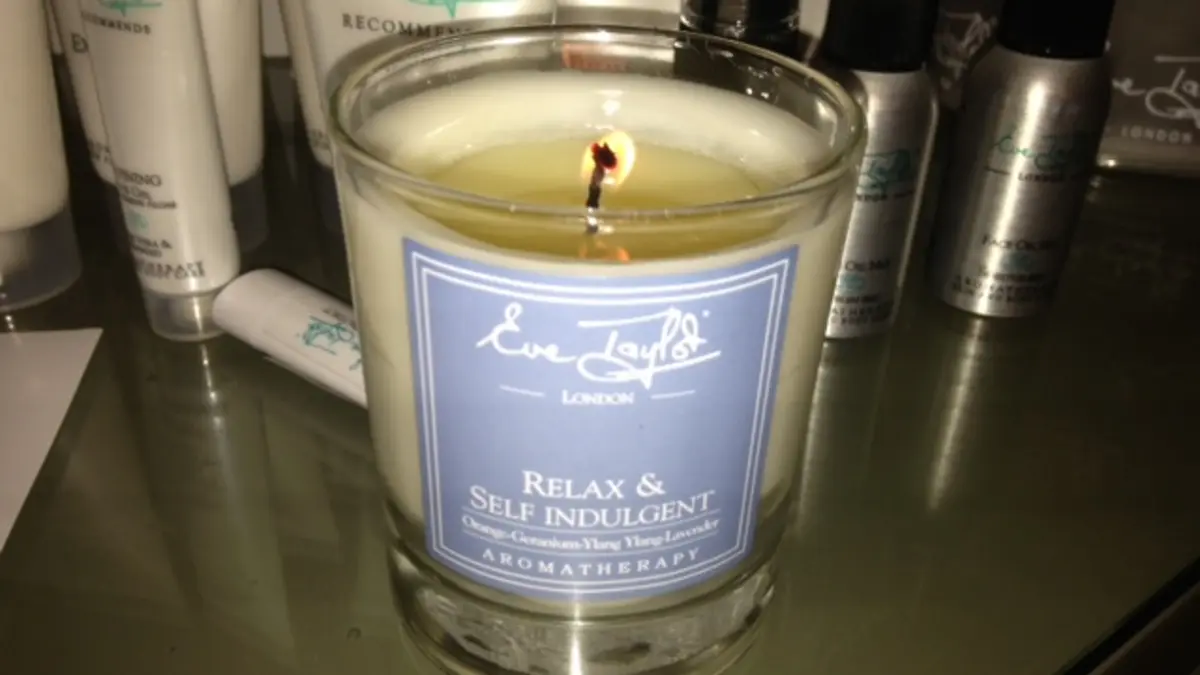

HealthWatchlist verdict: Some essential-oil studies report short-term relaxation or reduced anxiety around stressful events. A pleasant scent can also be part of a calming routine, but these findings do not establish treatment for an anxiety disorder.
For research on a particular oil, read our lavender relaxation review or frankincense relaxation review. For persistent symptoms, see the anxiety evidence guide.
What the research can tell us
A systematic review of aromatherapy for anxiety before surgery found lower anxiety scores across the included trials. A later systematic review of inhaled aromatherapy in clinical settings also found that most included studies reported less anxiety, with lavender among the oils used.
These results make a short-term calming effect plausible in some settings. They do not show that every relaxing scent has the same effect, that a home diffuser reproduces a clinical intervention or that aromatherapy treats an anxiety disorder.
The 2023 review included 76 studies involving 6,539 patients. It used a narrative synthesis because studies differed too much and had sufficient bias to make a single pooled estimate inappropriate.
More than 70% of the studies reported favourable anxiety results. That is a proportion of studies, not the percentage of patients helped. The authors also noted missing safety information and imprecise descriptions of oils and doses.
Lavender
Lavender is the most recognisable oil in this area and appears frequently in inhalation studies. The evidence is encouraging enough for a dedicated assessment, but differences in setting, dose, delivery and outcome keep confidence in the result limited.
Inhaled aromatherapy may ease short-term anxiety in some clinical situations, but that is not evidence that a home diffuser treats an anxiety disorder.
Read the full Claim ReviewA 2019 systematic review of lavender and anxiety found encouraging results, but included different preparations and routes. Evidence about an oral preparation should not be transferred to an inhaled scent.
Null findings also matter. A quasi-randomised pilot study of 123 patients undergoing venous-port needle insertion found no significant anxiety difference between lavender, eucalyptus and control groups.
Lavender reduced reported procedural pain in that study. Pain and anxiety were separate measurements, so improvement in one should not be reported as improvement in both.
Bergamot, rose and citrus oils
These oils are promoted for relaxation and sometimes appear in mixed aromatherapy programmes. Their aroma may be pleasant, but popularity and plausible brain mechanisms are not substitutes for replicated human evidence about a precise outcome. HealthWatchlist will not copy lavender’s score across to another oil.
The role of expectation and context
Aromatherapy is difficult to blind because people can smell the intervention. Preference also matters: an aroma associated with a pleasant memory may feel calming, while the same scent can cause headache or nausea in somebody else.
That does not make the experience imaginary. It means the effect of an oil cannot always be cleanly separated from the setting, ritual, expectation and personal response.
Oil-by-oil evidence reviews
The evidence cannot be transferred from one aroma to another. These reviews examine the material, route and outcome reported for each oil:
- Lavender oil and relaxation
- Rose oil and relaxation
- Ylang-ylang oil and relaxation
- Eucalyptus oil and relaxation
NCCIH’s aromatherapy overview explains the range of uses and the limits of the available research.
Cinnamon leaf and lime: checking the plant, blend and outcome
Both the identity of the preparation and the main trial result matter. Animal cinnamon experiments and a lime-containing dental fragrance blend cannot be summarised as proven effects of the individual retail oils.
Cinnamon leaf and relaxation
A 2022 animal experiment found changes consistent with reduced anxiety in some mouse behavioural tests after inhalation of cinnamon oil. But its methods specify cinnamon bark, and chemical analysis identified cinnamaldehyde as the main component. Results were not uniformly positive: the open-field, forced-swim, tail-suspension and Y-maze tests did not show an effect. The paper also studied cinnamaldehyde in zebrafish. Neither part measured relaxation in people using cinnamon leaf oil.
There is a separate leaf-oil study, but it tested a linalool-rich chemotype of Cinnamomum osmophloeum, a Taiwanese cinnamon species. Mice received the preparation orally for 14 days before behavioural testing. Some measures were consistent with reduced anxiety without an observed reduction in motor activity. That result belongs to the specified species, composition, animal model and oral route; it cannot be transferred to inhaling a different cinnamon leaf product.
We did not locate a controlled human trial establishing cinnamon leaf essential oil alone for relaxation. “Cinnamon” in a study title is insufficient to identify the plant part or preparation, and animal oral dosing provides no safe home-use instructions. A pleasant smell and a clinically demonstrated anxiety treatment remain different claims.
Related: Cinnamon leaf profile.
Lime and relaxation
Lime appears in the 2024 AROMA_dent study, which assessed 486 patients across four dental practices. One fragrance, called Good Mood, contained lime alongside sweet orange, lemon, litsea and osmanthus. Other study conditions used different oils or blends, with water as the control. Patients encountered the fragrance assigned to their practice and appointment week; this was not a lime-only experiment.
Across all participants, the pooled fragrance groups had slightly lower acute-anxiety scores than the control, but the difference was not statistically significant (P=0.080). Exploratory analyses found benefits in some subgroups, including women and participants with higher trait anxiety. The full report described the difference in the higher-trait-anxiety subgroup as smaller than its cited threshold for clinical importance. The primary result and exploratory findings should both be reported.
The study did not demonstrate superior anxiety relief from blends over single oils, and pain differences were not significant. It also recruited fewer participants than planned, limiting precision. Because the reported comparison pooled several fragrances, even a subgroup benefit cannot be attributed specifically to lime.
We did not locate a controlled human lime-only relaxation trial. This blended-fragrance research offers a tentative lead for further study, rather than proof that lime oil treats anxiety. Liking a citrus scent is a reasonable personal preference; it does not require claiming a clinical effect or applying concentrated oil to the skin.
Related: Lime profile.
What this means in practice
Fragrance is not required for a calming routine. The NHS describes a simple breathing exercise for stress that can be practised regularly. A personal preference for an aroma does not establish treatment of an anxiety disorder, and persistent or disruptive symptoms deserve appropriate support. See NHS guidance.
Search limitations: Targeted Europe PMC and web searches used common and botanical names with Lyme disease, Borrelia, monolaurin, PMS, premenstrual symptoms, relaxation and anxiety, followed by citation checks, completed 16 September 2026. This is an editorial review, not a systematic review or exhaustive unpublished-trial search. The 2017 and 2018 Borrelia screens, 2019 oil screen, 2020 botanical screen and supplement report, both cinnamon animal reports and AROMA_dent were checked in full. Other studies were appraised from indexed abstracts, limiting assessment of methods and adverse effects. Failure to locate a trial does not establish that none exists.
References for these comparisons
- Nguyen LTH, Nguyen NPK, Tran KN, Shin HM, Yang IJ. Anxiolytic-like Effect of Inhaled Cinnamon Essential Oil and Its Main Component Cinnamaldehyde in Animal Models. Molecules (Basel, Switzerland). 2022;27:7997. DOI:10.3390/molecules27227997.
- Cheng BH, Sheen LY, Chang ST. Evaluation of anxiolytic potency of essential oil and S-(+)-linalool from Cinnamomum osmophloeum ct. linalool leaves in mice. Journal of traditional and complementary medicine. 2015;5:27-34. DOI:10.1016/j.jtcme.2014.10.007.
- Czakert J, Kandil FI, Boujnah H, Tavakolian P, Blakeslee SB, Stritter W, Dommisch H, Seifert G. Scenting serenity: influence of essential-oil vaporization on dental anxiety – a cluster-randomized, controlled, single-blinded study (AROMA_dent). Scientific reports. 2024;14:14143. DOI:10.1038/s41598-024-63657-w.
- NHS. Breathing exercises for stress. Accessed 16 September 2026.
Safety
Use less rather than more, ventilate the room and stop if the scent causes coughing, wheezing, headache, nausea or eye irritation. Do not swallow an oil and do not assume a blend is safe because its name includes “calm” or “relax”.
Persistent anxiety, panic, low mood or sleep disruption needs appropriate support. Aromatherapy should not replace assessment or treatment.
Relaxation is not one clinical outcome
A study may measure a self-rated anxiety scale before a procedure, heart rate during an intervention, sleep later that night or a general mood score. Those outcomes are related but not interchangeable. A lower short-term score in a waiting room does not show treatment of generalised anxiety disorder, and a change in pulse does not necessarily mean the person felt better.
This is also why I avoid a single “relaxation oil” ranking. The oil, delivery method, setting and outcome must be matched. A review of aromatic plants and behavioural symptoms illustrates the variety of preparations and models in the literature; breadth of research is not the same as a replicated clinical effect for each oil.
Massage studies cannot isolate aroma easily
Aromatherapy massage combines touch, time, attention, a carrier product and fragrance. If the comparator is usual care or no massage, an improvement cannot be attributed confidently to the essential oil. A stronger design compares otherwise identical massages and tries to manage expectancy, though smell makes complete blinding difficult.
Inhalation trials avoid the effect of massage but still face scent recognition and personal preference. Small samples, several outcomes and short follow-up can make estimates look more certain than they are. Systematic reviews are useful, but their pooled result inherits weaknesses in the included trials.
A sensible way to use scent
Choose an aroma because you like it, not because a list assigns it a personality. Use a small amount for a limited time in a ventilated space. A familiar routine of lower lights, putting away work, sitting down and playing music may carry much of the value, and that is not a failure.
Keep the goal modest and observable: “I enjoy this scent while I unwind” is more honest than “this balances cortisol”. If the scent makes you tense, nauseated or headachy, stop. There is no benefit in persevering with an aroma simply because it is marketed as calming.
When relaxation advice is not enough
NHS guidance explains when persistent anxiety may need assessment and treatment. Urgent help is appropriate when someone is at immediate risk of harm. Essential oils should not delay psychological support, medical review or prescribed treatment.
My practical verdict
I would describe a preferred aroma as a possible comfort measure, not a sedative or treatment. If a small amount used briefly helps somebody settle, that can be worthwhile without making a medical claim. The evidence is strongest for short-term self-reported anxiety, particularly with lavender, and much weaker for broad claims about “balancing the nervous system”.
References
- Donelli and colleagues (2019): Effects of lavender on anxiety, systematic review and meta-analysis
- Yayla and Ozdemir (2019): Inhalation aromatherapy during venous-port access, quasi-randomised pilot study
- Systematic review and meta-analysis: Aromatherapy for preoperative anxiety
- Hedigan and colleagues (2023): Inhalation aromatherapy for stress and anxiety in clinical settings
- Review: Aromatic plants and behavioural symptoms
- NCCIH: Aromatherapy
- NHS: Generalised anxiety disorder
Lemongrass was not the strongest dental distraction
Evidence update: 13 September 2026.
In a 350-child comparison of sensory distractions, music and visual distraction performed better than the smell-based approach. There was no untreated comparison group. This supports considering fragrance-free options and avoids treating improvement during a dental visit as evidence of long-term anxiety recovery.
Related evidence review: Lemongrass Oil for Relaxation: Human Studies and Their Limits.
Frankincense now has a preliminary controlled finding
Evidence update: 13 September 2026.
A controlled biopsy study provides a short-term anxiety signal. A separate nurses’ pilot used lavender, frankincense and bergamot without a control group. The latter cannot isolate frankincense or establish that the blend caused the improvement. Neither protocol should become home nebuliser instructions.
Related evidence review: Frankincense Oil for Relaxation: What the New Human Studies Show.
Peppermint relaxation findings need the comparator
Evidence update: 14 September 2026.
A postoperative peppermint trial reported lower anxiety against no aroma intervention. However, a breast-biopsy study found no significant extra benefit from adding peppermint to lavender, and a placebo-controlled patch trial found no faster discharge. These different outcomes support cautious interpretation rather than a general anxiety-treatment claim.
Related evidence review: Peppermint Oil for Relaxation: Positive Anxiety Trials and Important Limits.
Related evidence review: Bergamot Oil for Anxiety: Positive Trials, Negative Findings and Safety.
Lavender labour studies suggest comfort, not faster birth
Evidence update: 14 September 2026.
A 120-person labour trial reported lower pain with lavender inhalation without shorter active or second-stage labour. Discuss any aromatherapy with the maternity team; it does not replace requested analgesia or appropriate obstetric care.
Related evidence review: Rosemary Oil for Memory: Human Trials, Mixed Results and Limits.
Related evidence review: Lavender Oil for Labour Pain: Trials, Comfort and Safety.