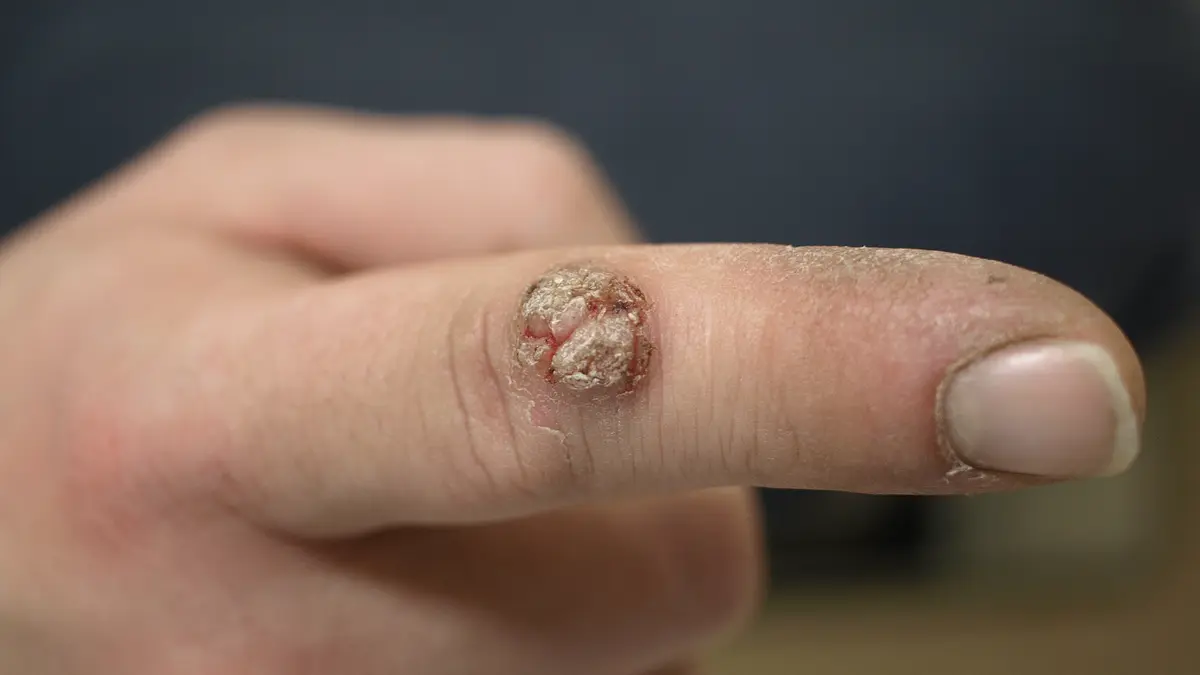

Bottom line: There is no good clinical evidence that an essential oil removes ordinary skin warts or verrucas. Warts often disappear without treatment, while pharmacy treatments such as salicylic acid have a modest evidence base.
Do not put neat essential oil on a wart, burn it, cut it out or use a home mixture on the face or genitals. A changing, bleeding, unusually painful or uncertain growth needs proper assessment.
What a wart is
The NHS describes warts and verrucas as common small lumps caused by a virus. They most often affect the hands, fingers, knees or feet. A verruca is a wart on the sole, where pressure can make it painful.
Many warts clear by themselves, but this can take months or years. That natural history makes personal stories difficult to interpret. If a wart disappears after someone starts using an oil, the timing does not show that the oil caused the clearance.
Genital warts are a different clinical problem. The NHS advises sexual-health assessment rather than an essential oil or an over-the-counter wart product.
What does the essential-oil evidence show?
Tea tree, oregano, thuja and other oils are sometimes promoted for warts. I found no convincing randomised human trial showing that a named essential oil reliably clears common warts or verrucas. Laboratory antiviral activity, a case report or a traditional-use claim cannot establish a safe treatment for a person.
The Cochrane review of topical treatments for non-genital skin warts included 85 trials involving 8,815 participants. It found a definite but modest benefit for salicylic acid. It did not establish essential oils as an effective treatment, and many of the included studies had design limitations.
The review found that cryotherapy was more painful and was not consistently better than salicylic acid. More aggressive freezing may improve clearance while increasing pain, blistering and scarring. Those findings concern clinical wart treatments, not a reason to improvise a stronger oil application.
Evidence about tea tree oil’s identity and safety should also be kept separate from evidence about a particular wart outcome. An oil can have antimicrobial or irritating properties in a laboratory without removing a wart in real skin.
What usually makes sense instead?
If a wart is not troublesome, waiting is reasonable. If it is painful, keeps returning or is embarrassing, a pharmacist can discuss a licensed treatment. NHS advice notes that pharmacy creams, plasters and sprays may take up to three months and can irritate the skin.
Salicylic-acid products must be used exactly as their label says. Do not apply them to the face, and ask a pharmacist or clinician before treating a child, a person with reduced sensation, poor circulation, diabetes or a weakened immune system.
A GP may offer freezing or refer a persistent, large or painful lesion to a dermatologist or podiatrist. The correct diagnosis matters because not every rough or dark growth is a wart.
Why applying an essential oil can backfire
Essential oils are concentrated mixtures. NCCIH says evidence for tea tree oil in skin conditions remains limited and warns against swallowing it. Neat application can cause irritation or allergic contact dermatitis, and an inflamed patch can make the original lesion harder to recognise. Some oils also cause photosensitivity or chemical burns.
Do not seal an oil under a plaster, apply it to broken skin or combine several oils with acids, alkalis or freezing products. Swallowing oil is unsafe and cannot treat a skin infection from inside the body. The general precautions in HealthWatchlist’s essential-oil safety guide apply here.
When to seek assessment
The NHS advises seeing a GP if you are worried about a growth, if it keeps coming back, or if it is large, painful, bleeding or changing. Assessment is also important for a wart on the face or genitals.
Do not keep treating a lesion at home because an oil seller calls it a wart. A diagnosis is particularly important if you have many lesions, take immune-suppressing medicine or have a condition that affects healing.
My verdict
Essential oils score 1/10 for the precise claim that they treat ordinary warts or verrucas. The score reflects the absence of convincing clinical evidence, not proof that every oil has no biological activity.
For a bothersome wart, use a recognised pharmacy or clinical option and allow time for it to work. Treat an essential oil as a fragrance product, not as a wart medicine.
References
- NHS: Warts and verrucas
- NHS: Genital warts
- Cochrane: Topical treatments for skin warts
- American Academy of Dermatology: Warts: diagnosis and treatment
- NHS: Contact dermatitis
- NCCIH: Tea tree oil
- Kairey and colleagues: Tea tree oil systematic review
- Posadzki and colleagues: Adverse effects of aromatherapy
- de Groot and Schmidt: Essential oils and contact allergy
- HealthWatchlist: Tea tree essential oil profile
- HealthWatchlist: Essential-oil safety guide