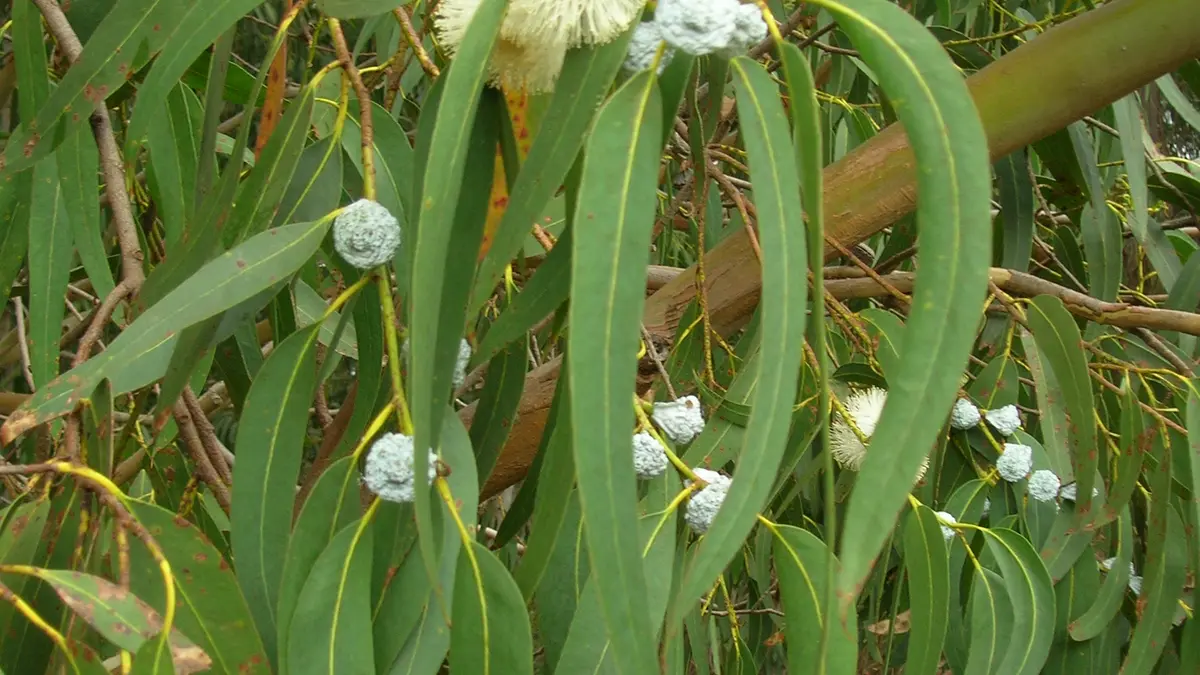

Short answer: eucalyptus essential oil is not one uniform oil. Products may come from Eucalyptus globulus, E. radiata, E. polybractea or other species, and are often rich in 1,8-cineole. The vapour can feel cooling or make breathing feel different, but that is not proof that it opens blocked airways or treats an infection.
Which eucalyptus?
“Eucalyptus oil” is a commercial category as well as a common name. The European Medicines Agency’s herbal-oil material covers oils obtained from selected cineole-rich species, including Eucalyptus globulus, E. polybractea and E. smithii. Eucalyptus radiata is also widely sold in aromatherapy.
Lemon eucalyptus is a separate source. Products bearing that name commonly come from Corymbia citriodora and have a citronellal-rich, lemony profile rather than the cineole-dominant smell of many medicinal-style eucalyptus oils. The botanical name is essential if the intended use or safety assessment depends on composition.
Extraction and chemistry
The volatile oil is steam-distilled from leaves and sometimes terminal branches. It may be rectified to increase the proportion of 1,8-cineole, also called eucalyptol. A recent review describes the wide chemistry and research literature around eucalyptus oils, but a review of the genus should not be read as evidence that every species or retail bottle behaves identically.
Storage matters. Light, oxygen and heat can change an oil after bottling. A credible supplier identifies the species, plant part and batch and provides an analysis rather than promising that all eucalyptus oil is “therapeutic grade”.
Congestion and cough claims
Eucalyptus has a long history in inhaled and topical cold products. The EU herbal monograph recognises specified traditional uses for certain preparations. “Traditional use” means long-standing use judged plausible under stated conditions; it is not the same as strong clinical proof that diffusing an arbitrary bottle treats a cold.
The sensation of cool or aromatic airflow can alter how open the nose feels without measurably reducing obstruction. That distinction is familiar from menthol research and matters for eucalyptus too. A scent may make a person feel that breathing is easier while the cause, whether mucus, inflammation, asthma or infection, remains.
Human studies of oral cineole medicines, combination products or chest rubs should not be transferred automatically to neat essential oil or a household diffuser. Dose, route, formulation and regulation differ.
Antimicrobial and air-cleaning claims
Laboratory experiments have reported antimicrobial effects from eucalyptus oils. They identify possible activity at defined concentrations and contact times. They do not show that a diffuser disinfects a room, prevents respiratory infection or reaches a germ-killing airway concentration safely.
A diffuser also releases volatile compounds and particles into occupied air. Ventilation, cleaning and established infection-control measures are more reliable than trying to medicate a room with fragrance.
Safety
Concentrated eucalyptus oil can be poisonous if swallowed. US Poison Control describes serious effects after eucalyptus-oil ingestion, including drowsiness, seizures and breathing problems. Keep bottles and filled diffuser reservoirs locked away from children. After ingestion, contact a poisons service promptly rather than inducing vomiting or waiting for symptoms.
Do not put undiluted oil in the mouth, nostrils or ears. Avoid the eyes and damaged skin. Inhalation can trigger coughing, wheeze, headache or irritation, particularly in someone with asthma or fragrance sensitivity. Stop and move to fresh air if symptoms appear. Extra caution is appropriate around babies, young children and animals.
Buying checks
- Full botanical name, not just “eucalyptus”.
- Leaf as the plant part and steam distillation or rectification stated.
- A batch-specific report showing the major constituents.
- Child-resistant storage and clear warnings against swallowing.
- No claim that aroma proves decongestion or that diffusion disinfects occupied air.
My assessment
Eucalyptus oil is a well-characterised aromatic material with recognised traditional uses in defined products. That does not make every home recipe effective or safe. I would use it only for brief fragrance use or in a finished, correctly labelled product, never swallow it, and treat breathing difficulty as a medical symptom rather than a cue to add more oil.
What would stronger evidence look like?
A respiratory trial must distinguish a change in perceived airflow from an objective change in obstruction, symptoms or recovery. It should identify the eucalyptus species, cineole content, route and dose and compare the complete preparation with a credible control. For an air-disinfection claim, researchers would need realistic occupied-room conditions, target organisms, ventilation, safe human exposure and meaningful infection outcomes. A petri-dish inhibition zone cannot answer either question.