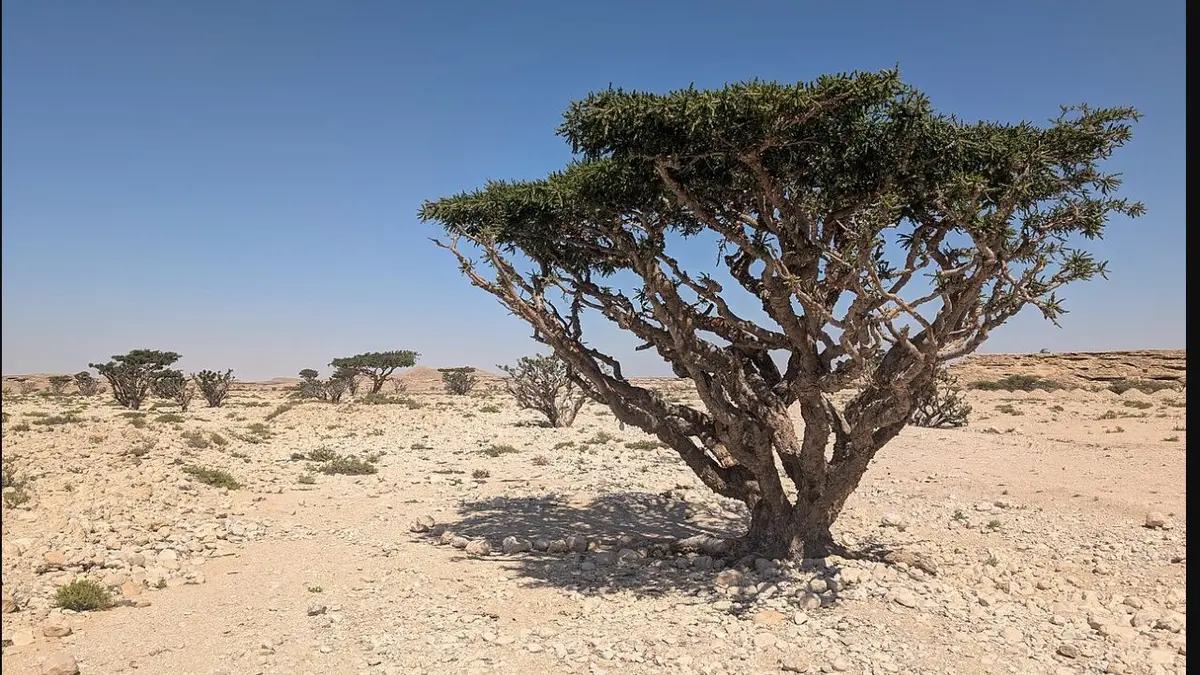

Short answer: frankincense essential oil is distilled from resin collected from a Boswellia species. It is mainly a fragrance material. Research on swallowed Boswellia serrata extracts does not prove that inhaling or applying the distilled oil treats inflammation, arthritis or cancer.
Frankincense is not one product
Frankincense, also called olibanum, is aromatic resin from trees in the genus Boswellia. Commercial products may come from Boswellia sacra, B. carterii, B. serrata, B. papyrifera or another species. The species, place of origin and processing affect the chemistry.
The resin can be burned as incense, ground, extracted with a solvent, made into an oral supplement or distilled to obtain essential oil. These preparations are not interchangeable. The US National Center for Complementary and Integrative Health describes boswellia supplements as extracts from gum resin or bark, not as equivalent to an aromatherapy oil.
Extraction and composition
Frankincense essential oil is usually produced by steam or hydrodistillation of the resin. The volatile oil commonly contains monoterpenes such as alpha-pinene, but the profile varies substantially by species and batch.
Boswellic acids are frequently used to market frankincense for inflammation. They are much less volatile than aroma compounds and are associated with resin extracts rather than being defining constituents of an ordinary distilled oil. A trial of a standardised oral extract therefore does not establish the effect of a diffuser or skin application.
Arthritis and inflammation claims
Clinical research on Boswellia serrata extracts has reported possible benefits for osteoarthritis. A 2020 systematic review and meta-analysis concluded that boswellia and its extracts may improve pain and function, while also calling for larger studies and consistent products.
That evidence concerns prepared oral extracts with specified boswellic-acid content. It cannot be used as proof that frankincense essential oil relieves joint pain when inhaled or rubbed on the skin. Massage itself can change short-term comfort, which further complicates an uncontrolled personal report.
Cancer claims
Frankincense is promoted online as a cancer treatment, often on the basis of cell experiments. A review of frankincense compounds covers laboratory work on inflammation, infection and cancer biology, but it also spans different species, extracts and isolated compounds.
Killing cultured cells at a particular concentration is not evidence that a person can reach that concentration safely or that a tumour will respond. The distilled oil should not replace surgery, radiotherapy, chemotherapy, immunotherapy or other evidence-based care.
Antimicrobial research
A 2023 laboratory study found antioxidant and antimicrobial activity in a tested Boswellia essential oil against food-related organisms. This supports chemical and formulation research. It does not show that diffusing frankincense disinfects a room, prevents infection or treats illness in humans.
Safety
Frankincense oil can irritate skin or cause allergy, and composition varies between species and suppliers. Avoid neat application, eyes, broken skin and ingestion. Use brief, ventilated diffusion and stop after respiratory irritation, headache or nausea. Anyone pregnant, caring for a young child or managing asthma, allergy or medicines should not infer safety from the long history of incense use.
Resin smoke is another route again. Burning incense produces combustion particles and is not equivalent to using a passive scent strip or a carefully operated diffuser.
Traceability and sustainability
Frankincense resin supports livelihoods in dry regions, but tree populations and harvest conditions differ. Kew describes the need to understand production and support sustainable harvesting. A supplier should name the species and origin and explain how resin is harvested, rather than relying on a generic “wild” claim.
Buying checks
- The Boswellia species is named.
- The product says essential oil, resin extract, incense or carrier-oil blend.
- Origin, batch number and distillation method are available.
- Sustainability information is specific enough to check.
- The label does not transfer boswellic-acid supplement research to the distilled oil.
- No cancer-treatment or disease-cure claim is made.
My assessment
Frankincense oil has a clear fragrance role and an interesting chemical research base. Most persuasive human evidence attached to the word “boswellia” concerns oral extracts, not essential oil. The central reading skill is therefore to identify the species and preparation before judging any health claim.