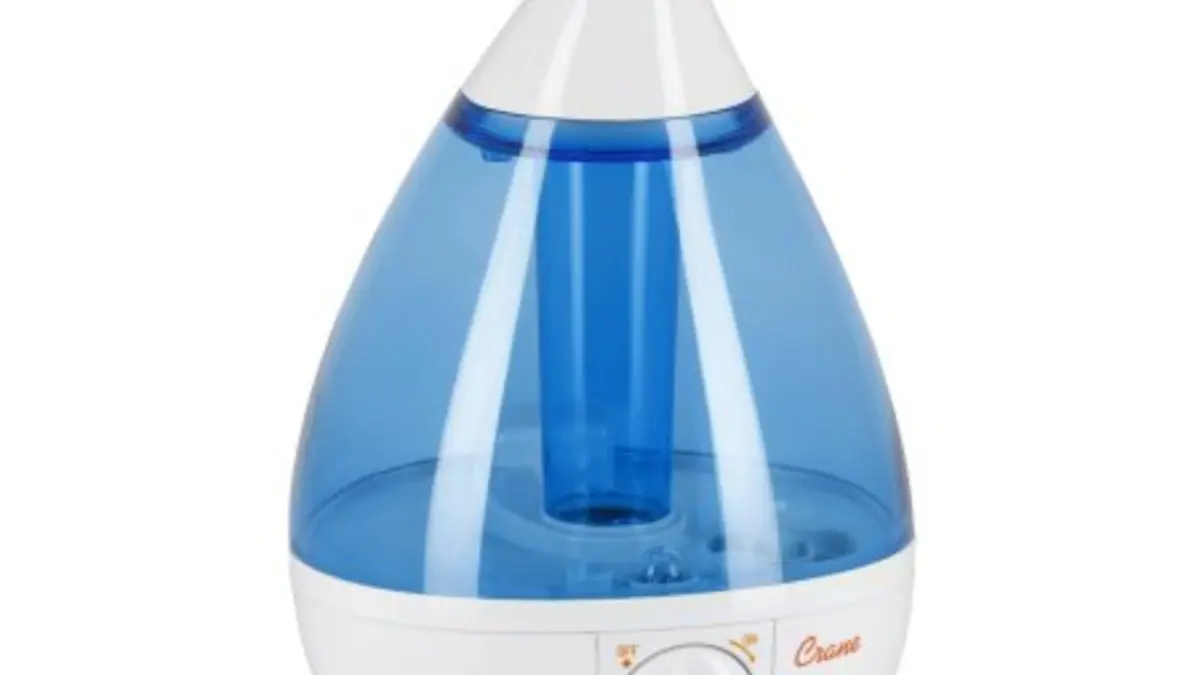

An essential-oil diffuser increases the movement of volatile fragrance compounds from a liquid into room air. The four common designs do that in different ways, which changes the strength of the aroma, the amount of oil used and what else is emitted.
Ultrasonic diffusers
An ultrasonic diffuser has a small vibrating disc beneath a reservoir of water. The rapid vibration produces tiny droplets that leave as a visible mist, carrying diluted oil with them. The white plume is an aerosol, not smoke.
Because the tank holds standing water and oil residue, it needs emptying and cleaning as the manufacturer directs. A larger tank usually means a longer run time, not a medically useful dose or effective room humidification.
Nebulising diffusers
A nebulising diffuser moves air across undiluted oil and breaks it into very small droplets. It needs no water and tends to create a stronger scent quickly. That also means faster oil use and less margin if somebody in the room finds the aroma irritating.
Passive diffusers
Reeds, porous ceramic, wood and fabric work by evaporation. Oil travels across a larger exposed surface and volatile compounds move into the surrounding air. There is no fan or mist, so the output is quiet but difficult to switch off without removing or covering the scented material.
Heat and fan diffusers
A fan moves air across an absorbent pad or tray. A heat diffuser raises the evaporation rate. Neither method needs to create a visible mist. High or poorly controlled heat can change the scent, and products that use a candle introduce an ordinary flame and burn risk.
What goes into the air?
Essential oils are mixtures of volatile organic compounds. Researchers measuring an ultrasonic diffuser in a chamber detected both volatile compounds and particulate matter. Indoor measurements during essential-oil diffusion also found increased concentrations of several fragrance compounds.
Those findings explain how scent spreads; they do not show that every use is harmful. They do show why “purifying the air” is the wrong description. A diffuser adds substances to the air. It does not filter particles, remove gases or replace ventilation.
Is a diffuser a humidifier?
An ultrasonic diffuser releases some water droplets, but its small reservoir and low output are intended to carry scent. A room humidifier is designed and rated to add moisture. Putting oil into a humidifier that is not designed for it can damage the machine and spread material in a way the manufacturer did not intend.
What happens to the aroma?
The lightest, most volatile compounds tend to reach the nose quickly. As the mixture evaporates, its balance can change. Room size, temperature, air movement, the amount of oil and the diffuser design all affect how strong it seems. A drop count is therefore not a reliable measure of what a person inhales.
Practical use
- Start with less oil and a shorter period than the maximum setting.
- Ventilate the room and do not aim the output at somebody’s face.
- Stop if the scent causes coughing, wheezing, headache, nausea or eye irritation.
- Keep oils and filled reservoirs away from children and animals.
- Clean water-based machines regularly and do not leave old liquid in the tank.
A diffuser can be a pleasant way to scent a room. Its mechanism does not turn an oil into a proven treatment, disinfectant or air cleaner.
Droplets, vapour and visible mist
The white plume from an ultrasonic device is an aerosol of small water droplets containing some oil. Volatile molecules also evaporate from those droplets and surfaces. A nebuliser produces an oil aerosol without a water tank. Passive products mainly rely on evaporation. These differences affect residue, output and where material deposits.
A visible plume is not a measure of therapeutic dose, and no plume does not mean no exposure. Room concentration depends on emission rate, air exchange, temperature and time. Domestic products rarely measure the amount an individual actually inhales.
What chamber studies add
Researchers have measured diffuser emissions while studying indoor exposure and cognitive performance. A later chamber study characterised emissions from diffused tea-tree oil. Controlled chambers help identify compounds and particle behaviour, but do not reproduce every occupied home.
The studies are useful for one basic conclusion: diffusion is an emission process. Whether an exposure is tolerable depends on product, amount, ventilation and the person or animal present. An oil’s laboratory antimicrobial activity does not prove that a safe airborne concentration will disinfect a real room.
Why the tank needs attention
Water left in a warm reservoir can collect residue and support microbial growth. Empty and dry the tank after use and clean it as the manufacturer directs. EPA guidance for water-based humidifiers explains the broader problem of stagnant water and mineral dispersal; although a diffuser is smaller, neglecting its reservoir is still unwise.
Do not run vinegar, bleach or another cleaner through the mist mechanism unless the instructions explicitly direct it. A chemical suitable for wiping an unplugged tank is not necessarily suitable for aerosolising.
Device claims versus oil claims
A timer, output control and automatic shut-off are device features. Relaxation or sleep is an oil-and-outcome claim. Air purification is an environmental-performance claim. Keeping them separate prevents a well-designed machine from being mistaken for proof that its contents have medical effects.
Likewise, coloured lights and a quiet motor may make a bedtime routine more pleasant without proving that the mist changes sleep physiology. A useful review can value those practical features honestly.
Who may need extra caution?
People with asthma, fragrance-triggered migraine or chemical sensitivity may react at amounts others tolerate. Babies, young children and animals have different exposure and poisoning risks. Do not diffuse in a closed room around someone who cannot choose to leave, and never put oil directly into an oxygen or respiratory device.
If coughing, wheezing, chest tightness, marked dizziness or breathing difficulty occurs, stop the device, move to fresh air and seek appropriate help. Adding another oil is not a way to reverse a reaction.