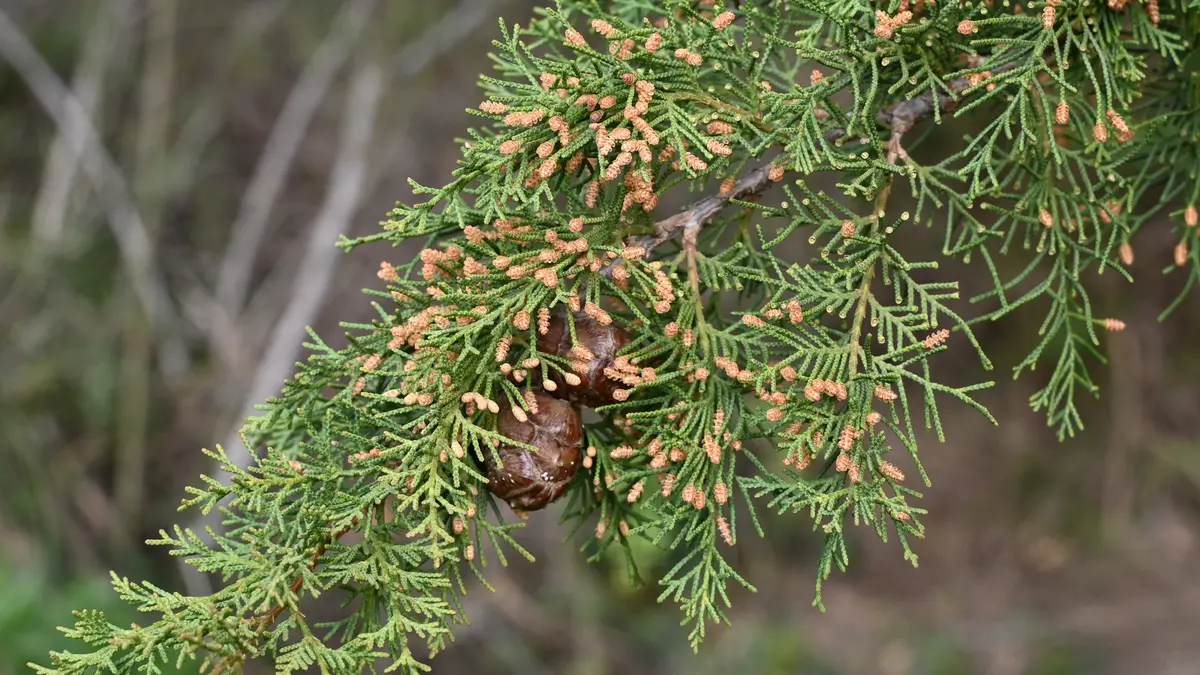

Short answer: cypress essential oil is commonly steam-distilled from the leaves and twigs of Mediterranean cypress, Cupressus sempervirens. Its chemistry and laboratory activity are reasonably described, but good human evidence for treating cough, poor circulation, varicose veins, anxiety or infection is lacking.
Identity and extraction
“Cypress” is used for several trees and commercially named oils. A useful bottle identifies Cupressus sempervirens, the plant part, extraction method and origin. Kew’s Plants of the World Online provides the botanical record for Mediterranean cypress.
The essential oil is usually distilled from leafy branches, cones or a defined mixture of aerial parts. Those materials are not necessarily chemically equivalent. A cypress hydrosol, cone extract, wood product and fragrance oil also answer different safety and evidence questions.
What is in cypress oil?
Monoterpenes such as alpha-pinene, delta-3-carene and limonene often feature in reported analyses, but proportions vary. A study of C. sempervirens oils documented composition alongside laboratory antimicrobial testing. Origin, season, plant organ and distillation can all affect the result.
A batch chromatogram is therefore useful for identity and formulation. It is not a certificate of clinical benefit, and the presence of a familiar constituent does not prove that the whole oil has the same effect as that isolated chemical.
Laboratory findings
Laboratory research has examined antioxidant and antimicrobial activity of cypress material. More recent preliminary work has explored biological effects under experimental conditions. Other studies have assessed activity against selected viruses or microorganisms.
These findings do not establish that diffused cypress oil prevents infection, that topical oil treats a fungal condition or that inhalation treats a respiratory illness. Test systems can use direct contact and concentrations that are unsuitable for normal human exposure. They are a reason to conduct better research, not a clinical recommendation.
Circulation, veins and fluid retention
Cypress oil is frequently promoted for circulation, varicose veins, cellulite and lymphatic drainage. HealthWatchlist did not find robust controlled human trials showing that the oil changes venous disease, oedema or lymphatic function. Massage may temporarily change comfort or the appearance of skin, but that does not show that the oil repairs veins.
New one-sided leg swelling, warmth, redness, chest pain or breathlessness can require urgent assessment. An aromatherapy mixture must not delay investigation of a blood clot or other serious cause.
Varicose veins are not simply a cosmetic surface problem, and oedema has many possible causes. A before-and-after photograph after massage cannot separate the effects of position, pressure, lighting and time. Claims about “moving toxins” do not provide a measurable vascular outcome.
Stress and respiratory claims
A woody aroma may be pleasant, and a familiar scent can support a relaxation routine. That subjective effect is not proof that cypress oil treats anxiety, insomnia or stress-related disease. Likewise, an odour that feels “clearing” does not show that airflow, oxygen levels or infection have improved.
Safety
Essential oils can irritate skin and trigger allergic contact dermatitis. A clinical review describes this problem across essential oils and fragrance constituents. Oxidised terpenes may be more sensitising, so careful storage matters.
- Do not swallow cypress oil or add it to food, drinks or capsules.
- Do not apply it neat or use it on broken or inflamed skin.
- Prefer a finished cosmetic over an improvised skin blend.
- Diffuse briefly at low intensity with ventilation.
- Stop after irritation, rash, headache, nausea, coughing or wheeze.
- Keep the bottle away from children and pets.
People who are pregnant, breastfeeding, treating a child, using several medicines or living with asthma or fragrance allergy should obtain advice about the exact product and route.
Store terpene-rich oils tightly closed and away from heat and direct light. Do not keep using a bottle that smells markedly different merely because it remains within a printed date. Storage after opening affects the material that reaches the skin.
Buying checklist
- Cupressus sempervirens is stated in full.
- The leaf, twig or cone material is identified.
- The origin, batch number and current analysis are available.
- The supplier gives realistic storage and exposure directions.
- Laboratory findings are not presented as proof of antiviral, antifungal or circulation treatment.
My assessment
Cypress oil has a recognisable fragrance and a useful body of chemical and laboratory research. Human treatment evidence is sparse. It is reasonable to judge it as an aromatic ingredient, while rejecting claims that it treats vascular, respiratory or infectious disease without controlled clinical evidence.
Cypress and urinary tract infection
The essential oil and methanol extract performed differently; the biofilm work included an intravenous-tube model, not patient UTI treatment. See the detailed UTI evidence comparison for the research, limitations and appropriate care.
Cypress and tinnitus
Cypress research on chemically induced external-ear swelling in rats does not establish treatment of tinnitus, hearing loss or inner-ear circulation. See the detailed evidence comparison for the studies, limitations and care context.
References
- Kew Plants of the World Online search for Cupressus sempervirens
- Composition and laboratory antimicrobial activity of cypress oils
- Experimental study of cypress composition and biological activity
- Recent preliminary biological research on cypress
- Review of Cupressus sempervirens preparations and health research
- Further experimental study of C. sempervirens
- Clinical review of allergic contact dermatitis from essential oils
Editorial responsibility and correction note
Editor: John Hamlen. This article has not been independently reviewed by a clinician.
Reference correction, 12 September 2026: Changes in this check: Correct bibliographic description against source record. This was a targeted correction, not a comprehensive new review of every claim in this article.
Read our editorial policy, evidence method and corrections policy, including how to report an error.