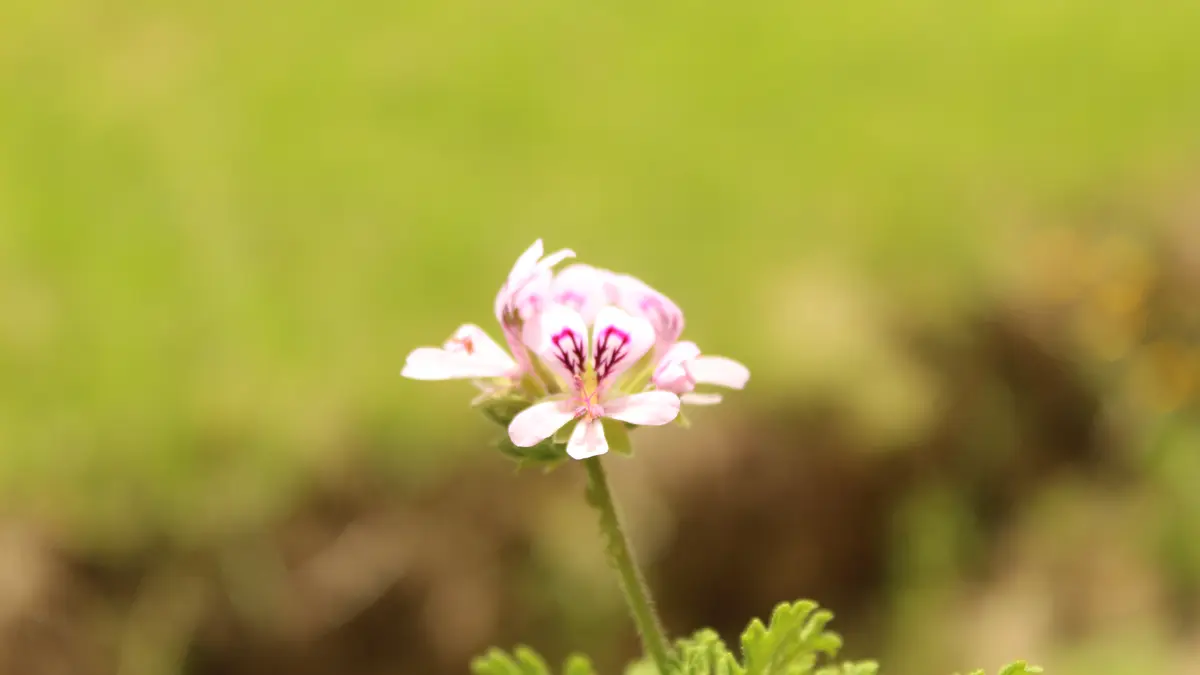

Short answer: geranium essential oil usually means an oil distilled from a scented Pelargonium, commonly Pelargonium graveolens or a cultivated hybrid. A few small inhalation studies report short-term changes in anxiety, fatigue or sleep measures, but they do not establish treatment for an anxiety disorder, insomnia, pain or hormonal problems.
Geranium is a trade name, not a complete identity
Commercial “rose geranium” and “geranium” oils can come from different Pelargonium taxa and cultivars. Kew’s Plants of the World Online provides the record for Pelargonium graveolens, but a supplier should still state the exact botanical name used for its product.
The oil is normally steam-distilled from leaves and flowering aerial parts. It is not the same as a garden geranium, a hydrosol, a plant extract or a synthetic rose fragrance. Evidence should match the material being sold.
Chemistry varies
Citronellol, geraniol, linalool and related compounds commonly contribute to the scent. A chemical study of geranium oil illustrates how the volatile profile can be characterised. Cultivar, origin, harvest and distillation can alter the proportions.
A current batch analysis helps establish composition and detect gross substitution. It does not show that an oil is clinically effective, and “therapeutic grade” is not a substitute for botanical and chemical information.
What do human studies suggest?
A small randomised study reported lower anxiety scores after geranium-oil inhalation during labour. The setting, brief exposure and subjective outcome matter. Participants can usually smell whether they received an aromatic intervention, so expectation and attention may influence results.
A controlled study in nurses examined inhaled geranium oil for fatigue and sleep-related outcomes. Its results are relevant but do not establish a treatment for chronic insomnia or an underlying sleep disorder. Another study considered pain and anxiety around lumbar spinal stenosis care, again in a specific context rather than as proof of a broad analgesic effect.
These studies support cautious interest in short-term aroma effects. They do not justify claims that geranium oil balances hormones, treats depression, controls blood pressure or replaces evidence-based pain care.
“Hormone balance” is not a single clinical outcome. A credible claim would need to name the hormone, population, preparation, dose, measurement and meaningful health effect. The inhalation studies above did not establish that kind of endocrine action.
Laboratory research
A review describes antimicrobial, anti-inflammatory and other experimental research on rose geranium. Much of that work uses cells, microorganisms, animals or isolated constituents. It cannot show that a diffuser disinfects a room or that a homemade skin blend treats infection.
Safety and allergy
Geraniol, citronellol and oxidation products can contribute to fragrance allergy. A clinical review documents allergic contact dermatitis associated with essential oils. An EFSA assessment of geranium oil also discusses composition and chemical safety in a defined use context; that assessment is not a recommendation to swallow aromatherapy oil.
- Do not swallow geranium oil or add it to food, drinks or capsules.
- Do not apply it neat or to damaged, eczematous skin.
- Prefer a finished cosmetic with a complete ingredient list.
- Diffuse briefly, with fresh air, and stop after headache, nausea, coughing or wheeze.
- Keep the bottle away from children and pets.
- Seek individual advice during pregnancy, breastfeeding or significant medicine use.
Buying checklist
- The full Pelargonium name, plant part and origin are stated.
- A batch-specific chromatogram is available.
- The supplier distinguishes the oil from hydrosol and fragrance oil.
- Small inhalation studies are described as preliminary, not as proof of treatment.
- No promise is made to “balance hormones” without a defined outcome and clinical evidence.
When reading a study, check whether the tested oil was chemically characterised and whether the control had a noticeable scent. Also check the number of participants, how long follow-up lasted and whether the measured change was large enough to matter. A statistically significant questionnaire difference may still be uncertain or modest in practice.
My assessment
Geranium oil has some human aroma research, which places it ahead of oils supported only by laboratory tests. The studies remain small, short and context-specific. The fairest conclusion is that inhalation may affect short-term subjective experience for some people, while disease-treatment and hormone claims remain unsupported.
Geranium oil and snoring
Small human studies report mixed questionnaire-based sleep results. Neither measured snoring, oxygen or breathing interruptions, so they do not establish a snoring treatment.
Read the geranium comparison in our snoring guide for both positive and negative findings.
Targeted evidence update: 14 September 2026. This section does not represent a new review of every claim on this profile.
References: Karimi N et al. Explore. 2024;20:82–88; Babaii A et al. Hayat. 2025.
Geranium and plantar heel pain
Geranium has been studied in other pain settings, but postoperative aroma findings and a shingles nerve-pain report do not establish treatment of plantar fasciitis. See the detailed plantar-fasciitis comparison for the studies, limitations and care context.
Geranium and sinus symptoms
Positive Pelargonium sidoides studies tested an oral root extract, not fragrant geranium essential oil; these products should not be treated as equivalent. See the detailed sinusitis comparison for the preparations, findings and limitations.
Geranium and eczema
Geranium has animal anti-inflammatory and human-cell research, plus a preliminary flower-oil report. These do not establish eczema relief in people or validate other plants sharing the common name. See the detailed eczema evidence comparison for the studies, limitations and care context.
Geranium and psoriasis
Geranium evidence concerns mouse inflammation and cultured fibroblasts, not established psoriasis control in people. The cell type, preparation and clinical outcomes matter. See the detailed evidence comparison for the primary studies, limitations and care context.
Geranium and rashes
Geranium experiments concern acute mouse inflammation and cultured cells. They do not establish treatment for allergic, infectious or otherwise unexplained human rashes. See the detailed evidence comparison for the primary studies, limitations and care context.
Geranium and oily skin
A six-person, two-hour study found a short-term surface-oil signal for a geranium tonic. It does not establish lasting oil control or superiority to standard skin care. See the detailed evidence comparison for the primary studies, limitations and care context.
Geranium and wrinkles
A positive small trial tested Geranium thunbergii extract, not Pelargonium geranium oil. Geranium essential-oil cream research located here was laboratory and animal work. See the detailed evidence comparison for the primary studies, limitations and care context.
References
- Kew Plants of the World Online search for Pelargonium graveolens
- Chemical characterisation of geranium essential oil
- Randomised study of geranium-oil inhalation during labour
- Controlled study of geranium aroma, fatigue and sleep outcomes in nurses
- Study of pain and anxiety in a lumbar-stenosis care setting
- Review of rose-geranium chemistry and experimental research
- EFSA safety assessment of geranium oil in a defined use context
- Clinical review of allergic contact dermatitis from essential oils