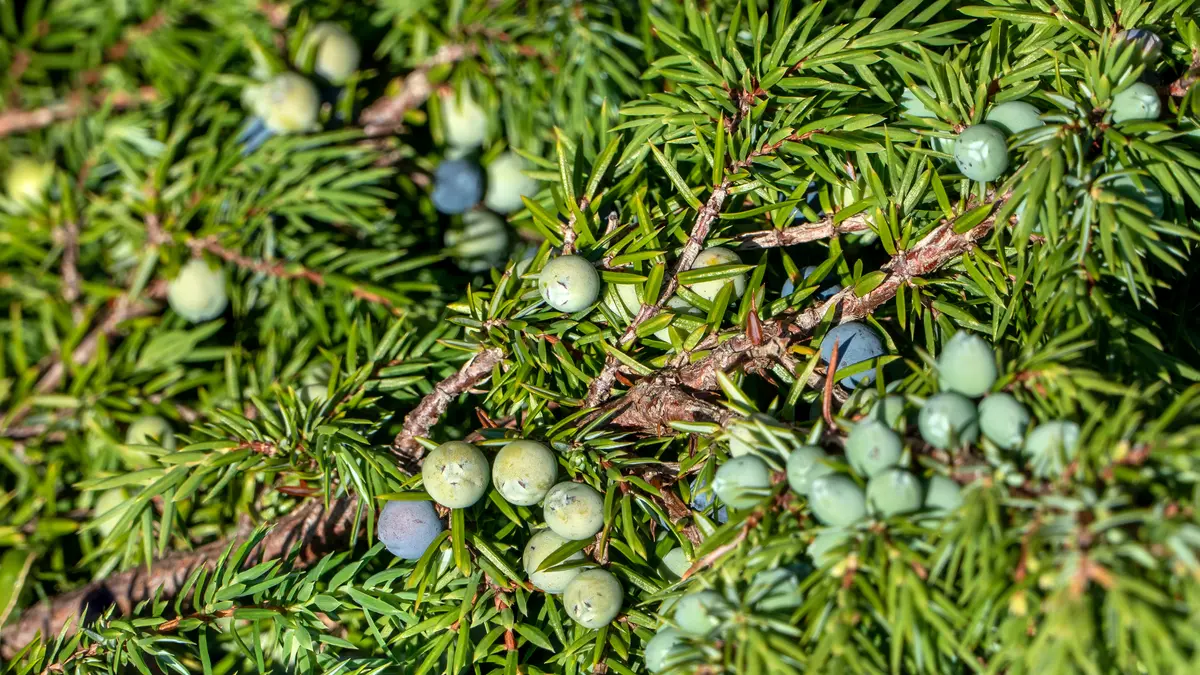

Short answer: juniper berry essential oil is normally distilled from the ripe berry-like cones of Juniperus communis. Traditional medicinal use and laboratory research exist, but human clinical evidence is limited. The oil is not the same as eating culinary juniper berries or drinking gin, and it should not be swallowed as a home “detox” or urinary remedy.
What is juniper berry oil?
Junipers produce fleshy cones commonly called berries. A label should name Juniperus communis, identify the cones as the plant part and state steam distillation. Needle, branch and wood oils can have different compositions. Kew’s Plants of the World Online provides the botanical record for common juniper.
Food flavouring is a different exposure from a concentrated essential-oil bottle. Evidence about gin, dried berries, tea or an extract cannot set a safe or effective dose for the oil.
Chemical composition
Alpha-pinene, sabinene, myrcene, limonene and other terpenes often appear in analyses, with large differences between samples. Research has documented geographic and compositional variation in juniper berry oils. Other analytical work has compared volatile profiles and experimental activity.
Species, location, ripeness, storage and the distilled plant part all matter. A current chromatogram and a traceable source are therefore more useful than a generic claim that the oil is “pure”.
Traditional urinary use
The European Medicines Agency has published a herbal summary for juniper oil based on traditional use in minor urinary complaints. Traditional-use recognition means that a product has a long history under defined conditions; it is not the same as high-quality clinical proof of effectiveness.
Urinary burning, blood in urine, fever, flank pain, pregnancy, recurrent symptoms or symptoms in a man or child need medical assessment. Essential oil should not delay diagnosis of infection, a kidney stone or another condition. Drinking extra water is not always appropriate for every heart or kidney condition, so even apparently simple advice may need personalisation.
What does experimental research show?
A laboratory study tested juniper-berry oil composition and antioxidant activity, including effects in yeast. Another experiment compared oils from different Spanish sources and tested their biological activity. Neither was a clinical review. Antimicrobial or antioxidant activity in these systems does not establish treatment of infection or inflammation in people.
HealthWatchlist did not find a robust body of controlled human trials showing that juniper berry essential oil treats urinary infection, oedema, arthritis, digestive disease or anxiety.
The word “detox” is especially unhelpful because it does not identify a substance, measurement or clinical endpoint. The liver and kidneys already process and remove many compounds. Increasing urine volume is not evidence that an essential oil removes unspecified toxins or improves organ function.
Safety
Traditional warnings around kidney disease and pregnancy are one reason not to improvise internal use. An EFSA assessment discusses juniper oil’s composition and safety for a specific animal-feed use; it should not be read as approval for human oral self-treatment.
Terpene-rich oils can also irritate or sensitise skin, particularly after oxidation. Keep the cap closed, follow storage directions and replace oil that has changed markedly.
- Do not swallow juniper berry oil or add it to water, food or capsules.
- Do not use it as a substitute for assessment of urinary symptoms.
- Avoid neat or large-area skin application.
- Do not use during pregnancy or with kidney disease without appropriate clinical advice.
- Diffuse briefly with ventilation and stop after irritation or breathing symptoms.
- Keep the bottle away from children and pets.
If urinary symptoms are being assessed, tell the clinician about any oils, supplements and over-the-counter products already used. Masking discomfort for a few hours does not show that the underlying cause has resolved.
Buying checklist
- Juniperus communis appears on the label.
- The plant part is berry-like cones, not an unspecified “juniper”.
- The origin, batch number and analysis are available.
- The supplier distinguishes culinary use, traditional products and essential oil.
- No detoxification, kidney-cleansing or infection-cure claim is made.
My assessment
Juniper berry oil has a clear botanical identity, a long flavour and fragrance history and some formally documented traditional use. Controlled human evidence is still limited, and internal self-treatment introduces avoidable uncertainty. It is best judged as a traceable aromatic ingredient rather than a detoxification or urinary cure.
Juniper berry and urinary tract infection
EMA traditional use concerns increased urine flow, not proven infection clearance; kidney and pregnancy restrictions remain relevant. See the detailed UTI evidence comparison for the research, limitations and appropriate care.
Juniper berry and tinnitus
Juniper research concerns rodent brain or anxiety models, sometimes using a different species. It does not establish a human tinnitus treatment. See the detailed evidence comparison for the studies, limitations and care context.
Juniper berry and oily skin
The small tonic study found lower early readings followed by a rise at two hours. Durable facial oil control with juniper berry oil remains unestablished. See the detailed evidence comparison for the primary studies, limitations and care context.
References
- Kew Plants of the World Online search for Juniperus communis
- European Medicines Agency: Juniper oil herbal summary
- European Medicines Agency assessment addendum
- Composition and variation in juniper berry essential oils
- Analytical and experimental research on juniper oil
- Juniper-berry oil composition and antioxidant tests, including a yeast model
- Juniper oils from different Spanish sources: Composition and experimental bioactivity
- EFSA assessment discussing juniper oil composition and safety
Editorial responsibility and correction note
Editor: John Hamlen. This article has not been independently reviewed by a clinician.
Reference correction, 12 September 2026: Changes in this check: Correct two original experiments described as reviews; Correct bibliographic description against source record. This was a targeted correction, not a comprehensive new review of every claim in this article.
Read our editorial policy, evidence method and corrections policy, including how to report an error.