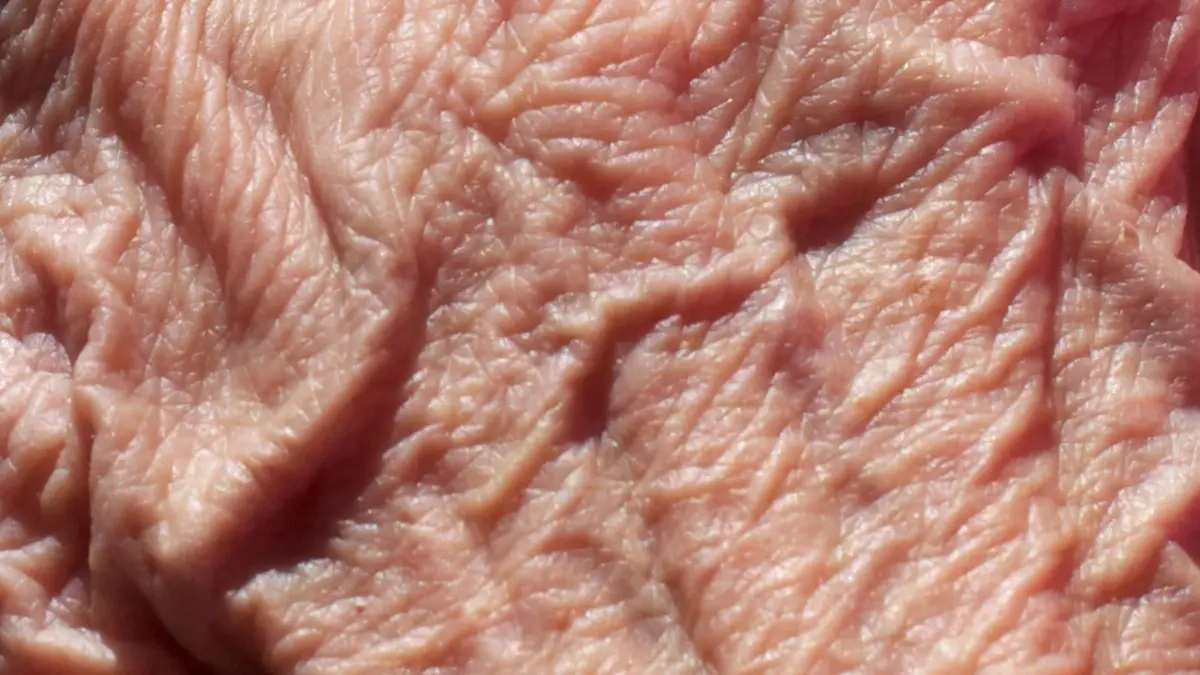

Bottom line: a moisturising plant oil can make dry skin look smoother for a while. Clinical treatment reviews do not establish an essential oil for reversing wrinkles or rebuilding lost collagen.
This guide separates temporary cosmetic effects from structural treatment claims. Essential oils can irritate skin and are not alternatives to sun protection.
What changes as skin ages
Wrinkles develop through intrinsic ageing and cumulative environmental exposure. Ultraviolet radiation, smoking and repeated facial movement influence the pattern.
The skin produces less collagen and changes how it organises elastin and moisture. A surface product may improve feel or hydration without reversing those deeper changes.
A British Journal of Dermatology review describes photoageing as a combination of wrinkles, texture change and uneven pigmentation. Prevention and treatment are different aims.
Why an oil can appear to work immediately
Fixed plant oils and moisturisers reduce water loss and smooth the outer skin surface. Light reflects differently from hydrated skin, so fine dry lines may look less obvious.
A review of topical plant oils found that composition affects barrier and inflammatory responses. Many studied materials were fixed oils, not volatile essential oils.
A short-lived softening effect is a valid cosmetic benefit. It should not be described as new collagen, permanent wrinkle removal or repair of sun-damaged DNA.
Rosehip oil is frequently included in essential-oil lists. It is normally a pressed seed oil. Evidence about rosehip cannot be transferred to rose, frankincense or lavender essential oil.
What the better-established evidence covers
A focused review of clinical evidence found that topical retinoids can improve clinical signs of photoageing. Irritation was common, and formulations and study quality varied.
A separate systematic review of topical tretinoin found evidence for fine and coarse wrinkles. Tretinoin is a medicine with specific risks and instructions, not an essential oil.
A dermatology review explains the biological rationale and clinical history of retinoids in skin ageing. This evidence illustrates the standard an anti-wrinkle claim should meet.
A 2025 network meta-analysis compared topical approaches for photoageing. It did not identify an essential oil as an established wrinkle treatment.
Trials also need adequate duration. Hydration can change within hours, while collagen remodelling takes longer. Mixing those time scales makes a weak product look more impressive.
Blinded assessment is difficult when a fragranced product reveals which treatment a participant received. Objective imaging can help, but it does not remove every source of bias.
What evidence exists for essential oils?
Laboratory studies report antioxidant, antimicrobial or anti-inflammatory activity for many volatile oils. These results depend on concentration and test conditions.
A test-tube antioxidant result cannot show that a cosmetic penetrates human skin, changes collagen or improves wrinkles without unacceptable irritation. Human comparative trials are required.
Frankincense, lavender, sandalwood and carrot seed oils are common online recommendations. Suitable trials using defined products and objective wrinkle measurements are absent or too weak to support the promises.
Commercial blends may include moisturising carriers, silicones, retinoids or humectants. An improvement after using the blend cannot be assigned to its essential-oil fragrance.
Sun protection has stronger evidence
A randomised Australian trial found less skin ageing with regular sunscreen use over four and a half years. This supports prevention rather than reversal.
NHS guidance combines sunscreen with clothing, shade and avoiding the strongest sun. Fragrant oils do not replace those measures.
Some expressed citrus oils are phototoxic. Applying one before ultraviolet exposure can cause inflammation, blistering and later pigmentation.
Fragrance allergy and irritation
A clinical review documents allergic contact dermatitis caused by essential oils. Facial skin and eyelids can be particularly troublesome sites.
Oxidised limonene and linalool are frequent fragrance allergens in patch-test populations. Oxidation increases after oils are exposed to air.
DermNet advises that dermatitis may appear where scented products touch the skin. Repeated exposure can maintain a reaction.
Do not apply neat essential oil near the eyes. Stop a new product if it causes burning, swelling, scaling or a persistent rash.
How to read an anti-wrinkle claim
- Look for human trials on the complete product, not only an ingredient mechanism.
- Check whether investigators measured hydration, appearance, wrinkle depth or collagen.
- Ask how long the effect lasted after the product stopped.
- Look for irritation rates and withdrawals, not only average improvement.
- Separate fixed oils from essential oils.
- Reject claims based only on testimonials or unstandardised photographs.
Realistic options
A bland moisturiser can help dryness and temporarily soften fine lines. Daily sun protection addresses a major preventable driver of photoageing.
For stronger treatment, a pharmacist, GP or dermatologist can discuss retinoids and procedures in the context of skin type, pregnancy, medicines, sensitivity and pigment-change risk.
Introduce one product at a time and allow enough time to judge it. This helps identify irritation and avoids crediting several changes to one ingredient.
Carrot seed and wrinkles: the small cosmetic studies in context
The broad conclusion above should be read alongside these small human formulation reports. They offer preliminary signals, but do not establish a dependable essential-oil treatment for wrinkles.
Carrot seed and wrinkles
There are small human cosmetic reports, so it would be inaccurate to say that carrot-seed preparations have never been tested on people. However, the products and study designs leave substantial uncertainty.
A formulation study published online in 2018 assessed carrot-seed-oil emulsions using stability, antioxidant, laboratory sun-protection and skin/biochemical measurements. Its indexed abstract does not describe a controlled human facial-wrinkle trial. It cannot establish lasting wrinkle reversal.
A small cream report included only 12 volunteers, divided among a base cream and three oil concentrations, for four weeks. Instrument readings favoured the highest concentration. With three people per group, no clearly described random allocation or blinding, and differences in starting measurements, the findings are highly preliminary. The report also has inconsistent descriptions of the oil/extract and concentration. A brief irritation check does not establish long-term allergy safety.
A separate 2022 nanoemulgel study measured six volunteers over four weeks and reported improved surface scores. Both compared formulations contained carrot seed oil, so it cannot separate the ingredient from the delivery system or moisturising base. Its estimated sun-protection value came from spectrophotometry, not a validated human sunscreen-performance trial.
The papers use inconsistent terminology for vegetable seed oil, extracts and essential oil. Without adequate characterisation, their findings cannot be transferred to a bottle of steam-distilled carrot seed oil. Cosmetic hydration or an instrument’s short-term wrinkle score is not proof of collagen rebuilding, equivalence to a retinoid or durable improvement after treatment stops. Continue established sun protection; do not use these preliminary laboratory SPF numbers to replace sunscreen.
Related: Carrot seed profile.
Care in context
NHS sun-safety guidance recommends shade, clothing and suitable sunscreen. Preliminary cosmetic or laboratory findings do not justify substituting carrot oil for those measures.
Search limitations: Targeted Europe PMC and web searches combined common and botanical plant names with the relevant skin condition, clinical trial, dermatitis, rash and wrinkle terms, with narrower follow-up searches and citation checks, completed 16 September 2026. This is an editorial review, not a systematic review or a complete unpublished-trial search. Indexed abstracts were used where full texts were unavailable; bibliographic-only allergy reports are identified in the text. Failure to locate a trial does not prove that none exists. Full texts were checked for the rosemary scalp trial, lavender cell and clinical pilot studies, sandalwood/turmeric radiotherapy trial and small carrot cream report. The carrot nanoemulgel author-posted report was checked. Other studies were appraised from indexed abstracts or explicitly limited bibliographic records. Product identity and inconsistent reporting limit several cosmetic studies.
Individual wrinkle claims: human studies and laboratory limits
These comparisons qualify the general overview with small positive human findings as well as experimental work. A study of an isolated molecule, another plant species or a complete moisturiser is not automatically evidence for bottled essential oil.
Clary sage and wrinkles
There is a relevant positive human result, but it is frequently attributed too broadly. A 2016 study of isolated sclareol combined cell and reconstructed-skin experiments with a 12-week cosmetic cream study. The abstract reports improved wrinkle measures compared with control. It identifies sclareol isolated from Salvia officinalis, not a trial of bottled Salvia sclarea essential oil.
Sclareol is a particular molecule. Its presence in a plant or oil does not make the whole oil equivalent to the tested cream: concentration, delivery and other ingredients matter. The indexed abstract was available, but the full clinical methods were not available for this review, so allocation, sample size and adverse-event reporting could not be fully appraised. This is a preliminary ingredient-specific finding, not a validated home formulation or evidence that clary sage oil reverses wrinkles. It also does not establish sun protection.
Related: Clary sage profile.
Geranium and wrinkles
A 2021 geranium and calendula formulation study investigated separate essential-oil-loaded vesicular creams. Antioxidant and enzyme assays, rat-skin penetration and irritation experiments supported further formulation research. They did not demonstrate wrinkle reduction in people. Laboratory SPF estimates also do not establish that a homemade cream is an effective sunscreen.
There is a small human trial under the name “geranium”, but it studied a different plant and preparation. A randomised, double-blind split-face study in 21 Japanese women reported improvements after eight weeks with Geranium thunbergii extract compared with placebo. Geranium thunbergii is not Pelargonium graveolens, the usual source of geranium essential oil. The favourable extract result therefore should not be presented as a trial of that oil. Together, these studies provide formulation and extract-specific leads, not convincing clinical evidence for bottled geranium oil on wrinkles.
Related: Geranium profile.
Lavender and wrinkles
A 90-day study involving 40 participants assessed mixed essential-oil preparations and skin-barrier measurements. The four-oil preparation included lavender, eucalyptus, tangerine and tea tree. Reported hydration and skin-morphology changes cannot be assigned to lavender alone, and they are not equivalent to a dependable, lasting wrinkle benefit.
Newer laboratory findings do not close that gap. A lavender-oil Pickering emulsion experiment studied UV injury in rats; a lavender-derived particle study used experimental models and a preparation distinct from volatile essential oil. These are research leads, not human sunscreen or anti-wrinkle trials of bottled lavender oil.
Safety also matters for a cosmetic used repeatedly. An Australian patch-test series documented lavender contact allergy among patients referred for testing. Such patients do not represent the general population, but the findings show why “natural” is not synonymous with non-allergenic. Stop a product that causes an itchy, red or persistent reaction.
Related: Lavender profile.
Myrrh and wrinkles
A myrrh essential-oil experiment examined protection of collected skin-surface lipids against UV-induced oxidation. This was an ex vivo antioxidant test, not a trial measuring wrinkles in people. Preserving a laboratory lipid sample does not establish clinical sun protection or reversal of skin ageing.
A fibroblast study of myrrh extracts also needs careful reading: water extract increased type III collagen messenger RNA under some conditions, while the reported type I change was not significant. Higher concentrations and ethanolic preparations could suppress cell proliferation. Gene expression in cultured cells is not evidence of improved facial appearance, and extracts are not interchangeable with essential oil.
Another often-adjacent collagen experiment used Commiphora mukul, or guggul, rather than a standard myrrh essential oil. A UV experiment using yeast likewise cannot support mixing myrrh into sunscreen. No controlled human myrrh-oil wrinkle trial was located. The available work is a rationale for further research, not a demonstrated cosmetic treatment.
Related: Myrrh profile.
Neroli and wrinkles
Neroli is the essential oil from bitter-orange flowers. A comparison of flower oil, hydrosol and ethanol extract assessed antimicrobial and antioxidant activity in laboratory tests. These preparations differed, and the findings did not measure wrinkles in people. Flower water and solvent extracts should not be relabelled as clinical evidence for neroli oil.
A separate essential-oil enzyme study included Citrus aurantium leaf and fruit-peel preparations. Even if such oils inhibit collagenase or elastase in an assay, they are not the same preparation as flower-derived neroli, and enzyme inhibition alone does not demonstrate a safe anti-wrinkle effect on human skin. The experiment also found toxicity to cultured non-cancerous keratinocytes with these oils, reinforcing the need for clinical safety assessment.
No controlled human trial isolating neroli essential oil for wrinkles was located in the targeted search. An essential-oil patch-test analysis included positive reactions to neroli among selected dermatology patients. That is not a population allergy rate, but it is relevant when deciding whether to add a fragrance to a daily facial product. Evidence for an entire multi-ingredient moisturiser would still not identify neroli as its effective component.
Related: Neroli profile.
Sandalwood and wrinkles
A 2026 report of Hawaiian sandalwood cream provides a small positive human finding. Twelve women used the cream twice daily for four weeks; the abstract reports a reduction in an instrumental wrinkle measure, alongside improved hydration. This deserves inclusion rather than a blanket statement that no human work exists.
However, the available abstract does not describe a control group or blinding, and the full methods were unavailable for this appraisal. Its Korean and English versions also differ in participant descriptions. Without a clear vehicle comparison, moisturisation, measurement variability and other changes cannot be separated from a sandalwood-specific effect. Hawaiian sandalwood should not automatically be treated as equivalent to East Indian Santalum album oil.
A human-cell study of essential oils is mechanistic research rather than a wrinkle treatment trial. Clinical patch-test data also document sandalwood allergy in selected patients. Overall, the cream report is preliminary cosmetic evidence that needs better controlled replication; it does not justify applying undiluted sandalwood or replacing sun protection.
Related: Sandalwood profile.
Care in context
NHS sun-safety guidance remains relevant: use shade, clothing and suitable sunscreen. None of these laboratory or small cosmetic studies establishes an essential oil as a replacement for sun protection. Stop a cosmetic that causes a persistent itchy or inflamed reaction.
Search limitations: Targeted Europe PMC and web searches used common and botanical names with sebum, oily skin, wrinkle, photoageing, collagen, clinical trial and safety terms, followed by narrower searches and citation checks, completed 16 September 2026. This is an editorial review, not a systematic review or exhaustive unpublished-trial search. Full texts were checked for the geranium/juniper tonic, geranium vesicular cream, rosemary emulsion, sea buckthorn cream and bitter-orange enzyme studies. Other studies were appraised from indexed abstracts; the sclareol and Hawaiian sandalwood clinical reports could not be fully assessed. Failure to locate a trial does not prove none exists.
Separate hydration from lasting changes in ageing
Evidence update: 13 September 2026.
Clinical research on vegetable oils largely concerns skin conditions and barrier function, not reversal of established wrinkles. In contrast, a long-term randomised sunscreen trial directly measured reduced progression of skin ageing. Coconut oil should not replace tested sun protection.
My verdict
Small cosmetic studies report some favourable changes, but different extracts, isolated ingredients and complete creams cannot be treated as equivalent to bottled essential oils. Moisturisation may improve appearance without establishing lasting reversal of skin ageing.
Judge any product by its complete formula and measured outcome. Protecting skin from ultraviolet exposure has much stronger human evidence than applying a fashionable volatile oil.
Editorial responsibility and correction note
Editor: John Hamlen. This article has not been independently reviewed by a clinician.
Reference correction, 12 September 2026: Changes in this check: Use the correct review design; Correct bibliographic description against source record. This was a targeted correction, not a comprehensive new review of every claim in this article.
Read our editorial policy, evidence method and corrections policy, including how to report an error.
Related evidence review: Coconut Oil for Wrinkles: Moisturising Evidence versus Anti-Ageing Claims.
References
- Singh S, Lohani A, Mishra AK, Verma A, Verma A. Formulation and evaluation of carrot seed oil-based cosmetic emulsions. Journal of cosmetic and laser therapy : official publication of the European Society for Laser Dermatology. 2019;21:99-107. DOI:10.1080/14764172.2018.1469769.
- Musnaini M, Fransisca S, Leslie W. Effectiveness Of Cream Formulation Of Carrot Seed Oil As Anti-Aging. International Journal of Health and Pharmaceutical. 3:331-340. DOI:10.51601/ijhp.v3i3.170. Publisher metadata lists 2023; repository dating differs.
- Arianto A, Bangun H, Sumaiyah, Siregar CNDYP. The use of carrot seed oil (Daucus carota L.) to formulate nanoemulgels as an effective natural sunscreen and skin anti-aging. International Journal of Applied Pharmaceutics. 2022;14(1):124-129. DOI:10.22159/ijap.2022v14i1.43481.
- NHS. Wrinkles care guidance. Accessed 16 September 2026.
- Park JE, Lee KE, Jung E, Kang S, Kim YJ. Sclareol isolated from Salvia officinalis improves facial wrinkles via an antiphotoaging mechanism. Journal of cosmetic dermatology. 2016;15:475-483. DOI:10.1111/jocd.12239.
- Lohani A, Verma A, Verma A, Hema G, Pathak K. Topical Delivery of Geranium/Calendula Essential Oil-Entrapped Ethanolic Lipid Vesicular Cream to Combat Skin Aging. BioMed research international. 2021;2021:4593759. DOI:10.1155/2021/4593759.
- Yoshida H, Yamazaki K, Komiya A, Aoki M, Nakamura T, Kasamatsu S, Murata T, Sayo T, Okada Y, Takahashi Y. Inhibition of HYBID (KIAA1199)-mediated hyaluronan degradation and anti-wrinkle effect of Geranium thunbergii extract. Journal of cosmetic dermatology. 2019;18:1052-1060. DOI:10.1111/jocd.12813.
- Infante VHP, Maia Campos PMBG, Gaspar LR, Darvin ME, Schleusener J, Rangel KC, Meinke MC, Lademann J. Safety and efficacy of combined essential oils for the skin barrier properties: In vitro, ex vivo and clinical studies. International journal of cosmetic science. 2022;44:118-130. DOI:10.1111/ics.12761.
- Liu L, Li D, Wang G, Yu J, Wan J, He D, Li Y, Ma J, Tang H, Wang L. Pickering emulsion of lavender essential oil stabilized by the sodium starch octenyl succinate-hyaluronic acid complex for skin photodamage prevention. International journal of biological macromolecules. 2026;358:151777. DOI:10.1016/j.ijbiomac.2026.151777.
- Li S, Liu F, Zhang S, Sun X, Li X, Yue Q, Su L, Yang S, Zhao L. Lavender Exosome-Like nanoparticles attenuate UVB-Induced Photoaging via miR166-Mediated inflammation and collagen regulation. Scientific reports. 2025;15:21286. DOI:10.1038/s41598-025-08817-2.
- Bingham LJ, Tam MM, Palmer AM, Cahill JL, Nixon RL. Contact allergy and allergic contact dermatitis caused by lavender: A retrospective study from an Australian clinic. Contact dermatitis. 2019;81:37-42. DOI:10.1111/cod.13247.
- Auffray B. Protection against singlet oxygen, the main actor of sebum squalene peroxidation during sun exposure, using Commiphora myrrha essential oil. International journal of cosmetic science. 2007;29:23-29. DOI:10.1111/j.1467-2494.2007.00360.x.
- Bai XZ, Hu DH, Bai L, Liu Y, Su YJ, Tang CW. [Effects of myrrh extract on proliferation and collagen mRNA expression of human fibroblasts in vitro]. Zhonghua shao shang za zhi = Zhonghua shaoshang zazhi = Chinese journal of burns. 2012;28:130-133.
- Ramachandran C, Quirin KW, Resek A, Melnick SJ. Protective and restorative effects of a Commiphora mukul gum resin and triheptanoin preparation on the CCL-110 skin fibroblast cell line. International journal of cosmetic science. 2012;34:155-160. DOI:10.1111/j.1468-2494.2011.00695.x.
- Chakravarty N, Kellogg C, Alvarez J, Equils O, Morgan M. UV Protection by Natural Products: C. myrrha Oil Versus Sunscreen. Journal of drugs in dermatology : JDD. 2018;17:905-907.
- Değirmenci H, Erkurt H. Relationship between volatile components, antimicrobial and antioxidant properties of the essential oil, hydrosol and extracts of Citrus aurantium L. flowers. Journal of infection and public health. 2020;13:58-67. DOI:10.1016/j.jiph.2019.06.017.
- Jugreet BS, Lall N, Anina Lambrechts I, Reid AM, Maphutha J, Nel M, Hassan AH, Khalid A, Abdalla AN, Van BL, Mahomoodally MF. In Vitro and In Silico Pharmacological and Cosmeceutical Potential of Ten Essential Oils from Aromatic Medicinal Plants from the Mascarene Islands. Molecules (Basel, Switzerland). 2022;27:8705. DOI:10.3390/molecules27248705.
- Geier J, Schubert S, Reich K, Skudlik C, Ballmer-Weber B, Brehler R, Weisshaar E, Uter W, IVDK. Contact sensitization to essential oils: IVDK data of the years 2010-2019. Contact dermatitis. 2022;87:71-80. DOI:10.1111/cod.14126.
- Shin SY, Liu B. A Study on the Clinical Efficacy of Wrinkle Improvement in Cream Containing Hawaiian Sandalwood Essential Oil. The Korean Human Image Design. 2026;8(1):128-139. DOI:10.23082/hid.2026.8.1.007. Author abstract; full methods unavailable.
- Han X, Beaumont C, Stevens N. Chemical composition analysis and in vitro biological activities of ten essential oils in human skin cells. Biochimie open. 2017;5:1-7. DOI:10.1016/j.biopen.2017.04.001.
- Topical retinoids for skin ageing: Focused clinical review
- Topical tretinoin for photoageing: Systematic review
- Retinoids in the treatment of skin ageing
- Network meta-analysis of topical photoageing treatments
- British Journal of Dermatology: Skin ageing review
- Topical plant oils and the skin barrier
- Randomised trial of sunscreen and skin ageing
- Contact allergy to essential oils
- Fragrance contact allergy to oxidised terpenes
- Oxidised limonene and linalool patch-test study
- DermNet: Limonene and linalool allergy