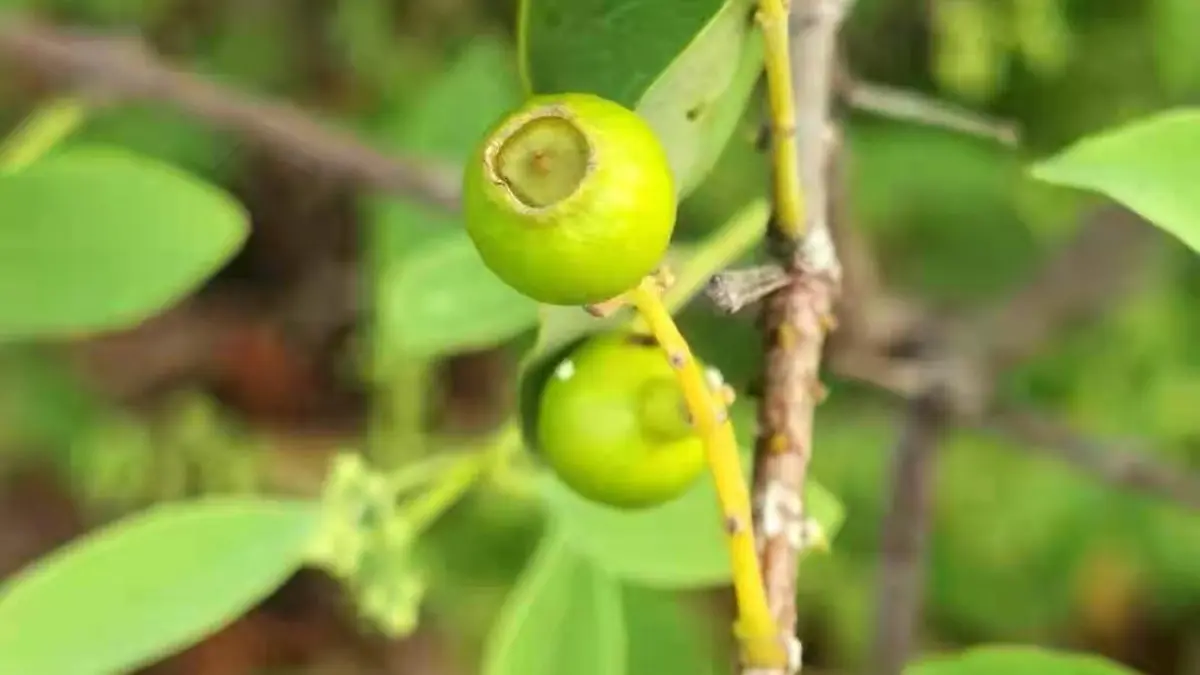

Short answer: “sandalwood oil” can come from several species. Indian sandalwood is Santalum album, while Australian sandalwood is usually Santalum spicatum; amyris is not a true sandalwood. Most medical claims rest on laboratory, animal or preliminary product research rather than robust clinical trials.
The species matters
Kew records Santalum album, a slow-growing, root-hemiparasitic tree valued for its aromatic heartwood. Other Santalum species produce oils with different compositions. “West Indian sandalwood” often refers to Amyris balsamifera, which is botanically unrelated and should be labelled as amyris.
True sandalwood oil is distilled from heartwood and roots rather than leaves. Species, age, growing conditions, heartwood content and distillation influence yield and composition. High value and limited supply make transparent sourcing especially important.
Chemistry and authenticity
Alpha-santalol and beta-santalol are major fragrance compounds in Santalum album oil. Other sandalwood species can have different santalol proportions. A scientific review discusses the experimental medicinal research on alpha-santalol, much of which involves cells or animals rather than patients.
Synthetic sandalwood aroma chemicals are legitimate perfume ingredients when declared accurately, but they are not the same as the natural oil. A batch chromatogram, species declaration and traceable origin are more meaningful than “therapeutic grade”.
Human research is preliminary
A human experiment compared sandalwood odour, alpha-santalol and an odourless placebo. Sandalwood increased several physiological measures of arousal, while alpha-santalol increased ratings of attentiveness and mood. These short-term results do not establish treatment for anxiety, depression or insomnia, and do not support a simple claim that inhaled sandalwood is sedating.
Topical sandalwood formulations have also been explored for skin conditions, including acne. These are product-specific investigations, often involving multiple ingredients or uncontrolled designs. They should not be translated into a claim that neat sandalwood oil treats acne, eczema, psoriasis or infection.
Antimicrobial, anti-inflammatory and anticancer findings in experimental systems are hypotheses for further study. They do not justify swallowing the oil, applying it to lesions or using it instead of oncology or dermatology care.
Sourcing and conservation
Sandalwood’s value and long maturation create risks of illegal harvest, species substitution and poorly documented supply chains. Conservation status and trade rules can change, so buyers should look for current, species-specific sourcing information rather than relying on a general “sustainable” badge.
A credible supplier should be able to name the plantation or region, describe traceability and explain whether the oil is Indian, Australian, New Caledonian or another sandalwood. Low price is a reason to scrutinise identity, not proof of adulteration by itself.
How to assess the evidence
Studies of alpha-santalol are constituent research, not necessarily tests of a complete commercial oil. Animal tumour models and cell experiments can identify biological pathways but cannot show that topical or inhaled sandalwood prevents cancer in people. A short physiological response to an odour is likewise not treatment of a psychiatric condition.
For a skin claim, check whether the trial used one ingredient or a multi-product regimen, whether it had a control group and whether assessors were blinded. Also check the species: evidence about Australian sandalwood should not be silently transferred to Indian sandalwood, or the reverse.
Safety
Natural origin does not prevent irritation or allergy. Essential oils are recognised causes of allergic contact dermatitis. Safety findings for one formulated cosmetic cannot be applied to undiluted oil.
- Do not swallow sandalwood essential oil.
- Do not apply it neat, to broken skin or near the eyes.
- Prefer a finished, safety-assessed cosmetic for topical use.
- Diffuse sparingly and ventilate the room.
- Keep concentrated products away from children and pets.
Buying checklist
- The full species and heartwood or root plant part are stated.
- Natural oil, amyris and synthetic fragrance are clearly distinguished.
- Origin and traceability information are current and specific.
- A batch chromatogram and lot number are available.
- Preclinical findings are not advertised as proof of treating disease.
My assessment
Sandalwood is an important fragrance material with complex sourcing and authenticity questions. Human evidence for health effects is preliminary and product-specific. The most useful profile begins with exact species and traceability, then keeps laboratory mechanisms separate from clinical effectiveness.
Sandalwood and urinary tract infection
Recent sandalwood antimicrobial research tested laboratory and food models, including carrot slices, not patients with UTI. See the detailed UTI evidence comparison for the research, limitations and appropriate care.
Sandalwood and snoring
Animal santalol sleep findings and human sandalwood arousal findings answer different questions; neither establishes a snoring treatment. See the detailed evidence comparison for the studies, limitations and appropriate care.
Sandalwood and jaw pain
A small inconclusive palliative-care pilot and a positive lavender–sandalwood biopsy-anxiety trial do not establish sandalwood as a TMD treatment. See the detailed evidence comparison for the studies, limitations and care context.
Sandalwood and rashes
A small radiotherapy study found benefits from a turmeric-and-sandalwood combination, with reporting and blinding limitations. It cannot establish sandalwood alone as a general rash remedy; contact sensitisation is documented. See the detailed evidence comparison for the primary studies, limitations and care context.
Sandalwood and wrinkles
A 12-woman Hawaiian sandalwood cream report found short-term improvement, but the available abstract leaves control and blinding unclear. It does not establish a general benefit of sandalwood oil. See the detailed evidence comparison for the primary studies, limitations and care context.
References
- Kew Plants of the World Online: Santalum album
- Review of alpha-santalol and experimental medicinal research
- Human experiment on East Indian sandalwood odour and alpha-santalol
- Clinical review of allergic contact dermatitis from essential oils
- Poison Control guidance on essential-oil exposure
Editorial responsibility and correction note
Editor: John Hamlen. This article has not been independently reviewed by a clinician.
Reference correction, 12 September 2026: Changes in this check: Replace unrelated PubMed record with verified intended paper; Report actual findings of the corrected human experiment. This was a targeted correction, not a comprehensive new review of every claim in this article.
Read our editorial policy, evidence method and corrections policy, including how to report an error.
Controlled eczema results temper the early optimism
Evidence update: 13 September 2026.
The posted SAN007 trial results report an EASI response in 17 of 35 participants using 5% sandalwood cream, 12 of 23 using vehicle, and 6 of 11 using 10% cream. These are participant counts, not percentages. The similar proportions do not establish a clear added benefit; no formal comparison accompanies this secondary outcome. The earlier positive report also has inconsistent participant counts between its text and figure caption.
Related evidence review: Sandalwood Oil for Eczema: The Pilot Study and the Placebo-Controlled Results.