
Bottom line: use the instructions for the exact diffuser, add no more oil than directed, ventilate and stop if anyone develops symptoms. A diffuser is a scent device, not a treatment or infection-control system.
There is no universal drop count or run time. Device capacity, oil, room, ventilation and the people or animals present all change exposure.
Identify the type before filling it
An ultrasonic diffuser uses water and high-frequency vibration to create droplets. A nebuliser disperses undiluted oil without a water tank.
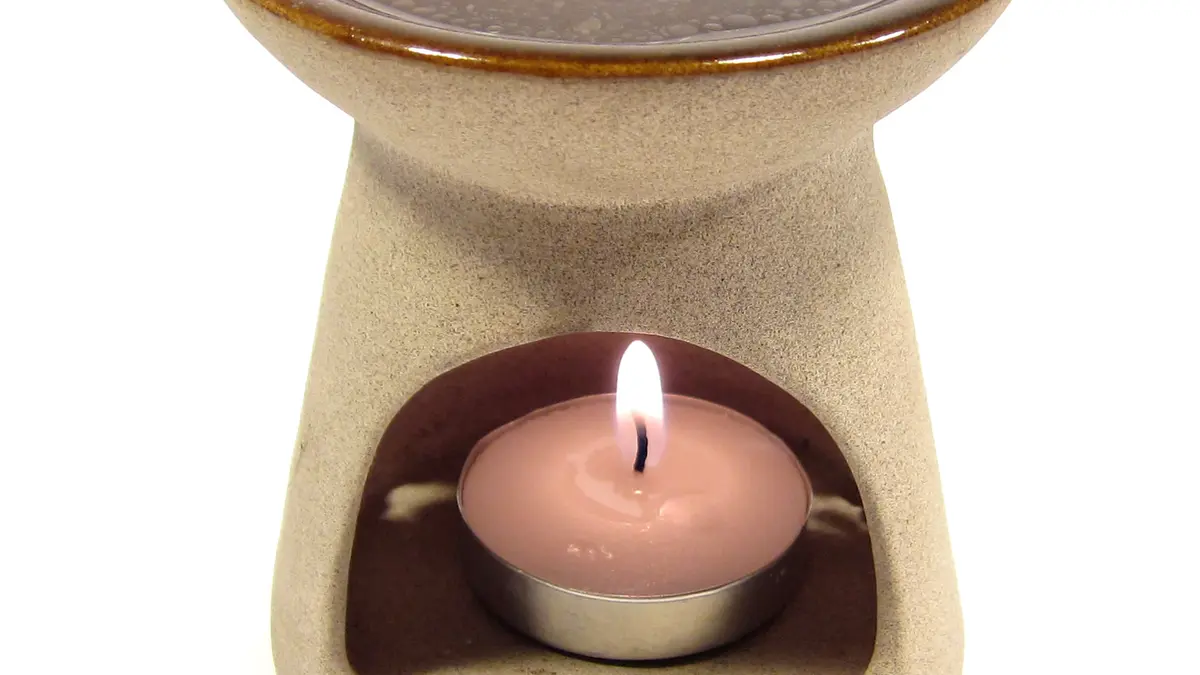
A heat diffuser warms a scented material, while a passive device relies on evaporation. These designs have different filling, cleaning and fire-safety requirements.
Do not pour water into a nebuliser or electrical base unless the manual explicitly tells you to do so. Do not put undiluted oil into a water-only device.
Find the model number, manual, fill line and timer controls before starting. A social-media recipe cannot override the manufacturer’s electrical and material limits.
Set up an ultrasonic diffuser
- Place the unplugged device on a stable, water-resistant surface.
- Keep it away from edges, direct sun, heat and valuable porous materials.
- Remove the cover as the manual describes.
- Add the specified water type without passing the maximum line.
- Add only the amount of oil permitted for that reservoir.
- Replace and lock the cover correctly.
- Plug in with dry hands and choose the shortest suitable setting.
Do not aim mist at a face, bed, pet cage, wall, screen or smoke detector. Leave space for air to move around the outlet.
Start with less exposure
A stronger smell is not evidence of greater benefit. Begin with a short session at the lowest output that gives the wanted scent.
Open a door or window when practical. Avoid continuous operation in a small, closed room, especially when anyone has asthma, migraine or fragrance sensitivity.
A chamber study measured volatile organic compounds and particles from ultrasonic essential-oil diffusers. Emission rates differed by oil and operating condition.
An indoor study found higher concentrations of several fragrance compounds while a diffuser operated. Concentrations changed over time and with room conditions.
These studies do not define a safe household dose. They show why “only natural vapour” is an inaccurate description of what enters the air.
Watch for symptoms
Stop and ventilate if anyone develops coughing, wheezing, chest tightness, eye irritation, nausea, dizziness or headache. Move into fresh air when symptoms begin.
The American Academy of Allergy, Asthma and Immunology advises caution around diffusers for people with asthma. Odours can trigger symptoms even without a classic allergy.
Severe breathing difficulty, collapse, seizure or inability to wake requires emergency help. Do not keep diffusing because a blend is advertised for breathing.
Children and pregnancy
Keep bottles, cords and filled reservoirs out of children’s reach. Small quantities of some essential oils can cause serious poisoning when swallowed.
Poison Control advises prompt expert help after an essential-oil exposure. Do not induce vomiting unless a poison professional directs it.
Pregnancy, breastfeeding, age, epilepsy, allergies and medicines can alter what is appropriate. Ask a qualified professional about the exact product rather than relying on a generic “safe oils” list.
Pets need their own assessment
The ASPCA advises considering the species, product and exposure route. An animal should be able to leave the room.
Do not diffuse beside a cage, tank, sleeping area or food bowl. Birds can be particularly vulnerable to airborne pollutants.
The RSPCA advises contacting a vet promptly if poisoning is suspected. Bring the bottle or ingredient information when seeking help.
Clean the reservoir
Unplug and empty a water-based diffuser after use. Wipe it as the manual directs and let it dry before storage.
Oil residue can affect output and mix with the next scent. Stagnant water can also support microbial growth.
The US Environmental Protection Agency recommends frequent cleaning and fresh water for home humidifiers. A small aroma diffuser is different, but reservoir hygiene remains relevant.
Use only the cleaning agent and method allowed by the manufacturer. Do not submerge a powered base or scrape an ultrasonic plate with a hard object.
Do not confuse a diffuser with a humidifier
Some ultrasonic diffusers release water droplets, but their reservoirs and output may be too small for meaningful humidity control. A humidity problem needs measurement and a device designed for it.
EPA guidance warns that poorly maintained humidifiers can disperse microorganisms or minerals. Adding essential oil does not solve that problem.
What a diffuser cannot do
A diffuser cannot sterilise a room to a healthcare standard. It cannot replace fresh-air ventilation, a carbon-monoxide alarm, prescribed medicine or treatment for an infection.
NCCIH describes aromatherapy as a complementary practice and notes limited rigorous evidence for many promoted uses. A pleasant scent is a valid preference without a medical promise.
Laboratory antimicrobial results involve controlled concentrations and direct contact. They do not show that a household mist makes occupied air safe from pathogens.
Before every session
- Check the model, fill line and oil instructions.
- Consider asthma, migraine, pregnancy, children and animals.
- Use a short timer and ventilate.
- Keep the mist away from faces and sensitive surfaces.
- Stop at the first sign of discomfort.
- Empty, clean and dry the device afterwards.
My verdict
A diffuser is simple to use when the manual sets the boundaries. Most avoidable problems come from overfilling, excessive oil, continuous exposure, poor ventilation or neglected cleaning.
Use it for scent at the lowest comfortable level. If the goal is treating a symptom or cleaning the air, choose an intervention with evidence for that exact job.
References
- VOC and particle emissions from ultrasonic essential-oil diffusers
- Essential-oil compounds measured during indoor diffusion
- Controlled exposure study of diffused essential oils
- Recent study of emissions from essential-oil diffusion
- US EPA: Use and care of home humidifiers
- AAAAI: Oil diffusers and asthma
- ASPCA: Essential oils around pets
- RSPCA: Poisoning in pets
- Poison Control: Essential oils
- NCCIH: Aromatherapy
- Contact allergy to essential oils