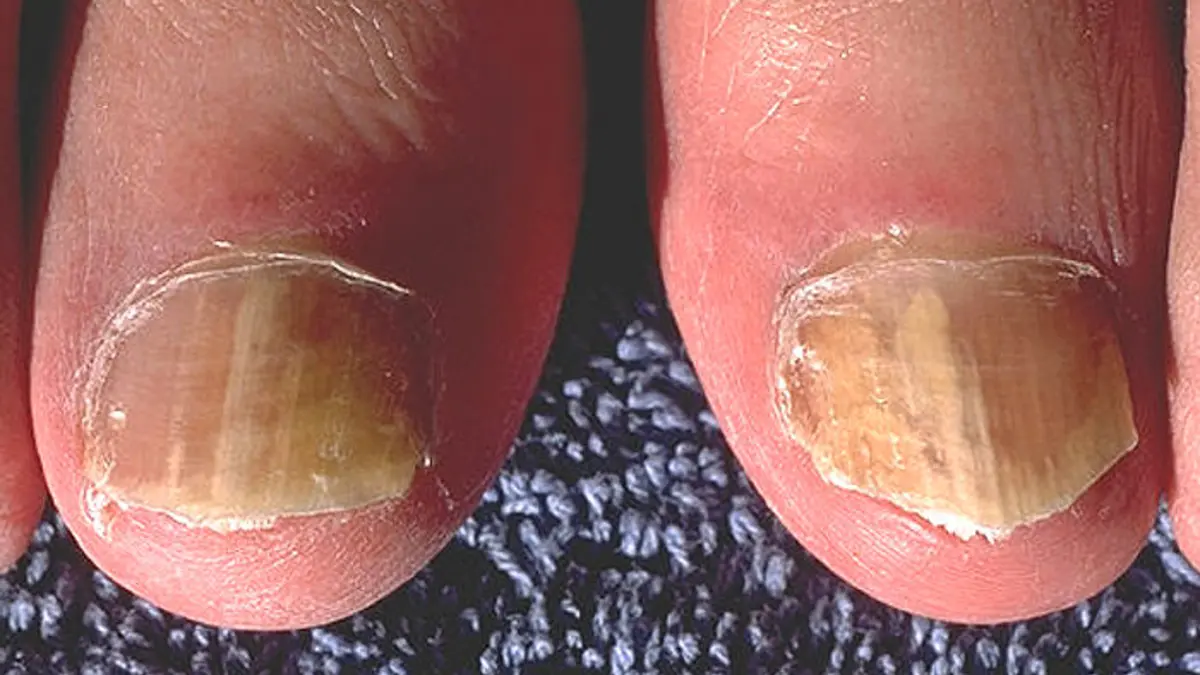

Bottom line: tea tree oil has been tested for fungal toenails, but the main trial found low cure rates and no advantage over clotrimazole solution. Neat oil can irritate skin and is not a dependable substitute for diagnosis and treatment.
Fungal nail infection is also called onychomycosis. Thick or discoloured nails can have other causes, so appearance alone does not confirm a fungal infection.
Why nail fungus is difficult to treat
A fungal infection can make a toenail thick, brittle, crumbly or discoloured. The infection lies in and under a hard nail plate, which makes it difficult for a topical product to reach every affected area.
The NHS says fungal nail infections can take a long time to treat. A healthy-looking replacement must grow from the base, so visible improvement can take many months even after treatment works.
Psoriasis, injury and other nail disorders can look similar. NICE Clinical Knowledge Summaries recommends confirming infection before oral treatment. That helps avoid exposing someone to a medicine they do not need.
The best-known tea tree oil trial
A 1994 randomised trial enrolled 117 people with culture-confirmed toenail infection. Participants used either 100% tea tree oil or 1% clotrimazole solution twice daily for six months.
At six months, cultures were negative in 18% of the tea tree group and 11% of the clotrimazole group. The difference was not statistically significant. Neither treatment produced a high mycological cure rate.
About 60% in each group reported full or partial improvement in appearance. Appearance and laboratory cure are not interchangeable, and the study did not show that neat tea tree oil was superior.
A combination study cannot isolate the oil
A later trial tested a cream containing the antifungal medicine butenafine and tea tree oil. It reported better results than placebo, but the formula contained an established antifungal drug.
That trial cannot tell us whether tea tree oil added benefit, whether butenafine did the work, or whether the combination mattered. It is not evidence for applying undiluted oil from a bottle.
A 2022 review of complementary approaches to onychomycosis found a small and varied evidence base. Different mixtures, endpoints and study designs make confident comparisons difficult.
Laboratory activity is not a clinical cure
Tea tree, oregano, thyme and clove oils can inhibit fungi under laboratory conditions. A recent laboratory study reported antifungal activity from tea tree oil, while also saying clinical studies are needed to confirm long-term effectiveness and safety.
A culture plate does not reproduce a thick nail, surrounding skin, repeated exposure or the concentration that can be used safely. Laboratory findings can justify research, but they do not provide a treatment instruction.
What established care looks like
A pharmacist may suggest an antifungal nail medicine for a mild infection. These products need consistent use for months. Keeping feet dry, treating athlete’s foot and avoiding shared nail tools can reduce reinfection.
A GP may take a nail sample and prescribe antifungal tablets when infection is severe, painful or has not responded to topical treatment. Tablets are not suitable for everyone and may require attention to interactions or liver health.
The British Association of Dermatologists explains diagnosis, topical treatment, tablets and recurrence. It also notes that damaged nail appearance may persist until new nail grows.
Tea tree oil safety
NCCIH says tea tree oil should not be swallowed and that topical use can cause redness or irritation. Old or poorly stored oil can become more likely to trigger allergy as its components oxidise.
A clinical review of essential-oil contact allergy found tea tree among the oils producing notable patch-test reactions. Applying it twice daily for months creates repeated exposure.
Do not apply essential oil to cracked, bleeding or inflamed skin around the nail. Stop if burning, swelling, blistering or a spreading rash develops.
When to get help
Speak to a pharmacist or GP if the nail is painful, the infection is severe or treatment has not worked. Seek professional advice earlier if you have diabetes, poor circulation or a weakened immune system.
A dark streak, pigment spreading onto nearby skin, bleeding or a changing nail should be assessed. Not every abnormal nail is fungal, and a home oil trial can delay the correct diagnosis.
My verdict
Tea tree oil has more direct human evidence than most oils proposed for fungal nails. That evidence is still weak: the main trial produced low laboratory cure rates and found no significant advantage over its comparator.
I would not use neat tea tree oil as the default treatment. Confirm the problem, use a regulated antifungal when appropriate and expect nail recovery to take time.
References
- NHS: Fungal nail infection
- NICE CKS: Management of fungal nail infection
- British Association of Dermatologists: Fungal nail infections
- Buck and colleagues: Tea tree oil compared with clotrimazole
- Syed and colleagues: Butenafine and tea tree oil cream
- Nickles and colleagues: Complementary therapies for onychomycosis
- Álvarez and colleagues: Laboratory antifungal activity of tea tree oil
- NCCIH: Tea tree oil
- de Groot and Schmidt: Essential oils and contact allergy