Bottom line: menthol can make the nose feel clearer without measurably opening it. I found no good evidence that inhaled or topical essential oils cure acute sinusitis, and putting oil inside the nose can cause irritation.
This review distinguishes perceived airflow, symptom comfort and treatment of an infection. A cooling sensation is not evidence that sinus drainage or the cause has changed.
What sinusitis is
Sinusitis is inflammation of the lining of the sinuses, commonly after a cold. Swelling interferes with mucus drainage and can cause facial pain or pressure, a blocked or runny nose, reduced smell, headache and discoloured mucus.
The NHS says it usually clears within four weeks. Most acute cases are viral, so antibiotics are rarely needed. Green or yellow mucus by itself does not prove a bacterial infection.
Why peppermint and eucalyptus feel active
Menthol activates cold-sensitive receptors and can create a strong impression of easier breathing. A controlled experiment found that inhaled menthol reduced the sensation of respiratory discomfort, but sensation is not the same outcome as sinus drainage or infection cure.
A study of people with colds found menthol improved the subjective sensation of nasal airflow without changing measured nasal resistance. This is a useful warning against treating “feels open” as “is open”.
Eucalyptus oil contains 1,8-cineole, and some oral cineole studies have reported symptom changes in respiratory conditions. Those standardised capsules are not evidence for inhaling diffuser vapour, applying oil around the nose or adding it to a saline rinse.
Do essential oils kill the infection?
Tea tree, thyme, oregano, eucalyptus and other oils inhibit microbes in laboratory experiments. A sinus is not a culture plate: the organism may be viral, the concentration reaching the tissue is unknown, and concentrations that harm microbes may also irritate human cells.
I found no persuasive controlled trial showing that an inhaled essential oil shortens acute sinusitis, prevents complications or reduces the need for established care. Laboratory antimicrobial activity should not be reported as a clinical cure.
Eight oil claims: what the clinical preparations actually tested
Some specific herbal medicines have shown sinus-symptom benefits in trials. The preparation, route and diagnosis determine what can reasonably be concluded. Acute viral illness, chronic inflammation, allergy and postoperative recovery are different settings.
Basil and sinusitis
A laboratory study of Omani basil oil found inhibition of several microbes, including Streptococcus pneumoniae and Haemophilus influenzae. However, Pseudomonas putida and Pseudomonas aeruginosa resisted the tested oil (Hanif and colleagues, 2011). Even within one experiment, the oil did not act equally against every organism.
The researchers measured growth around oil-treated discs in culture dishes. They did not treat people with sinusitis or establish a concentration that safely reaches an infected sinus. The oil was a specified, linalool-rich basil preparation; another basil product may have a different composition.
These findings support further laboratory research, not a claim that basil inhalation cures sinusitis. We did not locate a controlled patient trial establishing basil essential oil alone for acute or chronic rhinosinusitis.
Related: Basil profile.
Chamomile and sinusitis
A double-blind, placebo-controlled study randomised 74 people with chronic rhinosinusitis to chamomile-extract nasal drops or placebo. Symptom-related quality of life and nasal endoscopy findings favoured the extract (Nemati and colleagues). This is relevant human evidence, but the product was an extract formulation, not bottled chamomile essential oil, and the condition was chronic disease rather than a new viral infection.
A separate study in 123 people with allergic rhinitis compared nasal-washing approaches alongside a steroid spray. The group receiving seawater spray with chamomile liquid extract had greater symptom-score improvement than the comparison groups (Atar and colleagues). Allergy-related rhinitis does not establish treatment of an infection.
These promising results need to remain attached to the tested formulations and diagnoses. We assessed the indexed abstracts; complete formulation, long-term safety and replication questions remain. Do not make nasal drops by adding essential oil to saline or substitute a homemade preparation for prescribed treatment.
Related: Chamomile profile.
Clove and sinusitis
A 2026 experiment exposed cells derived from human nasal tissue to clove oil. Cell viability declined with increasing exposure, and every tested amount reduced viability compared with untreated cells (nasal-cell study). The laboratory setup does not define a safe home dose, but it provides a direct reason not to assume that antimicrobial activity means nasal-tissue safety.
Other research has incorporated clove oil into a specialised nasal gel carrying the antifungal medicine voriconazole (formulation study). The formulation improved laboratory antifungal and drug-delivery measures, with kidney-safety testing in rabbits. It cannot establish treatment with clove oil alone or be transferred to ordinary viral sinusitis. A drug-delivery experiment is not a patient cure trial.
We did not locate a controlled clinical trial establishing clove essential oil alone for sinusitis. The useful next research question concerns both effectiveness and preservation of the nasal lining, not simply whether an oil can inhibit a microbe.
Related: Clove profile.
Geranium and sinusitis
Searches for geranium and sinusitis often retrieve Pelargonium sidoides root extract, known as EPs 7630. It is a different preparation from the fragrant geranium essential oil usually made from Pelargonium graveolens.
A placebo-controlled trial recruited 103 people with acute rhinosinusitis of presumed bacterial origin. Symptom scores improved more with the root extract, and the trial stopped at its planned interim analysis after meeting its efficacy rule (Bachert and colleagues). The result concerns that oral extract.
A later open-label trial randomised 50 patients to the extract or amoxicillin. Several outcomes favoured the extract, but rhinorrhoea and postnasal-drip improvements did not differ significantly (Perić and colleagues). Its small size and lack of blinding limit confidence in comparative symptom findings.
Neither study tested geranium essential oil. We did not locate a controlled geranium-oil sinusitis trial. Do not interpret botanical family membership as proof of equivalent treatment or use it to replace an antibiotic prescribed for a particular clinical reason.
Related: Geranium profile.
Lavender and sinusitis
A 2019 placebo-controlled trial randomised 288 adults with acute viral rhinosinusitis to oral Tavipec capsules or placebo for seven days. Symptoms and disease-related quality of life favoured Tavipec by day eight (Dejaco and colleagues). The capsules contained distilled spike-lavender oil, Lavandula latifolia, in a gastroresistant preparation.
Adverse events occurred in 26 of 147 capsule users versus 8 of 141 placebo users, mainly gastrointestinal complaints. None was classified as serious. The manufacturer sponsored the study; two authors were employees and the others disclosed financial support during the trial.
This is product-specific evidence of symptom benefit, not evidence for swallowing aromatherapy oil or inhaling ordinary lavender. Participants needing antibiotics and those with chronic or recurrent rhinosinusitis were excluded. The short trial does not establish prevention of complications or long-term safety. Independent replication would strengthen confidence.
Related: Lavender profile.
Lemon and sinusitis
Lemon claims sometimes borrow evidence about limonene or standardised oral oil combinations. In a placebo-controlled trial, 463 adults with acute viral rhinosinusitis received ELOM-080 or placebo. Symptom scores favoured the preparation, while smell-identification scores improved similarly in both groups (Pfaar and colleagues). An older trial also reported symptom benefit with standardised Myrtol (Federspil and colleagues).
These are trials of specified oral medicines, not lemon oil alone. They cannot establish that diffusing lemon oil, applying it to the face or putting it in a rinse treats a sinus infection.
The chronic-rhinosinusitis capsule study discussed below also matters: its main eight-week outcome did not show a significant advantage over placebo (2025 trial). Products, diagnoses and outcomes need to remain separate. We did not locate a controlled trial establishing whole lemon essential oil alone for sinusitis.
Related: Lemon profile.
Oregano and sinusitis
A small controlled trial tested a throat spray containing Origanum syriacum alongside two eucalyptus species, peppermint and rosemary in 60 adults with upper respiratory illness. The main complaints were sore throat, hoarseness or cough (Ben-Arye and colleagues).
The mixture gave greater symptom relief after 20 minutes, but the groups did not differ significantly after three days. The full paper reports P=0.42 for that later comparison; its abstract contains a conflicting decimal. The complete results support a short-lived symptom effect, not a sustained treatment advantage.
This was neither an oregano-only intervention nor a sinusitis trial. It cannot isolate oregano’s contribution or establish eradication of infection. The small sample and potentially recognisable aromas also limit interpretation. We did not locate a controlled oregano-only sinusitis trial, and the tested throat spray is not a recipe for nasal use.
Related: Oregano profile.
Pine and sinusitis
Pinene is a chemical constituent, not a synonym for whole pine essential oil. Trials of eucalyptol-limonene-pinene capsules therefore need to be described as combination-product studies.
A 2025 postoperative trial analysed 174 people with chronic rhinosinusitis and nasal polyps. Adding the capsules to nasal corticosteroid treatment improved some imaging, endoscopy and individual symptom measures compared with corticosteroid alone (Sima and colleagues). It was open-label, and most individual symptom items did not differ significantly. Surgery and background treatment are essential parts of the context.
The larger blinded chronic-disease trial below did not show a significant advantage on its main eight-week outcome (Hu and colleagues). Neither study isolated pinene, tested whole pine oil or assessed a diffuser. We did not locate a controlled pine-essential-oil trial for sinusitis. A constituent appearing in a medicine does not validate an aromatherapy substitute.
Related: Pine profile.
A limiting result from the larger chronic-sinusitis trial
A double-blind study analysed 291 patients receiving budesonide nasal spray plus either eucalyptol-limonene-pinene capsules or placebo. Its primary endpoint was symptom-score change at eight weeks. The additional capsule benefit was not statistically significant at that point (P=0.093), although some earlier and individual symptom results favoured treatment (2025 trial).
A positive secondary outcome does not turn an unsuccessful primary comparison into a clear overall success. Nor do these results invalidate every different product: they limit claims about this combination, population and duration.
What this means for care
These studies do not support putting bottled essential oil into the nose, adding it to a nasal rinse or swallowing an aromatherapy product. Formulated medicines and research extracts require their own safety assessment and instructions.
NHS guidance supports rest, fluids, suitable pain relief and correctly prepared saline rinsing for mild sinusitis. Ask a pharmacist for advice. Seek a GP review if symptoms persist after three weeks of self-care or recur; seek urgent advice if you are very unwell, symptoms worsen or your immune system is weakened.
Search limitations: Targeted Europe PMC and web searches using common and botanical names with sinusitis, rhinosinusitis and respiratory-treatment terms, followed by citation checks, completed 15 September 2026. This is not an exhaustive systematic review. Full reports were checked for the spike-lavender trial, mixed throat spray, postoperative capsule trial and basil laboratory experiment. Other findings were assessed from indexed abstracts, which limit appraisal of formulation details, adverse events and bias. A failure to locate a trial does not prove that none exists.
Rosemary, tea tree and thyme for sinusitis
The final comparisons distinguish a mixed throat spray, laboratory antimicrobial tests and a honey preparation. None is a clinical trial of the named essential oil alone for sinusitis.
Rosemary and sinusitis
Rosemary was included in a five-oil throat spray tested in 60 adults with upper respiratory illness. The other ingredients included oregano, peppermint and two eucalyptus species (Ben-Arye and colleagues).
The spray improved the participants’ main complaint more than placebo after 20 minutes, but there was no significant difference after three days. The measured complaints were sore throat, hoarseness and cough. This was not a rosemary-only trial or a trial of diagnosed sinusitis.
The full paper also identifies the small sample and possible recognition of the aromas as limitations. Its three-day comparison gives P=0.42, correcting a conflicting decimal in the abstract. We did not locate a controlled patient trial establishing rosemary essential oil alone for sinusitis. A brief effect from a throat spray cannot establish improved sinus drainage or eradication of an infection.
Related: Rosemary profile.
Tea tree and sinusitis
A 2001 laboratory study tested tea tree and niaouli oils after adding compounds isolated from manuka oil. The mixtures inhibited bacteria including Staphylococcus aureus and Moraxella catarrhalis (Christoph and colleagues). These were modified mixtures in laboratory assays, not ordinary tea tree oil administered to sinusitis patients.
The experiment compared antimicrobial activity with Myrtol, but outperforming another preparation in a culture does not establish better clinical treatment. Exposure, tissue tolerance and the cause of illness all remain unresolved. Manuka oil, manuka honey and tea tree oil are also different materials.
We did not locate a controlled clinical trial establishing tea tree essential oil alone for sinusitis. NCCIH warns against swallowing tea tree oil and notes that topical use can cause irritation or allergy. This laboratory result does not justify nasal drops, homemade rinses or swallowing the oil.
Related: Tea tree profile.
Thyme and sinusitis
A 2018 experiment found antimicrobial activity from Thymus sipyleus oil against selected organisms associated with rhinosinusitis. Its composition and vapour profile varied with the testing conditions (laboratory study). This was a specified thyme species in culture, not a patient trial.
The human nasal-spray study often cited for thyme tested thyme honey. It enrolled 64 people after sinus surgery, with 54 completing follow-up. Both groups improved; the indexed report states that symptom, endoscopy and CT-score differences between groups were not significant, despite describing a greater endoscopic reduction with honey (Hashemian and colleagues). Honey is not essential oil, and improvement within a group does not establish an added treatment effect.
An older nasal-cell study found no effect of thyme oil on ciliary beat frequency under its test conditions (Neher and colleagues). Taken together, these results do not establish that thyme oil improves sinus clearance or cures infection. We did not locate a controlled thyme-essential-oil sinusitis trial.
Related: Thyme profile.
Keep care matched to the diagnosis
Do not add essential oil to nasal drops or rinses, or interpret a culture result as proof that a retail oil treats infection. NHS guidance recommends assessment when symptoms persist after three weeks of self-care or keep recurring, and urgent advice if you are very unwell or symptoms worsen.
Search limitations: Targeted Europe PMC and web searches using common and botanical names with sinusitis, rhinosinusitis, temporomandibular disorders, bruxism and pain, followed by citation checks, completed 15 September 2026. This is not an exhaustive systematic review. Full reports were checked for the mixed throat spray, children’s dental-anxiety trial and clary-sage psychological study. Other studies were appraised from indexed or publisher abstracts, limiting assessment of methods, safety and bias. The published Boswellia paper supersedes its earlier preprint. Failure to locate a trial does not establish that none exists.
What guidance recommends
NICE guidance on acute sinusitis emphasises self-care, expected duration and limited antibiotic use. A pharmacist or GP may advise a nasal corticosteroid in some circumstances; antibiotics are reserved for selected cases.
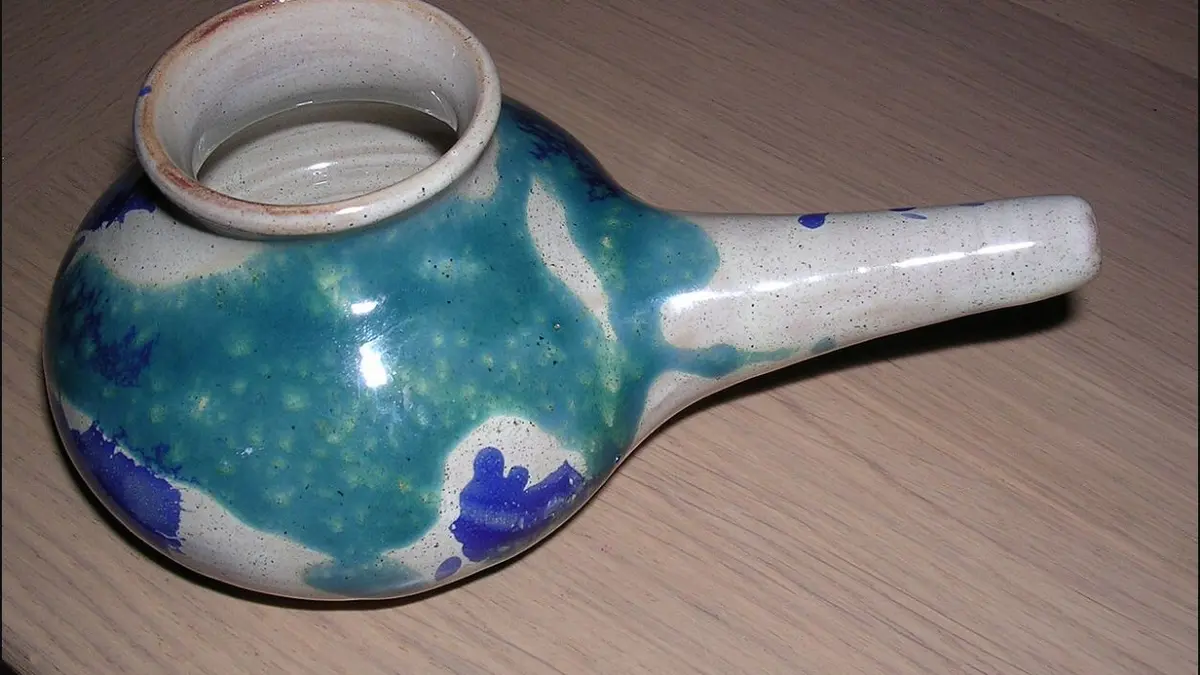
The NHS suggests rest, fluids, suitable pain relief, avoiding smoking and cleaning the nose with a salt-water solution. Use properly prepared water and follow the stated method or a regulated saline product. Essential oil should not be added.
A Cochrane review found limited evidence that saline irrigation may help chronic rhinosinusitis. Chronic disease is not the same as a short acute infection, but the intervention at least has a plausible mechanical purpose and does not require fragrance oil.
Safety: nose, steam and children
Do not drip essential oil into the nostrils or add it to a nasal-rinse bottle. Concentrated oil can irritate mucous membranes, and aspiration of oily material can injure the lungs.
Bowls of hot water create a separate scald risk. The British Burn Association warns that steam inhalation causes preventable burns and says there is no evidence it speeds recovery.
Keep concentrated oils away from children and pets. Peppermint and eucalyptus products need particular caution around young children; use only age-appropriate regulated products and follow their labels.
When to seek medical help
See a GP if symptoms have not improved after three weeks of self-care, recur frequently or remain on one side. Seek urgent advice if you are very unwell, painkillers do not help, symptoms worsen or your immune system is weakened.
Eye swelling, double vision, reduced vision, a severe frontal headache, neurological symptoms or marked deterioration require urgent assessment. Do not rely on a temporary cooling feeling when symptoms are worsening.
Read the route and study design behind the headline
Evidence update: 13 September 2026.
A network meta-analysis found encouraging cineole evidence for selected acute post-viral symptoms. A 2025 review concerns capsule preparations; despite its abstract describing five randomised trials, its detailed assessment identifies one non-randomised study. Neither review establishes that a diffuser clears a sinus infection.
My verdict
Menthol can alter the sensation of airflow, which may explain why peppermint products feel effective. That is not proof of decongestion and does not show that essential oils treat sinusitis.
I would not put essential oil in the nose, in a rinse or into hot steam. Follow NHS self-care guidance, use a pharmacist when needed and seek assessment when the duration or warning signs justify it.
Related evidence review: Essential Oils for Earache: Evidence and Why Ear Drops Need Care.
Related evidence review: Essential Oils for Strep Throat: Laboratory Claims versus Treatment.
Related evidence review: Eucalyptus Oil for Sinusitis: Cineole Capsules versus Inhalation.
Related evidence review: Peppermint and menthol: breathing comfort versus sinus infection.
References
- Hanif MA, Al-Maskari MY, Al-Maskari A, Al-Shukaili A, Al-Maskari AY, Al-Sabahi JN. Essential oil composition, antimicrobial and antioxidant activities of unexplored Omani basil. Journal of Medicinal Plants Research. 2011;5(5):751–757.
- Nemati S, Yousefbeyk F, Ebrahimi SM, FaghihHabibi AF, Shakiba M, Ramezani H. Effects of chamomile extract nasal drop on chronic rhinosinusitis treatment: A randomized double blind study. American journal of otolaryngology. 2021;42:102743. DOI:10.1016/j.amjoto.2020.102743.
- Atar Y, Karaketir S, Aydogdu I, Sari H, Bircan HS, Uyar Y, Ekincioglu E, Karaketir SG, Atac E, Berkiten G. Comparison of Isotonic Seawater Nasal Spray Containing Chamomile Liquid Extract and Other Isotonic Seawater Nasal Washing Solutions for Allergic Rhinitis. The Annals of otology, rhinology, and laryngology. 2022;131:427-434. DOI:10.1177/00034894211025411.
- Kesimli MC, Bayar Muluk N, Kurt A, Keskin SU, Bulbul MV, Alaskarov E, Cingi C. Dose-Dependent Effects of Clove Oil on Human Nasal Epithelial Cells In Vitro. The Journal of craniofacial surgery. 2026;:. DOI:10.1097/scs.0000000000012617.
- Kammoun AK, Khedr A, Hegazy MA, Almalki AJ, Hosny KM, Abualsunun WA, Murshid SSA, Bakhaidar RB. Formulation, optimization, and nephrotoxicity evaluation of an antifungal in situ nasal gel loaded with voriconazole‒clove oil transferosomal nanoparticles. Drug delivery. 2021;28:2229-2240. DOI:10.1080/10717544.2021.1992040.
- Bachert C, Schapowal A, Funk P, Kieser M. Treatment of acute rhinosinusitis with the preparation from Pelargonium sidoides EPs 7630: a randomized, double-blind, placebo-controlled trial. Rhinology. 2009;47:51-58.
- Perić A, Gaćeša D, Barać A, Sotirović J, Perić AV. Herbal Drug EPs 7630 versus Amoxicillin in Patients with Uncomplicated Acute Bacterial Rhinosinusitis: A Randomized, Open-Label Study. The Annals of otology, rhinology, and laryngology. 2020;129:969-976. DOI:10.1177/0003489420918266.
- Dejaco D, Bocian-Sobkowska J, Szymanski W, Zacke G, Hockner V, Riechelmann H. Tavipec in acute rhinosinusitis: a multi-centre, doubleblind, randomized, placebo-controlled, clinical trial. Rhinology. 2019;57:367-374. DOI:10.4193/rhin19.089.
- Pfaar O, Beule AG, Jobst D, Kraft K, Stammer H, Röschmann-Doose KIL, Wittig T, Stuck BA. Phytomedicine ELOM-080 in Acute Viral Rhinosinusitis: A Randomized, Placebo-Controlled, Blinded Clinical Trial. The Laryngoscope. 2023;133:1576-1583. DOI:10.1002/lary.30418.
- Federspil P, Wulkow R, Zimmermann T. [Effects of standardized Myrtol in therapy of acute sinusitis–results of a double-blind, randomized multicenter study compared with placebo]. Laryngo- rhino- otologie. 1997;76:23-27. DOI:10.1055/s-2007-997381.
- Hu L, Li H, Yang L, Zhao C, Tan G, Li H, Zheng G, Yu S, Xie L, Liu Y, Song X, Wang Q, Chang W, Zhang J, Zhang D, Gu Y, Wang D. Efficacy and safety of intranasal corticosteroids combined with mucoactive drugs for chronic rhinosinusitis. International immunopharmacology. 2025;165:115341. DOI:10.1016/j.intimp.2025.115341.
- Ben-Arye E, Dudai N, Eini A, Torem M, Schiff E, Rakover Y. Treatment of upper respiratory tract infections in primary care: a randomized study using aromatic herbs. Evidence-based complementary and alternative medicine : eCAM. 2011;2011:690346. DOI:10.1155/2011/690346.
- Sima Y, Liu J, Liu J, Zheng G, Yang Y, Peng X, Qi Y, Wang X, Zhao Y, Wang Y, Zhao P, Zhao J, Zhang Y, Zheng M, Liu C, Song X, Dong Y, Gong X, Lv W, Wang Z, Wang X, Zhang L. A Multicenter, Randomized, Controlled Clinical Trial on the Efficacy and Safety of Eucalyptol, Limonene, and Pinene Enteric Capsules in the Treatment of Chronic Rhinosinusitis With Nasal Polyps Postoperatively. Clinical and translational allergy. 2025;15:e70123. DOI:10.1002/clt2.70123.
- NHS. Sinusitis (sinus infection). Accessed 15 September 2026.
- Christoph F, Kaulfers PM, Stahl-Biskup E. In vitro evaluation of the antibacterial activity of beta-triketones admixed to Melaleuca oils. Planta medica. 2001;67:768-771. DOI:10.1055/s-2001-18350.
- NCCIH. Tea Tree Oil: Usefulness and Safety. Accessed 15 September 2026.
- Demirci F, Karaca N, Tekin M, Demirci B. Anti-inflammatory and antibacterial evaluation of Thymus sipyleus Boiss. subsp. sipyleus var. sipyleus essential oil against rhinosinusitis pathogens. Microbial pathogenesis. 2018;122:117-121. DOI:10.1016/j.micpath.2018.06.025.
- Hashemian F, Baghbanian N, Majd Z, Rouini MR, Jahanshahi J, Hashemian F. The effect of thyme honey nasal spray on chronic rhinosinusitis: a double-blind randomized controlled clinical trial. European archives of oto-rhino-laryngology : official journal of the European Federation of Oto-Rhino-Laryngological Societies (EUFOS) : affiliated with the German Society for Oto-Rhino-Laryngology – Head and Neck Surgery. 2015;272:1429-1435. DOI:10.1007/s00405-014-3233-x.
- Neher A, Gstöttner M, Thaurer M, Augustijns P, Reinelt M, Schobersberger W. Influence of essential and fatty oils on ciliary beat frequency of human nasal epithelial cells. American journal of rhinology. 2008;22:130-134. DOI:10.2500/ajr.2008.22.3137.
- NICE NG79: Sinusitis (acute), antimicrobial prescribing
- Nishino and colleagues: Menthol and respiratory discomfort
- Eccles and colleagues: Menthol, nasal resistance and airflow sensation
- Chong and colleagues: Saline irrigation for chronic rhinosinusitis
- British Burn Association: Steam inhalation warning
- NCCIH: Aromatherapy
- Posadzki and colleagues: Adverse effects of aromatherapy